

























 ChatGPT
 Perplexity
 Claude
 Google AI
Outsourcing Android app development means hiring an external team to build and maintain your Android app. It works when you need platform-specific expertise fast and can’t justify a full-time Android hire at US market rates ($100,000–$125,000/year). It fails when the vendor treats Android as generic mobile development, and you usually won’t find out until you’re deep into a rebuild.
The founder who got burned wasn’t careless. They checked portfolios, read reviews, and got on discovery calls. What they missed: the vendor routed the work through a Flutter generalist team, never asked which Android OS versions their users ran, and scoped against a feature list instead of a user flow. None of it was visible at signing.
This guide covers how to structure the decision, the engagement, and the relationship, so you end up with a working app, not a rebuild.
Key Takeaway
- The native vs. cross-platform decision is yours to make: Understanding what your product actually needs, hardware integration, device fragmentation exposure, iOS parity, before you brief a vendor means you can evaluate their recommendation confidently rather than take it on faith.
- A discovery sprint is the most underused risk-mitigation tool in outsourcing: A paid, time-boxed sprint ($2,000–$8,000) tells you more about a vendor’s real capabilities than any portfolio or sales call.
- Fixed-price contracts feel safe but often aren’t. The vendor prices in uncertainty you haven’t specified yet, and when scope disputes arise, you’re the one who absorbs the cost.
- Post-launch is where most outsourcing relationships quietly fail: Bug severity definitions, OS update compatibility commitments, and Play Store policy responsibilities should all be in your contract before you sign, not negotiated after something breaks.
- IP ownership means nothing without code accessibility: Your repo must be the working repo from day one. A signed assignment clause is worthless if the codebase is undocumented and the only person who understood it has stopped returning messages.
- The engagement model should match your stage: Fixed-price for defined MVPs, T&M with milestone gates for active development, dedicated team for 12+ month roadmaps, each protects you differently, and choosing the wrong one compounds every other risk.
When Outsourcing Android Development Actually Makes Sense (And When It Doesn’t)
Android commands roughly 70% of the global mobile OS market, running on approximately 3.9 billion active devices worldwide. In markets across Africa, Latin America, and South and Southeast Asia, that share exceeds 85%. If your users are anywhere outside the US and Western Europe, building an Android product isn’t one option among several, it’s the primary distribution channel.
The business case for outsourcing typically comes down to one of three realities.
The cost of in-house expertise doesn’t match your stage.
The 2025 Dice Tech Salary Report puts the average US software developer salary at $128,386, with mid-level engineers earning $100,000–$125,000. A senior Android engineer with current Jetpack Compose experience, Play Store deployment history, and real familiarity with device fragmentation sits at the high end of that band, before benefits, onboarding, or ramp time. For a startup or early-growth company whose product hasn’t yet proven market fit, that’s a difficult commitment to justify.
Your timeline is shorter than in-house hiring allows.
Finding, interviewing, and onboarding a senior Android developer takes three to five months on a good run. Outsourcing compresses that to weeks. When your roadmap has a hard external date, a partnership launch, a funding milestone, a platform dependency, that gap matters.
Your scope is defined enough to contract.
Outsourcing works best when the work can be scoped, delivered, and measured. If you’re still in discovery, genuinely uncertain what the product needs to do, outsourcing introduces alignment risk that an internal product conversation resolves faster and cheaper.
When It Doesn’t Make Sense
If Android development is the competitive core of your product, if the app is the product in a way that demands daily, tightly integrated engineering, outsourcing introduces handoff latency that compounds at each iteration.
However, before making a final decision, it’s worth understanding the full economics of outsourcing versus building internally. Whether you’re evaluating freelancers, a dedicated development team, or a mobile app development company with Android expertise, cost visibility is essential to making the right call.
The best place to start is with a detailed breakdown of Android app development costs. Understanding how pricing changes based on app complexity, team structure, geographic location, and long-term maintenance requirements will help you evaluate potential partners more effectively and avoid budget surprises later.
The Native vs. Cross-Platform Decision, And Why Your Vendor’s Answer Might Not Be Neutral
When you ask an outsourcing vendor whether to build natively in Kotlin or cross-platform with Flutter or React Native, you’ll get a confident answer. That answer reflects their team composition at least as much as it reflects your product requirements.
A vendor whose bench is primarily Flutter developers will make a compelling case for Flutter. A vendor with strong Kotlin engineers will explain why native is the right choice. Both will give you technically defensible reasoning. The problem is that you’re evaluating the reasoning without access to the context that shaped it.
Here’s a quick look at what factors you can look at when choosing between native and cross-platform:
| Criteria | Native Kotlin | Flutter | React Native |
|---|---|---|---|
| Hardware & platform integration (Bluetooth, NFC, camera, background processing, OEM-specific APIs) | Strong fit | Partial fit | Poor fit |
| Device fragmentation exposure (Sub-$200 devices, Xiaomi / Transsion / OPPO OEM variants, Android 10–15 range) | Strong fit | Partial fit | Poor fit |
| iOS parity required (Simultaneous Android + iOS launch from a shared codebase) | Poor fit | Strong fit | Strong fit |
| UI complexity (Custom animations, platform-native feel, complex layout requirements) | Strong fit | Strong fit | Partial fit |
| Long-term maintenance (Talent availability, Google Play compliance, OS update compatibility) | Strong fit | Partial fit | Partial fit |
| Timeline pressure (Fastest path from brief to Play Store for an API-driven product) | Partial fit | Strong fit | Strong fit |
| Post-launch flexibility (Ability to swap vendors, hire in-house, or extend the codebase cleanly) | Strong fit | Partial fit | Partial fit |
If you’re still not sure, this is worth understanding in detail, because getting the technical approach wrong at the start of a project isn’t a minor error, it surfaces as a rebuild six to twelve months later.
Native Android (Kotlin) is the right call when:
- Your app requires deep platform integration, Bluetooth LE, NFC, camera APIs, biometric authentication flows, or background sync behavior that varies by manufacturer.
- You’re building for a wide and fragmented device pool: Sub-$200 devices, older OS versions, or regional OEM brands like Xiaomi, Transsion, or OPPO that implement Android differently from flagship Samsung or Google Pixel hardware.
- Play Store compliance and Google’s target API level requirements are central to your go-to-market: Google’s developer documentation is explicit: apps must target the latest API level to submit updates, and older-style XML layouts and background processing patterns are increasingly flagged.
- You need Jetpack Compose for complex, performant, and customized UI: Google’s Android Developers Blog describes the shift toward Compose as a platform-wide transition, not an optional upgrade, vendors still building entirely in the legacy XML/View system are working against the grain of where Android development is heading
Cross-platform (Flutter, React Native) makes sense when:
- You’re building simultaneously for Android and iOS and your UI is relatively standard, forms, dashboards, catalogues, data display.
- A shared codebase matters more than platform-specific optimization.
- Your app is primarily API-driven rather than hardware-reliant.
If you’re also working through the native vs. cross-platform decision in detail, our guide covers the full technical and commercial comparison, answering all your queries.
How to Vet an Android Outsourcing Partner without a Technical Background
The core challenge is that the people best placed to evaluate an Android development partner are Android developers. If you don’t have one, you’re working from indirect signals, and vendors know it.
Here’s what actually differentiates strong vendors from strong pitches.
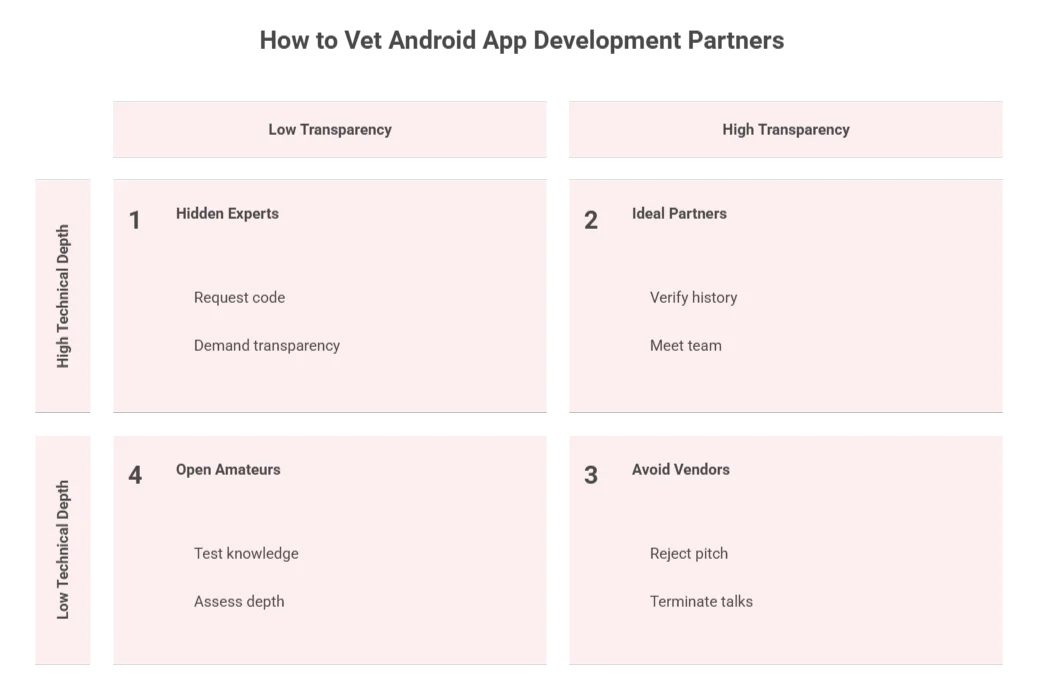
Ask about their Play Store release history specifically.
Not whether they build Android apps, ask how many apps they’ve shipped to the Play Store in the last 18 months, what the average ratings are, and whether any have faced compliance rejections for target API level requirements.
Ask who does the work, not who’s in the room.
Ask directly: “If we move forward, who specifically would be on this project? Can I meet them before we sign?” Legitimate partners accommodate this readily.
Request a code review of a live project.
You don’t need to evaluate the code technically. You’re evaluating whether they’ll share it. A vendor who won’t show you code from a previous project, even a public or deprecated one, is protecting something.
Test their Android knowledge with one question.
Ask: “How do you handle Android OS version fragmentation across a typical user base?”
The Discovery Sprint: The Risk-Mitigation Tool Most Clients Skip
The single most effective way to evaluate an outsourcing partner is to pay them to do a bounded piece of work before you commit to a full engagement.
A discovery sprint is a paid, time-boxed engagement, typically one to three weeks, costing between $2,000 and $8,000, where the vendor scopes your project in detail, asks clarifying questions, and produces a technical architecture proposal or detailed specification. It’s not a free consultation. It’s a paid work sample.
What you’re evaluating is the process, not the deliverable.
The Three Mistakes Clients Make Before They Sign Anything
These patterns discussed below show up consistently when engagements go sideways, usually within the first 60 days. Zaid Trimizi, Senior Customer Success and Product Manager at AppVerticals, has sat across the table from enough clients to know exactly where the cracks form.
Scoping by feature list instead of user flow.
A founder comes in with a tidy spreadsheet. Login, onboarding, dashboard, notifications, settings, twelve features, each with a one-line description. The vendor quotes against it. Everyone shakes hands.
Six weeks later, nobody can agree on what “notifications” actually meant. Does it cover the state where a user has denied Android notification permissions entirely? Does it handle the edge case where a background sync fails on a Xiaomi device running a heavily modified Android skin? The spreadsheet didn’t say. The contract didn’t either. Now it’s a dispute.
A feature list negotiation produces a contract. A user flow conversation produces a specification. Contracts get disputed. Specifications get built. Before you sign anything, ask the vendor to walk through your primary user journeys end-to-end, not feature by feature, but as a user would actually experience them. Where they ask incisive questions, note it. Where they ask none, pay attention.
Choosing fixed-price because it feels like the safer option.
The logic is understandable. A fixed number feels like a ceiling. It feels like the vendor is absorbing the risk. What’s actually happening is more complicated.
The reason is incentive misalignment. A fixed-price vendor is optimised to close the contract and deliver to the letter of the spec, not to build something that performs consistently across your user base’s actual devices. Edge cases, performance considerations on sub-$200 handsets, manufacturer-specific Android behavior, these live outside the spec. So they often don’t get built.
For most Android projects in the $20,000–$80,000 range, a time-and-materials engagement with clearly defined milestone gates is a more reliable structure. It gives you real visibility into where time is going, the ability to reprioritise as you learn, and a vendor whose incentive is to work efficiently rather than to minimize scope interpretation.
Treating the PM as the technical decision point.
This one is subtle, and Zaid considers it the most common mistake non-technical clients make once the project is underway.
A client without an engineering background naturally gravitates toward the PM, they’re responsive, they speak in plain language, and they’re explicitly there to be the bridge. So every question goes through them. Architecture concerns, scope changes, technology decisions, all filtered through a single coordination layer.
What the client receives isn’t the engineer’s answer. It’s the PM’s interpretation of it. By the time a technical concern has been raised by the client, processed by the PM, discussed internally, and reported back, something has usually been lost, or softened.
Insist on direct access to the lead engineer for architecture decisions, scope changes, and anything involving a shift in technical direction. Make it a condition before you sign, not a request you make three months in when something has already gone wrong.
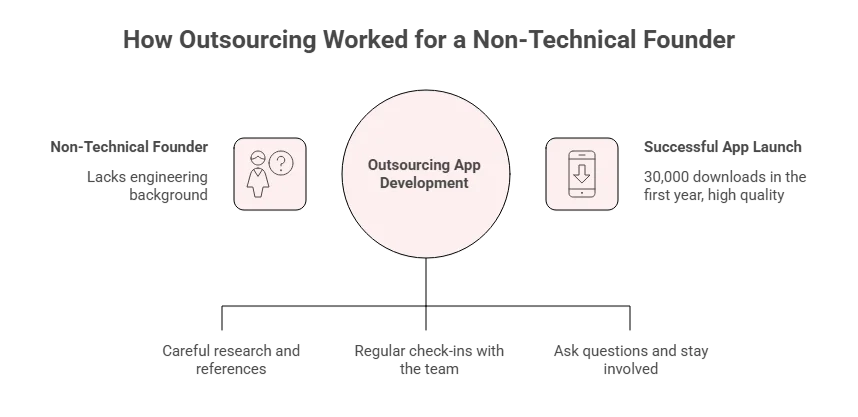
50,000 Downloads, Zero Technical Background: What a Real Outsourcing Engagement Looks Like
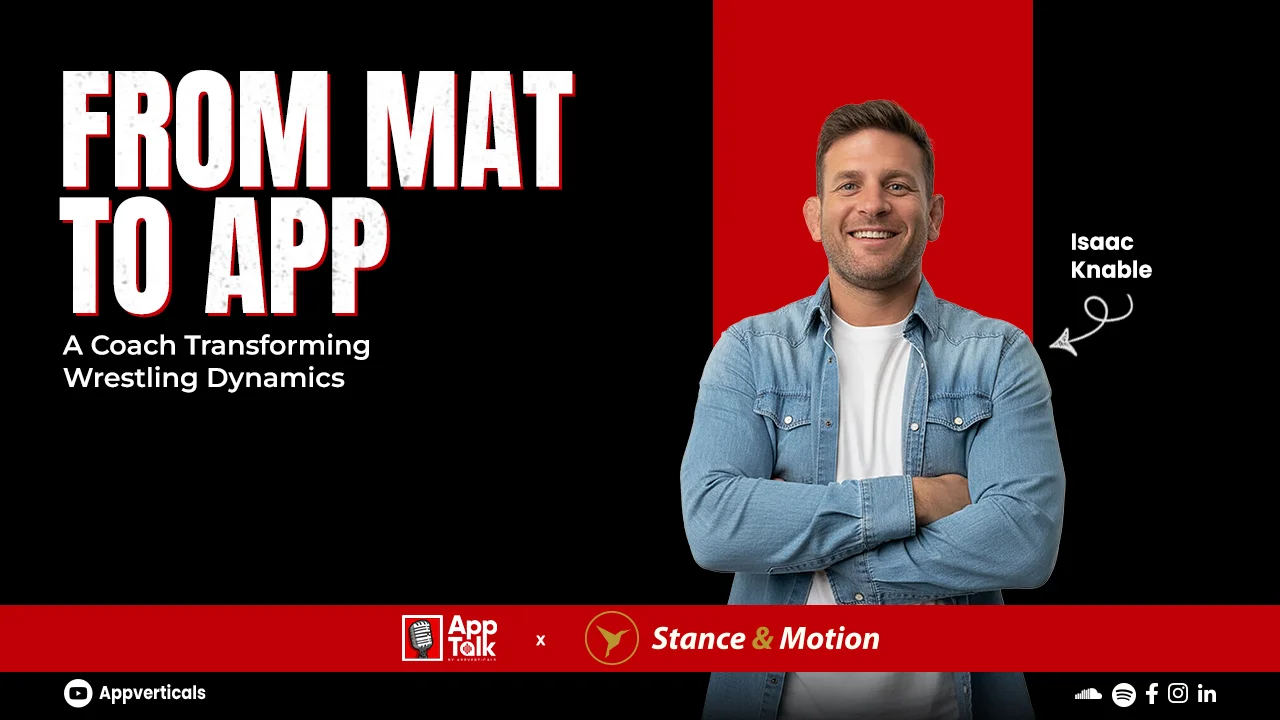
Isaac Knable had a clear product vision and no engineering background. A wrestling coach with over 20 years on the mat, founder of a wrestling academy, and inventor of the Footwork Trainer, he wanted to build Stance and Motion, a mobile app to help wrestlers at every level, from youth beginners to competitive athletes, develop footwork and movement mechanics from home, with no equipment required.
The idea had been sitting with him since 2018. Getting it built was a different matter entirely.
Speaking on AppTalk, Isaac described the vendor selection process with the kind of honesty that doesn’t usually make it into case studies. He’d considered freelancers, spoken to high school connections, and eventually narrowed the field to three candidates, a process he described as long, research-heavy, and deliberately careful. What tipped the decision toward AppVerticals wasn’t portfolio depth or price. It was the energy in the conversation, the confidence the team brought, and, critically, the references. Isaac reached out to people who had already built apps through AppVerticals and asked them directly what the experience was like.
What follows is a useful illustration of how a non-technical founder should manage an outsourced build. Isaac’s own reflection on what he’d do differently was specific: he’d check in more. Not because anything went wrong, but because the instinct to trust the team and step back can quietly become a gap in communication that costs you later.
When he did reach out, the response was there. Messages answered within the hour. The PM, Muhammad, described by Isaac was consistently available and reliable throughout the process.
The app has been largely self-sustaining for months without active development pushes, running on organic reach while Isaac focuses on marketing through his own social channels.
The story isn’t remarkable because everything went smoothly. It’s useful because Isaac is precise about where the friction was, budget pressure, post-launch bug anxiety, the learning curve of understanding what “device issues” actually means, and honest that the communication discipline was something he had to learn through the process, not something he arrived with.
That’s the reality of most successful outsourced builds. The technical execution is only part of it. The client’s willingness to stay engaged, ask questions, and check in consistently is the variable that most directly determines how well the vendor can serve them.
Engagement Models: Which One Protects You at Each Stage
The Deloitte 2024 Global Outsourcing Survey found that 80% of executives plan to maintain or increase their third-party outsourcing investment. The same survey identified outcome-based and milestone-structured engagements as the fastest-growing delivery models, which reflects a market that has learned, broadly, that open-ended vendor relationships without defined measurement points tend to drift.
There are three standard engagement models for Android outsourcing. The right one depends on where you are in the product lifecycle.
Here’s a quick look at the engagement models you can choose from before we go into details:
| Fixed Price | Time & Materials | Dedicated Team | |
|---|---|---|---|
| Best for | Defined MVP, single module | Active development, evolving scope | Long-term roadmap, scaling |
| Cost predictability | High | Medium (with milestone gates) | Medium–High |
| Flexibility | Low | High | High |
| Client control | Low after signing | High | High |
| Typical range | $15K–$80K | $20K–$150K+ | $8K–$25K/month |
| Primary risk | Scope disputes | Budget overrun without gates | Team composition drift |
Fixed Price
Best for bounded, stable-scope work: a defined MVP with a locked feature set, a specific module, a UI redesign with clear deliverables.
The appeal is cost predictability. The risk is that fixed-price projects require a specification detailed enough that there’s no interpretive room in “done.” Most clients don’t have that specification before they sign. Most vendors price against the specification they have, which is always incomplete.
Use fixed-price when the scope is genuinely stable and you’ve already run a discovery sprint that produced a detailed technical spec. Don’t use it as a substitute for scoping.
Time and Materials (T&M)
Best for active product development with requirements that will evolve. Payment is tied to time logged and milestones reached, not to a pre-defined deliverable.
The risk is budget overrun without controls. T&M without milestone gates is a blank cheque. T&M with clearly defined two-week milestones, where each gate requires a demo or deployment, is a fundamentally different and significantly safer arrangement. The milestone structure is the protection, not the model itself.
Dedicated Team
Best for ongoing development where the outsourced team functions as a de facto internal engineering function, typically when you have 12+ months of roadmap, consistent development volume, and the economics of a monthly retainer ($8,000–$25,000/month for a typical Android team) compare favorably against fully-loaded US hiring costs.
Thinking through Android outsourcing for your own product?
We help founders and product managers navigate these decisions before they become expensive mistakes. No pitch, just clarity.
What Post-Launch Support Should Actually Cover (And What Most Contracts Leave Out)
The engagement doesn’t end at launch. For most Android apps, launch is where the real operating environment begins, and it’s significantly more complex than the development environment.
An Android OS update changes background process permissions. Google updates its target API level requirements and flags apps that haven’t complied for Play Store removal. A manufacturer pushes a custom Android skin that breaks a background sync process on 15% of your user base. A third-party SDK used in the build reaches end-of-life. None of this is unusual. All of it is inevitable over a 12-to-24-month window.
A typical outsourcing contract’s post-launch section amounts to: “We’ll provide 30 days of bug fixes.” That clause is not a support agreement. It’s a cooling-off period.
A real post-launch support contract covers the following.
Bug severity definitions with explicit response time SLAs.
Critical bugs, app crashes on launch, payment flows broken, authentication failures, should have a response commitment within 4 hours and a resolution SLA of 24–48 hours. Major issues, features unavailable, data display errors, should be addressed within 24 hours.
Minor issues, UI inconsistencies, edge-case rendering, can roll into the next sprint cycle. Without these definitions, every post-launch conversation starts with an argument about severity.
Android OS update compatibility commitments.
Google releases a major Android version annually. Manufacturer overlays add further variance. Your contract should specify that the vendor is responsible for maintaining compatibility with new major OS versions for a defined period, typically 12 months post-launch, at a pre-agreed rate, whether covered by a retainer or billed at a defined hourly rate.
Google’s Play Store requirements mandate that all new app updates target the latest API level; a vendor not actively monitoring these requirements will leave you scrambling to comply on a deadline you didn’t know was coming.
Play Store policy change responsibility.
Google’s Play Store policies update frequently, privacy permission declarations, content policy requirements, billing API changes. When a compliance update is required, who owns the cost?
The general principle: if the change is driven by an external policy or platform shift (Google’s requirements, a third-party SDK, a deprecated API) rather than a defect in the original build, the cost structure should be pre-negotiated rather than disputed under pressure.
Retainer structure vs. per-ticket billing.
A monthly retainer covering a defined block of hours, typically 10–20 hours for a stable app, is more predictable than per-ticket billing, which turns every request into a scope negotiation. For apps with active user bases or dependent third-party integrations, the retainer model protects you from the scenario where a critical fix sits for three days while a vendor waits for commercial approval.
Knowledge transfer requirements.
If you ever want to move development in-house or switch vendors, your contract should define what a proper handoff requires: inline documentation, a maintained README that a new developer can actually follow, architecture decision records (ADRs) for non-obvious design choices, and a defined handoff sprint, typically two to four weeks, where the outgoing team walks the incoming team through the codebase.
Without this defined in writing, handoff quality depends entirely on goodwill. Goodwill is plentiful when the relationship is warm. It’s absent when it isn’t.
Protecting Your IP, Code Ownership, and What Happens When the Relationship Ends
You can find detailed explanation of why you need to check-box each of the above-mentioned areas below:
IP ownership is standard outsourcing advice. Getting it right in practice requires more specificity than most contracts provide.
The standard guidance, “make sure your contract includes IP assignment”, is necessary but not sufficient. An IP assignment clause covers who legally owns the code at signing. It doesn’t address what happens to the code’s usability when the relationship ends, which is the practical risk that actually affects clients.
Your repository should be the working repository from day one.
Not a mirror, not a periodic export, the repository the vendor commits to should be under your account and your control from the first line of code. If the relationship ends for any reason, termination, vendor insolvency, a commercial dispute, you have a complete, current codebase immediately.
Documentation standards belong in the SOW, not in goodwill.
Specify minimum documentation requirements as a deliverable: inline comments for non-obvious logic, a maintained README, ADRs for architecture decisions. These take no significant extra time when built from the start.
Require a maintained third-party dependency inventory.
Every Android app has dependencies: Retrofit for networking, Glide for image loading, Dagger or Hilt for dependency injection, Firebase for analytics, payment SDKs. Your contract should require a dependency registry with licence types and update status.
Define the handoff sprint contractually.
If you exit the relationship, the contract should specify a transition period, typically two to four weeks, where the outgoing team documents and walks a new team through the architecture. Some clients include a penalty clause for non-compliance. At minimum, the obligation should be explicit and tied to final payment.
For large engagements, consider code escrow. For projects above $200,000 or for mission-critical applications, a code escrow arrangement, where source code is held by a neutral third party and released under defined conditions such as vendor insolvency or material breach, provides protection that justifies the cost and administrative overhead.
Who Should Choose What: A Practical Decision Framework
Outsourcing decisions don’t have a single correct answer. They have conditions. Here’s how to frame the choice based on where you actually are.
Early-stage startup (pre-Series A, no internal Android team)
Outsourcing makes sense if your scope is defined well enough to be contracted.
- Run a discovery sprint before committing to a full build.
- Use a fixed-price or milestone-based T&M structure for your MVP.
- Keep the scope deliberately narrow, a working, performant core product is more valuable than a feature-complete but fragile one.
- Budget for post-launch support from the start; it’s far cheaper to structure it in the initial engagement than to renegotiate it after launch under pressure.
Growth-stage company (Series A–B, small internal team, scaling product)
A dedicated team often makes sense when Android development is ongoing and your roadmap extends 12+ months. The economics of a dedicated team at $8,000–$20,000/month compare favorably to the fully-loaded cost of a US mid-level Android hire.
Prioritise vendor consistency, team drift in dedicated models is the most common source of velocity decline over time. Make team composition change notification a contractual term.
Enterprise or established business building a new Android product line
Your primary risk isn’t cost, it’s integration complexity and compliance. Prioritise vendors with demonstrable experience in your industry’s compliance requirements (HIPAA for health, PCI-DSS for payments, GDPR for European users) and in Android’s enterprise management tooling (Android Enterprise, Managed Device Work Profiles).
Vetting should include a technical architecture review, not just a portfolio check or reference call.
If you’ve had a bad outsourcing experience before Conduct reference calls with at least two previous clients, not testimonials supplied by the vendor, but calls you arrange independently. Ask specifically about what went wrong and how the vendor handled it. Every engagement has friction. How a vendor responds to problems tells you more than how they perform when everything is smooth.
Conclusion
A well-outsourced Android app ships on time, performs consistently across the device fragmentation Android actually presents, and leaves you with a vendor relationship you can scale or exit cleanly. That outcome isn’t the default, it’s the result of the right engagement model, a contract that protects you after launch, and a partner who understands Android specifically rather than mobile generically.
The decisions that determine whether your engagement succeeds are almost all made before the first line of code is written: how you structure the discovery sprint, how thoroughly you scope the user flows, what your post-launch terms actually say, and whether the team who shows up for the work is the one who showed up for the pitch.
Get those things right, and the technical execution follows.
Unlock Your Telemedicine App’s Full Potential
We’ll tell you honestly whether outsourcing is the right move, which model fits your stage, and what a realistic scope looks like, before you’ve committed to anything. No pitch, no proposal until you want one.


![AI_in_App_Development_Statistics[1]](https://www.appverticals.com/wp-content/uploads/2025/12/AI_in_App_Development_Statistics1.png)