About Us

About Us
We’re a future-focused tech partner working with some of the world’s top enterprises. At AppVerticals, we design solutions that drive growth and reimagine digital experiences.

Services
Software Development
Mobile App Development
Web Design & Development
Tell us what you're looking for, and we'll tailor a solution based on your business needs.
Talk to Experts
Health Tech

EdTech

Logistics

Real Estate

Ecommerce

Sports

Fintech

Travel

Restaurant

Automotive
HIPAA-compliant digital solutions for hospitals, clinics, and healthtech startups driving better patient outcomes.
What we do:
Scalable learning platforms for schools, universities, and EdTech startups transforming education delivery.
What we do:
Real-time tracking and automation solutions for freight companies, warehouses, and delivery services.
What we do:
PropTech platforms for brokerages, property managers, and real estate marketplaces are streamlining operations.
What we do:
High-converting commerce platforms for D2C brands, retailers, and online marketplaces are driving revenue growth.
What we do:
Fan engagement platforms for sports teams, leagues, and betting operators are creating immersive experiences.
What we do:
PCI-DSS compliant solutions for digital banks, payment platforms, and InsurTech companies, ensuring security.
What we do:
Booking and hospitality solutions for OTAs, hotels, and tourism platforms, enhancing traveler experiences.
What we do:
Online ordering and operations software for restaurants, cloud kitchens, and food delivery platforms.
What we do:
Connected vehicle platforms for automotive OEMs, dealerships, and mobility providers are accelerating innovation.
What we do:
Our Odoo implementation brings financial discipline, operational visibility, and process control across departments. From accounting automation to manufacturing workflows, we design ERP systems that reduce operational leakage and provide real-time decision clarity.
We use Sitecore to drive measurable revenue growth through intelligent personalization and behavior-driven content delivery. By aligning marketing automation, data orchestration, and omnichannel engagement, we help brands turn digital touchpoints into retention engines.
We architect AWS environments that stay stable under scale, traffic spikes, and compliance pressure. From secure cloud migrations to CI/CD automation and cost governance, we engineer cloud foundations that protect performance while enabling rapid product evolution.
We implement Dynamics 365 to align systems with actual business operations, bringing clarity, control, and accountability across CRM, ERP, and service functions. From sales to finance, configurations eliminate inefficiencies and enable confident, real-time decisions.
Tell us what you're looking for, and we'll tailor a solution based on your business needs.
Talk to ExpertsPortfolio
AppVerticals was featured in Inc. 5000 as
America’s Fastest Growing Tech Company
See what it might cost to bring your app idea to life. Our calculator gives you a quick, simple estimate based on what you need.



 verified expert
Senior Writer and Editor - App, AI, and Software
Muhammad Adnan is a Senior Writer and Editor at AppVerticals, specializing in apps, AI, software, and EdTech, with work featured on DZone, BuiltIn, CEO Magazine, HackerNoon, and other leading tech publications. Over the past 6...
See Full Bio19 minutes read
In 2026, real estate apps must be fast, scalable, and user-centric to meet rising consumer expectations.
According to the National Association of Realtors (NAR), 97% of homebuyers now begin their search online, making real estate apps a crucial tool for driving engagement.
This guide will walk you through the real estate app development process, from market research to post-launch scaling, helping you create an app that meets modern needs and stands out in a competitive market.
Real estate app development refers to the process of building mobile or web applications that enable users, including homebuyers, renters, sellers, and agents, to search, explore, compare, and transact properties online.
A real estate app development company plays a critical role in this process by designing and building custom solutions that cater to the specific needs of the real estate market.
96–100% of homebuyers use the internet during their home search, and 69% use mobile devices like phones or tablets to view listings.
This shift toward mobile usage highlights why real estate apps have become essential tools for both consumers and professionals, enabling instant access to listings, location‑based property search, in‑app communication with agents, and real‑time updates on price changes or new properties.
When building a successful real estate app, the must-have features include property search and listings, interactive maps with geolocation, user profiles and preferences, real-time notifications, and secure payment gateways.
A successful real estate app must deliver functionality users expect and use repeatedly. From property discovery to smooth transactions, these features form the backbone of modern real estate apps.
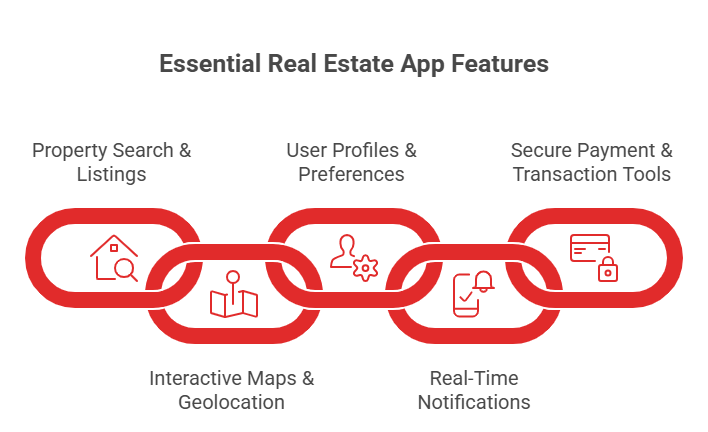
Property search with detailed listings, including photos, pricing, filters, and sorting, is the core feature of any real estate app. Users must be able to find properties for sale, rent, or investment quickly using intuitive search and filter tools.
Interactive maps powered by Google Maps or similar APIs help users see property locations in context, like nearby amenities, transit options, schools, and neighborhood details, making geolocation search essential for discovery.
User accounts allow people to save favorite properties, set alerts, manage preferences, and receive personalized recommendations based on their behavior and search history.
Push alerts for new listings, price changes, and updates on saved searches keep users engaged and informed, increasing retention and conversion in competitive markets.
For marketplaces and rental apps, integrated payment gateways and secure transaction flows (e.g., deposits, booking fees) are critical for trust and convenience. This enhances user confidence and supports smoother deals.
To build a successful real estate app, follow a structured step-by-step process that includes market research, defining key features, designing the user experience, and selecting the right technology stack.
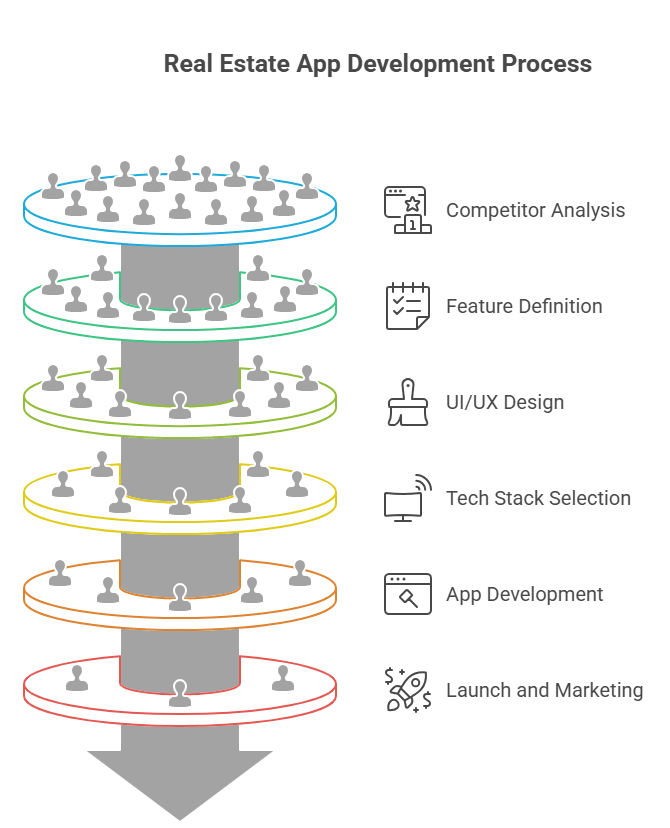
Here’s a step-by-step guide that will help you design, develop, and deploy a high-performance app that meets user needs and stands out in the competitive real estate market:
Start by defining who your target audience is, like homebuyers, sellers, renters, or real estate agents. What are their main pain points?
Understand how users interact with apps today, including their specific needs and preferences. This will allow you to create features that truly add value.
Look at successful real estate apps like Zillow, Realtor.com, and Redfin. Study their features and user experience (UX).
What are users praising? What are they complaining about?
By identifying gaps in the market (e.g., slow property updates, limited search filters, or poor mobile experience), you can tailor your app to meet real needs and stand out.
Based on your research, define the must-have features for your app, focusing on an MVP (Minimum Viable Product) that solves the key problems for your users.
Key features to include are property search, user profiles, location-based search, and real-time notifications.
By starting with essential features, you can get user feedback early, and avoid wasting resources on unnecessary functionality.
Your app’s design should be clean, simple, and intuitive. A cluttered or confusing interface will turn users away quickly.
Focus on user-friendly navigation, easy property browsing, and clear calls to action (e.g., “Book a Tour” or “Contact an Agent”).
An app that’s easy to use will drive higher engagement and retention, as studies show that design is key to app success.
The tech stack you choose will directly impact your app’s performance, speed, and scalability. For a real estate app, consider:
Choosing the right tech stack ensures smooth performance under high traffic and supports future growth.
Once you’ve selected your tech stack, start building. Focus on front-end and back-end integration, while ensuring your app handles real-time data (like property updates) smoothly.
Conduct manual and automated testing to ensure the app works flawlessly under all conditions.
Testing early saves you from bugs that can ruin the user experience and damage your brand.
After your app goes live, collect feedback from real users to make data-driven improvements.
Use App Store Optimization (ASO) to improve visibility and attract users. To retain users, plan for regular updates, like introducing new features, fix bugs, and adapt to user needs.
Post-launch marketing strategies (like email campaigns and partnerships with agents) will help drive app growth.
The cost to develop a real estate app can range from $30,000 to $250,000 or more, depending on factors like app complexity, platform choice, and the development team’s location.
According to the Standish Group’s CHAOS Report, around 50% of software projects exceed their budgets, often due to underestimated technical complexity.
Below, I break down the key factors influencing the cost and provide an estimate for low-end, mid-tier, and high-end apps.
| Factor | Description | Impact on Cost |
|---|---|---|
| App Complexity & Features | The number of features like property search, user profiles, payment gateways, etc., impacts development time. | Higher complexity = higher cost |
| Platform | Whether the app is being developed for iOS, Android, or as a cross-platform app (e.g., using Flutter). | Cross-platform tends to be cheaper |
| Development Team Location | The region where your development team is located (local vs offshore). | Offshore teams are usually more affordable |
| Design & Customization | Custom UI/UX design and features (like virtual tours) can significantly increase costs. | Custom design = higher cost |
Real estate app costs vary based on the app’s complexity, platform choice, and the development team’s location. Here’s a breakdown of typical costs:
| App Type | Features | Estimated Cost Range |
|---|---|---|
| Low-End Apps | Basic property listings, simple search filters. | $30,000 – $60,000 |
| Mid-Tier Apps | Interactive maps, user profiles, saved searches. | $60,000 – $120,000 |
| High-End Apps | Real-time updates, AI-driven recommendations, virtual tours. | $120,000 – $250,000+ |
These apps typically offer basic functionality, such as property listings, search filters, and user contact forms. The cost is generally lower due to fewer features and simpler design.
These apps include features like interactive maps, user profiles, and more dynamic property search functionality. Costs increase due to additional complexity in both frontend and backend development.
High-end apps include advanced features like real-time property updates, AI integration, virtual tours, and advanced filtering options. These apps require more development time and custom features, leading to higher costs.
| Region | Hourly Rate | Development Team Type | Typical Features Developed | Estimated Development Time |
|---|---|---|---|---|
| North America (US & Canada) | $150 – $300 per hour | Local developers with high expertise in tech and design. | Custom UI/UX, advanced integrations, real-time updates, secure payment systems. | 6 – 12 months |
| Western Europe | $100 – $200 per hour | Skilled developers with experience in scalable apps and high-performance systems. | Property search, user profiles, custom search filters, advanced security features. | 5 – 9 months |
| Eastern Europe (Poland, Ukraine, etc.) | $40 – $100 per hour | Offshore developers offering good balance of quality and cost. | Interactive maps, geolocation, user notifications, push messages. | 4 – 7 months |
| GCC (UAE, Saudi Arabia, Qatar) | $60 – $150/hr | Regionally experienced teams with local market & regulatory knowledge | Mid to high-tier apps, Arabic localization, fintech/payment integrations | 5 – 8 months |
When building a real estate app, choosing the right tech stack is critical for the app’s performance, scalability, and future growth.
The tech stack consists of frontend and backend technologies, databases, and services that help ensure the app functions smoothly, handles real-time data, and provides the best user experience.
Below, I’ll dive into the best technologies for each layer of your real estate app.
Frontend technologies are essential for the user interface (UI) of your real estate app. These technologies ensure that your app is fast, responsive, and user-friendly.
| Frontend Technology | Best For | Advantages | Disadvantages |
|---|---|---|---|
| Swift (iOS) | Native iOS apps | High performance, smooth UX, great for iPhone/iPad users | Limited to iOS, requires separate development for Android |
| Kotlin (Android) | Native Android apps | Easy integration with Android OS, strong community support | Limited to Android, requires separate development for iOS |
| Flutter (Cross-Platform) | Both iOS & Android | Single codebase for both platforms, faster development | Less native-like feel compared to Swift or Kotlin |
The backend powers the server-side logic of your app, handling things like user authentication, property listings, search filters, and data storage.
| Backend Technology | Best For | Advantages | Disadvantages |
|---|---|---|---|
| Node.js | Real-time data apps, scalable applications | Non-blocking I/O, fast performance, large community | Single-threaded, requires more configuration for complex apps |
| Django | Python-based apps, secure and robust apps | Secure, fast development, built-in features like authentication | Slower performance for large apps compared to Node.js |
| Firebase | Real-time apps, easy integration with Google Cloud | Real-time database, fast setup, scalable | Limited to Google Cloud, might not be suitable for complex apps |
For real-time updates, such as when a new property is listed, or a price change happens, choosing the right service is critical. Firebase and AWS offer solutions for real-time data handling, but they differ in capabilities and ease of use.
| Real-Time Data Service | Best For | Advantages | Disadvantages |
|---|---|---|---|
| Firebase | Real-time apps (chat, notifications) | Built-in real-time database, scalable, easy to use | Limited to Google Cloud ecosystem, less control over backend |
| AWS | Enterprise-level apps | Highly customizable, scalable, supports multiple services | More complex, requires configuration, higher setup time |
Once your real estate app is live, marketing it effectively is essential for user acquisition, retention, and business growth.
App marketing helps drive visibility, installs, and engagement, ensuring that your app doesn’t just sit in the app store but thrives in a competitive market.
Here’s how to effectively market your real estate app after launch.
App Store Optimization (ASO) is one of the most cost-effective ways to increase visibility in the app stores and attract organic installs. Optimizing your app’s listing ensures that it ranks higher for search queries related to real estate.
| ASO Factor | Description | Impact on Marketing |
|---|---|---|
| App Title & Description | Use keywords like “property search,” “real estate app,” or “homebuying.” | Higher ranking for relevant search queries in app stores. |
| App Screenshots & Videos | Showcase key features such as property listings, interactive maps, etc. | Increase user engagement by visually demonstrating value. |
| Ratings & Reviews | Encourage happy users to leave positive reviews. | Boost credibility and influence download decisions. |
| Keywords Optimization | Research real estate keywords and include them in your app’s metadata. | Drive organic traffic to your app listing. |
Key Insight: App store rankings can significantly impact your app’s visibility. Apps with optimized listings get higher organic downloads, improving long-term user acquisition.
Paid campaigns can accelerate your app’s visibility and drive targeted users to download your app. These campaigns can be run across Google Ads, Facebook, Instagram, and LinkedIn, depending on where your audience is most active.
| Paid Campaign Type | Description | Best For |
|---|---|---|
| Google Search Ads | Target users actively searching for real estate solutions. | High intent users looking for property apps. |
| Facebook/Instagram Ads | Use highly targeted ads based on user interests, behaviors, and location. | Brand awareness and lead generation. |
| LinkedIn Ads | Great for targeting real estate professionals, brokers, and agents. | B2B marketing for real estate agencies. |
Key Insight: Paid campaigns help you reach a broader audience, increase app downloads, and build brand awareness. A well-targeted ad can attract high-quality users who are more likely to stay.
Partnerships with agents and brokers are invaluable for word-of-mouth marketing and business growth. Real estate professionals are key players in the property transaction process, and partnering with them can offer mutual benefits.
| Partnership Strategy | Description | Impact on Marketing |
|---|---|---|
| Referral Programs | Provide real estate agents with a referral code or commission for every lead generated. | Boost downloads through trusted industry professionals. |
| Co-marketing Campaigns | Collaborate on content or events (e.g., webinars, property tours). | Increase credibility by partnering with established agents. |
Key Insight: Real estate agents and brokers are trusted sources for potential users. Partnerships with these professionals can drive quality leads and user growth for your app.
Content marketing is a long-term strategy that helps attract organic traffic to your website or app. By creating valuable content that addresses common buyer and seller pain points, you can build brand authority and generate quality leads.
| Content Strategy | Description | Impact on Marketing |
|---|---|---|
| Blog Posts & Articles | Write about topics like “How to Buy a Home”, “Best Property Search Tips”, etc. | Attract organic traffic and establish expertise in real estate. |
| SEO for Keywords | Optimize blog posts with real estate keywords such as “property app” or “buying home app”. | Increase app visibility on Google search and drive downloads. |
| Lead Magnets (eBooks, Guides) | Offer free downloadable content in exchange for user information (e.g., “Guide to Buying a Home”). | Build email lists for targeted marketing and user retention. |
Key Insight: Content marketing helps you dominate search results and establish authority in the real estate space, leading to better visibility and higher-quality leads.
Developing a real estate app is complex, with unique challenges that need to be addressed for the app to succeed.
For real estate tech startups, too many apps collapse not because of lack of opportunity, but because of shortcuts taken during development. According to CB Insights, 35% of startups fail due to a product-market fit issue — often because critical research, validation, or planning steps were skipped at the beginning.
Common issues that arise include user adoption and retention, data privacy, and integrating with multiple MLS feeds.
Below, I discuss how to overcome these challenges and ensure a smooth development process.
Building an app that attracts users is just half the battle, keeping them engaged is just as critical. Real estate apps often face issues with user retention, as users might download the app, try it once, and never return.
According to Verizon, 74% of breaches involve the human element, but weak backend security remains a top technical cause.
Addressing concerns such as complex navigation or irrelevant listings is essential for long-term success.
| Challenge | Solution | Impact on User Retention |
|---|---|---|
| Complex UI/UX | Design a simple, intuitive UI/UX that minimizes confusion. | Better user engagement, reduced churn. |
| Irrelevant or outdated listings | Implement real-time data synchronization and keep listings updated. | Improved trust and user satisfaction. |
| Slow loading times | Optimize app performance and reduce load times with caching and compression techniques. | Faster access leads to better user retention. |
According to IBM, the average cost of a data breach is $4.45 million annually. When dealing with user data, real estate apps must comply with stringent data privacy and security regulations like GDPR (General Data Protection Regulation) and CCPA (California Consumer Privacy Act).
Failure to meet these standards can result in severe penalties and damage to your brand’s reputation.
| Regulation | Requirement | Impact on Security |
|---|---|---|
| GDPR | Requires apps to obtain explicit consent before collecting user data. | Penalties for non-compliance can go up to 4% of global revenue. |
| CCPA | Gives California residents the right to opt out of data collection. | Helps build trust and avoids legal issues. |
| PCI DSS Compliance | Essential if you handle payment processing or credit card info. | Ensures secure transactions, reduces fraud risk. |
Ensuring data privacy compliance is critical for user trust and legal protection. GDPR violations can lead to fines of up to 4% of annual revenue for companies that fail to adhere.
Real estate apps often need to integrate with Multiple Listing Service (MLS) feeds, which provide the property data necessary for users to search and browse listings.
However, managing large-scale data from multiple sources can pose a significant challenge.
| Challenge | Solution | Impact on Data Management |
|---|---|---|
| Multiple data sources | Implement APIs to integrate multiple MLS feeds seamlessly. | Ensures accurate and real-time data updates. |
| Data quality issues | Use data validation tools to ensure clean, accurate data. | Improved data quality, reducing errors. |
| Scaling data handling | Leverage cloud-based solutions like AWS or Google Cloud for scalable infrastructure. | Seamless scalability, even as data volume grows. |
Integrating MLS feeds efficiently is essential for real-time property updates. Apps like Zillow rely on continuous MLS feed updates to ensure listings are always up-to-date.
AppVerticals go beyond apps and websites. As a full-service app and software development company, it help businesses create solutions that drive growth, engage users, and stay ahead in evolving markets.
Real estate apps that succeed are built by teams who understand both technology and the business of real estate.
Working with a trusted real estate app development company gives you a competitive edge, thanks to expertise in user journeys, secure data handling, and scalable architecture.
A strong online presence is just as important. That’s why having a skilled engineers by your side ensures your platform connects seamlessly with buyers, sellers, and investors.
Every real estate app that succeeds today begins with a structured, deliberate process. Ideas alone aren’t enough to compete in a market where users expect speed, simplicity, and trust from the first tap.
The real estate app development is a sequence of clear stages, including research, planning, execution, testing, and iteration, each shaping the product into something users rely on, not just try once.
Founders who approach development with this mindset avoid real estate app mistakes that slow growth, and position themselves to scale faster, respond smarter, and lead longer.
If you’re planning to build a real estate app, understanding the process is step one. Executing it intelligently defines where the app goes next.
verified expert
Muhammad Adnan is a Senior Writer and Editor at AppVerticals, specializing in apps, AI, software, and EdTech, with work featured on DZone, BuiltIn, CEO Magazine, HackerNoon, and other leading tech publications. Over the past 6 years, he’s known for turning intricate ideas into practical guidance. He creates in-depth guides, tutorials, and analyses that support tech teams, business leaders, and decision-makers in tech-focused domains.
 We’re AppVerticals
AppVerticals is where innovative startups and Fortune 500s come for transformation.
View About Us Real Estate
Choosing from the many real estate software development companies in USA can be challenging, especially when every business has unique needs. The U.S....

15 min read
 Real Estate
Global investment in real estate technology surpassed $11.38 billion last year. This shows that investors are betting on tools that streamline propert...

10 min read
 Real Estate
Choosing the best real estate app depends on what problem you’re trying to solve. Some platforms prioritize listing volume, others focus on MLS accura...
22 min read
Discover how our team can help you transform your ideas into powerful Tech experiences.
AppVerticals © 2026 | All Rights Reserved

Get In Touch.














 ChatGPT
 Perplexity
 Google AI