About Us

About Us
We’re a future-focused tech partner working with some of the world’s top enterprises. At AppVerticals, we design solutions that drive growth and reimagine digital experiences.

Services
Software Development
Mobile App Development
Web Design & Development
Tell us what you're looking for, and we'll tailor a solution based on your business needs.
Talk to Experts
Health Tech

EdTech

Logistics

Real Estate

Ecommerce

Sports

Fintech

Travel

Restaurant

Automotive
HIPAA-compliant digital solutions for hospitals, clinics, and healthtech startups driving better patient outcomes.
What we do:
Scalable learning platforms for schools, universities, and EdTech startups transforming education delivery.
What we do:
Real-time tracking and automation solutions for freight companies, warehouses, and delivery services.
What we do:
PropTech platforms for brokerages, property managers, and real estate marketplaces are streamlining operations.
What we do:
High-converting commerce platforms for D2C brands, retailers, and online marketplaces are driving revenue growth.
What we do:
Fan engagement platforms for sports teams, leagues, and betting operators are creating immersive experiences.
What we do:
PCI-DSS compliant solutions for digital banks, payment platforms, and InsurTech companies, ensuring security.
What we do:
Booking and hospitality solutions for OTAs, hotels, and tourism platforms, enhancing traveler experiences.
What we do:
Online ordering and operations software for restaurants, cloud kitchens, and food delivery platforms.
What we do:
Connected vehicle platforms for automotive OEMs, dealerships, and mobility providers are accelerating innovation.
What we do:
Our Odoo implementation brings financial discipline, operational visibility, and process control across departments. From accounting automation to manufacturing workflows, we design ERP systems that reduce operational leakage and provide real-time decision clarity.
We use Sitecore to drive measurable revenue growth through intelligent personalization and behavior-driven content delivery. By aligning marketing automation, data orchestration, and omnichannel engagement, we help brands turn digital touchpoints into retention engines.
We architect AWS environments that stay stable under scale, traffic spikes, and compliance pressure. From secure cloud migrations to CI/CD automation and cost governance, we engineer cloud foundations that protect performance while enabling rapid product evolution.
We implement Dynamics 365 to align systems with actual business operations, bringing clarity, control, and accountability across CRM, ERP, and service functions. From sales to finance, configurations eliminate inefficiencies and enable confident, real-time decisions.
Tell us what you're looking for, and we'll tailor a solution based on your business needs.
Talk to ExpertsPortfolio
AppVerticals was featured in Inc. 5000 as
America’s Fastest Growing Tech Company
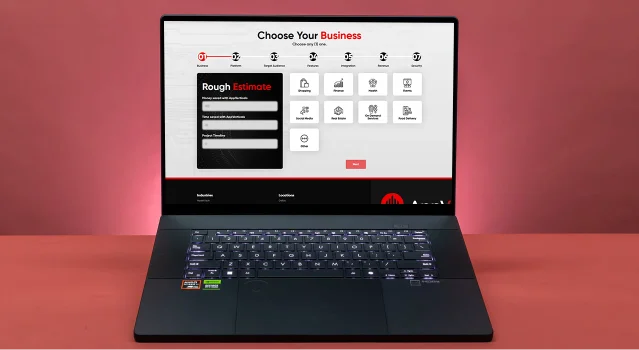
See what it might cost to bring your app idea to life. Our calculator gives you a quick, simple estimate based on what you need.


 verified expert
Senior Content Writer — Mobile & Software Development, AI
Zainab helps tech brands sound more human. She takes app ideas, features, and updates and turns them into content people actually want to read. Whether it’s for a launch, a campaign, or just making things...
See Full Bio8 minutes read
Businesses choose React Native when they need to launch faster, control app development costs, maintain one product vision across iOS and Android, and still deliver a high-quality user experience. It is especially effective for brands that prioritize speed-to-market, feature consistency, scalability, and long-term maintainability over building two entirely separate native codebases.
That logic is visible in AppVerticals’ work for Coca-Cola Dubai, where the company used a mobile-first architecture with React Native to support 2M+ peak users, 99.98% uptime, 45% faster user journeys, AA accessibility compliance, and zero critical launch bugs.
Let’s explore why AppVerticals chose React Native for Coca Cola Dubai and what’s in there to learn for businesses considering cross-platform app development.
| Business Priority | Why React Native Helps | Coca-Cola Dubai Relevance |
|---|---|---|
| Faster delivery | Shared codebase and faster iteration | 150+ prototypes and 45% faster user journeys |
| Scalability | Mature architecture plus flexible backend integrations | 2M+ peak users and 99.98% uptime |
| Cost control | Less duplicated work across platforms | Strong fit for enterprise rollout efficiency |
| Consistency | Shared UI/business logic improves parity | Useful for global brand experience |
| Maintainability | Easier updates and coordinated releases | Valuable in high-visibility apps |
| Native flexibility | Native modules available when needed | Helps future-proof platform choices |
For CTOs, product managers, and digital transformation leaders, the question is rarely ‘Is React Native popular?’ The real question is: Will this cross-platform framework help us hit business goals faster without introducing unnecessary delivery risk?
That is why ‘Why Choose React Native’ is fundamentally a business strategy question. React Native reduces duplication across platforms, improves engineering efficiency, accelerates release cycles, and helps teams maintain product parity.
In other words, React Native matters because it helps businesses solve familiar app-development pain points:
Those are not theoretical problems. They are the exact kinds of pressures enterprise and growth-stage brands face when mobile becomes a core revenue, loyalty, or engagement channel.
Schedule a quick architecture review to assess delivery risks, scalability, and integration complexity, ensuring the right framework choice before committing budget.
Coca-Cola needed a mobile-first digital experience built for speed, reliability, usability, and scale. AppVerticals, an expert mobile app development company, delivered that vision with a stack that included React Native on the frontend, plus Node.js, PostgreSQL, and AWS.
The result was a platform engineered over 9 months by a 10-member design and engineering team, validated through 150+ prototypes, and built to handle 2M+ peak users with 99.98% uptime.
That matters because React Native was not chosen in a vacuum. It aligned with Coca-Cola Dubai’s business and product realities:
Coca-Cola needed a mobile-first platform that could be designed, tested, refined, and launched efficiently. More than 150 prototypes were built and a measurable 45% improvement was experienced in user journeys, showing a delivery model centered on fast iteration and UX refinement. That is exactly where React Native performs well: rapid iteration, reusable UI patterns, and faster cross-platform development.
The platform had to withstand enterprise-level demand. AppVerticals built the solution ensuring it supports 2M+ peak users while maintaining 99.98% uptime and a 1.2-second median page load speed. For decision-makers, that is the central takeaway: React Native was used in a production environment where stability and performance were non-negotiable.
The final product delivered faster journeys, zero critical bugs at launch, and AA accessibility compliance. That combination suggests React Native was part of a broader engineering decision designed to balance speed with quality rather than sacrifice one for the other.
High-visibility consumer brands cannot afford buggy rollouts. The app experienced zero critical launch bugs, which is particularly significant in a brand environment where trust, campaign performance, and public perception are tightly linked.
The app’s workflow spanned across design, app development, performance engineering, and accessibility compliance. React Native supports this kind of coordinated workflow because teams can move more cohesively across platforms with fewer duplicated product decisions.
The Coca-Cola Dubai project is not just another portfolio page. It offers a practical framework for deciding when React Native is the right strategic choice.
React Native makes sense when your business needs:
That is why AppVerticals’ implementation for Coca-Cola is such a relevant example. It demonstrates that React Native is not only useful for startups or MVP development. In the right architecture, it can support a globally recognized brand’s high-traffic, high-visibility mobile experience.
Evaluate your product requirements, traffic goals, and integrations to determine if React Native is the right fit with our experts.
React Native’s biggest practical advantage remains the ability to build for iOS and Android from a largely shared codebase. Bacancy highlights this as a core reason companies choose React Native, emphasizing code reuse, lower cost, and shorter development cycles.
Instagram Engineering described developer velocity as a defining value and said the company explored React Native to help product teams’ ship features faster through code sharing and higher iteration speeds. Instagram later reported high code-sharing levels across several shipped features, including 99% for Post Promote and 92% for Push Notification Settings.
One of the more important strategic reasons to choose React Native is flexibility. If your app needs a device-specific feature, teams can still extend the app with native modules instead of abandoning the framework altogether. Bacancy highlights native modules as a major advantage, and React Native’s official architecture direction reinforces that approach through stronger native interoperability.
React Native’s official team says the New Architecture is ‘now ready to be used in production’ and explains that removing the bridge enables faster startup and more direct communication between JavaScript and native runtimes. That matters for businesses because performance objections that once discouraged React Native adoption are becoming less decisive for mainstream product categories.
Shopify identifies one of the most overlooked executive benefits: talent portability. Teams can move engineers more fluidly across web, iOS, Android, and shared business logic. That improves staffing flexibility and reduces organizational silos.
A focused consultation can identify which features can stay shared, which should be native, and what architecture will best support your launch timeline.
While React Native is a powerful tool, it might not be the best choice in certain scenarios. Consider avoiding React Native if your app requires:
In these cases, opting for native development with Swift (iOS) or Java (Android) might be a better choice for optimal performance and user experience.
Choose React Native when your goal is to build and scale a business-critical mobile product efficiently, not when your goal is to win a purity contest between frameworks.
The best evidence is not theory. It is execution.
React Native was not merely good enough for Coca Cola Dubai. It was aligned with the brand’s delivery needs, customer-experience goals, and scale expectations.
So if your organization is asking, ‘Why Choose React Native?’ the most accurate answer is this: Choose React Native when your business needs fast, scalable, maintainable cross-platform delivery with room for native flexibility where it matters.
If your app must support high traffic, campaign spikes, strong UX, and rapid iteration, book a discovery call before development starts.
verified expert
Zainab helps tech brands sound more human. She takes app ideas, features, and updates and turns them into content people actually want to read. Whether it’s for a launch, a campaign, or just making things clearer, she’s all about simple words put together to form stories that stick.
 We’re AppVerticals
AppVerticals is where innovative startups and Fortune 500s come for transformation.
View About Us ios
ios
If you want to build an iOS app with Claude Code, the appeal is obvious: less blank-page friction, faster prototyping, quicker UI scaffolding, and a m...

12 min read
 Mobile App
Cyber threats in 2025 are no longer rare. They’re constant. Verizon’s Digital Secure app is one example of how consumer tools are adapting, but for bu...

10 min read
 Mobile App
I’ve spent years watching enterprise mobile initiatives succeed, or stall, based on one thing: whether leadership treats the app as a business system ...
15 min read
Discover how our team can help you transform your ideas into powerful Tech experiences.
AppVerticals © 2026 | All Rights Reserved

Get In Touch.











 ChatGPT
 Perplexity
 Google AI