About Us

About Us
We’re a future-focused tech partner working with some of the world’s top enterprises. At AppVerticals, we design solutions that drive growth and reimagine digital experiences.

Services
Software Development
Mobile App Development
Web Design & Development
Tell us what you're looking for, and we'll tailor a solution based on your business needs.
Talk to Experts
Health Tech

EdTech

Logistics

Real Estate

Ecommerce

Sports

Fintech

Travel

Restaurant

Automotive
HIPAA-compliant digital solutions for hospitals, clinics, and healthtech startups driving better patient outcomes.
What we do:
Scalable learning platforms for schools, universities, and EdTech startups transforming education delivery.
What we do:
Real-time tracking and automation solutions for freight companies, warehouses, and delivery services.
What we do:
PropTech platforms for brokerages, property managers, and real estate marketplaces are streamlining operations.
What we do:
High-converting commerce platforms for D2C brands, retailers, and online marketplaces are driving revenue growth.
What we do:
Fan engagement platforms for sports teams, leagues, and betting operators are creating immersive experiences.
What we do:
PCI-DSS compliant solutions for digital banks, payment platforms, and InsurTech companies, ensuring security.
What we do:
Booking and hospitality solutions for OTAs, hotels, and tourism platforms, enhancing traveler experiences.
What we do:
Online ordering and operations software for restaurants, cloud kitchens, and food delivery platforms.
What we do:
Connected vehicle platforms for automotive OEMs, dealerships, and mobility providers are accelerating innovation.
What we do:
Our Odoo implementation brings financial discipline, operational visibility, and process control across departments. From accounting automation to manufacturing workflows, we design ERP systems that reduce operational leakage and provide real-time decision clarity.
We use Sitecore to drive measurable revenue growth through intelligent personalization and behavior-driven content delivery. By aligning marketing automation, data orchestration, and omnichannel engagement, we help brands turn digital touchpoints into retention engines.
We architect AWS environments that stay stable under scale, traffic spikes, and compliance pressure. From secure cloud migrations to CI/CD automation and cost governance, we engineer cloud foundations that protect performance while enabling rapid product evolution.
We implement Dynamics 365 to align systems with actual business operations, bringing clarity, control, and accountability across CRM, ERP, and service functions. From sales to finance, configurations eliminate inefficiencies and enable confident, real-time decisions.
Tell us what you're looking for, and we'll tailor a solution based on your business needs.
Talk to ExpertsPortfolio
AppVerticals was featured in Inc. 5000 as
America’s Fastest Growing Tech Company
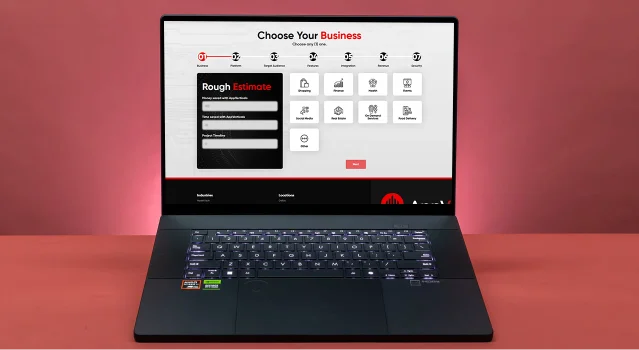
See what it might cost to bring your app idea to life. Our calculator gives you a quick, simple estimate based on what you need.


 verified expert
Senior Content Writer — Mobile & Software Development, AI
Zainab helps tech brands sound more human. She takes app ideas, features, and updates and turns them into content people actually want to read. Whether it’s for a launch, a campaign, or just making things...
See Full Bio11 minutes read
That stat explains why the react native vs swift debate still matters: this is not just a developer preference question anymore. It is a business decision about speed, platform strategy, user experience, and what kind of product you are actually building.
If you are a CTO, startup founder, or product owner, the right answer is rarely “always React Native” or “always Swift.”
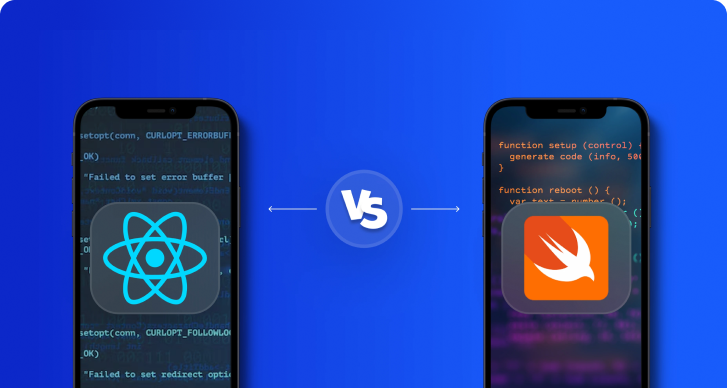
The better question is simpler: what should your team optimize for right now, cross-platform app development leverage or the deepest possible iOS-native experience? This guide answers all your queries and doubts in great detail using real-world examples so you can make an informed decision in the end.
| Feature | React Native (by Meta) | Swift (by Apple) |
|---|---|---|
| Platforms | iOS, Android, and Web | Apple ecosystem exclusively |
| Language | JavaScript/TypeScript | Swift |
| Performance | Near-native; can lag in high-intensity tasks | True native; superior for graphics and CPU-intensive apps |
| Development Speed | Faster for dual-platform (single codebase) | High for iOS-only using SwiftUI |
| UI Framework | React Native Elements / Expo | SwiftUI / UIKit |
| Native API Access | Requires “bridges” or native modules | Direct, day-one access to all Apple APIs |
| Cost & Team Composition | Lower initial cost; smaller team for cross-platform projects | Higher initial cost; larger team for iOS-only development |
| Time to Market | Faster (single codebase for iOS and Android) | Slower (separate development for iOS) |
| Long-Term Maintenance | Higher (cross-platform technical debt) | Lower (native development for iOS) |
At the highest level, React Native is a cross-platform framework, while Swift is Apple’s native programming language for iOS and the wider Apple ecosystem. That one native vs cross-platform distinction shapes everything else: staffing, release speed, code reuse, performance ceilings, debugging complexity, and how tightly your app can integrate with Apple-specific capabilities.
In practical terms, react native vs swift for iOS app development usually comes down to this:
That is why all our comparisons like ios swift vs react native, react native vs ios swift, and swift vs react native as an expert mobile app development company, point back to the same core tradeoff: breadth versus depth.
Make an informed decision for your app’s future! Book a mobile app consultation to ensure you pick the right stack before committing to a costly mistake.
React Native works better when the product goal is faster multi-platform delivery with acceptable native feel, not maximum iOS specialization.
It is especially strong when your team already has React or JavaScript expertise, your product roadmap includes both iOS and Android, and the app logic is more business-flow-heavy than hardware-intensive.
That is also how major engineering teams evaluate it.
A practical example is Shop Local Delmarva. AppVerticals built it as a community-commerce platform spanning mobile, web, backend integrations, and admin tooling. The product needed smooth syncing between mobile and web, fast business onboarding, admin control, instant listing updates, and scalable discovery. React Native made sense because the problem was not “how do we squeeze the last ounce of iOS-only animation performance out of this product?” It was “how do we launch and scale a reliable, accessible multi-surface platform fast?”
The outcomes back that up. The platform handled 1,500+ listings, supported 15,000+ users accessing listings, delivered sub-second average search results, achieved 97% crash-free sessions, and improved discovery time by 45%. It also enabled 80% business self-onboarding, which is a huge operational win for a product built around directory management and ongoing listing updates. For that kind of product, React Native worked better because speed of delivery, synchronization, and maintainability mattered more than native iOS exclusivity.
So if someone asks, “Is React Native still relevant in 2026?” the serious answer is yes, especially for mature product teams that want shared mobile foundations without giving up production-grade reliability.
React Native is usually the better fit when:
Swift works better when the product needs to feel unmistakably native to iOS and when the app depends on deep Apple-platform integration, tight performance control, or complex real-time experiences.
This is where the swift vs react native decision becomes less about developer comfort and more about product stakes.
Those claims matter because they map directly to what native iOS teams usually care about most: performance, safety, predictability, and long-term alignment with Apple’s tooling direction.
A useful real-world example is Glee App. AppVerticals used Swift for iOS alongside Angular, Node.js, Firebase, Stripe, and AWS components. That choice makes sense when you look at the product: event discovery, ticketing, service booking, secure transactions, and real-time chat/social features. Those are interaction-sensitive flows where native responsiveness and tighter control over the iOS experience can justify the native path.
The product results were meaningful: 1,000+ events discovered, 10,000+ tickets booked, 500+ service bookings, and 100+ real-time engagement interactions. In this case, Swift likely worked better because the iOS app was not just a front-end wrapper for shared business logic. It was part of a high-trust, experience-led transaction flow where speed, interaction quality, and platform polish carry real commercial weight.
There is another overlooked factor here. The React Native team itself says its top priority is to match the expectations people have for each platform and to value native look-and-feel over forced cross-platform sameness. That is a strong endorsement of platform-specific UX standards, and it indirectly supports the case for Swift when your app absolutely cannot compromise on iOS fidelity.
Swift is usually the better fit when:
If your app requires premium UX, secure transactions, or complex native interactions, book an iOS product strategy call to ensure the right approach for your project.
Here is the practical react native vs swift performance view:
| Area | React Native | Swift |
|---|---|---|
| Runtime performance | Strong for most business apps; can be excellent with good architecture | Highest ceiling for iOS-native performance |
| UI smoothness | Very good, but more variable in complex edge cases | Most consistent for advanced, animation-heavy, or hardware-tied flows |
| Native APIs | Accessible, but often via bridges/modules | Direct and immediate access |
| Development speed | Faster for dual-platform delivery | Faster only when the roadmap is iOS-only |
| Debugging | Can be more layered due to JS/native interplay | More straightforward in Apple tooling |
| Code reuse | Major advantage across iOS and Android | Limited to Apple ecosystem |
This matches what experienced teams report. So when someone does a react native vs swift performance comparison, the honest answer is not that React Native is “slow.” It is that Swift has the higher performance ceiling and the cleaner native path, while React Native is often fast enough for a large class of commercial products.
The right choice depends on whether your bottleneck is runtime constraints or product delivery constraints.
A lot of teams now think they are evaluating react native vs swift, when the real decision is closer to SwiftUI vs react native. That matters because SwiftUI has made native Apple development more approachable and faster than older UIKit-heavy workflows.
Apple describes SwiftUI as a way to build sophisticated UIs with declarative code, real-time previews, and native performance across Apple platforms.
So, react native vs SwiftUI comes down to platform scope. If your roadmap is Apple-only, SwiftUI is often the more direct and more future-aligned choice. If your roadmap is iOS plus Android, React Native still holds the broader business advantage. In other words, SwiftUI improves the native case; it does not erase the cross-platform case.
From a business perspective, React Native usually wins on initial delivery efficiency when the plan includes both mobile platforms. You can consolidate teams, reduce duplicated effort, and share a large percentage of business logic.
That is why the mobile app development cost analysis in a react native vs native swift conversation often favors React Native for startups, multi-platform products, and MVP development.
Swift, however, can be cheaper in the long run when your app is deeply iOS-specific and when workarounds in a cross-platform stack would create hidden technical debt. Paying more upfront for native development can be rational if it reduces performance issues, native module maintenance, or platform-specific UX compromises later.
Set up a product planning consultation to explore both cross-platform and iOS-native options before committing to a development path.
Choose React Native if you are shipping a multi-platform product, moving fast, and building features that center on forms, listings, dashboards, marketplaces, subscriptions, or standard social/product workflows. The Shop Local Delmarva case is a strong example: the business needed a connected ecosystem more than a single-platform masterpiece, and React Native served that goal well.
Choose Swift if the app is iOS-first, experience-sensitive, or built around advanced interaction quality, payment trust, or native performance. The Glee App illustrates that logic: event flows, ticketing, bookings, and real-time engagement all benefit from a native iOS implementation when polish and responsiveness matter.
The smartest way to approach react native vs swift is to stop treating it as a framework popularity contest. It is a product strategy decision. If you need speed, reuse, and multi-platform efficiency, React Native is often the stronger bet. If you need maximum iOS performance, native UX fidelity, and tighter platform control, Swift is still the gold standard.
If you want a one-line verdict, here it is: React Native is usually the better business choice for multi-platform efficiency. Swift is usually the better product choice for iOS-native depth.
Book a consultation to analyze the specific needs of your app and get expert advice on the best approach.
verified expert
Zainab helps tech brands sound more human. She takes app ideas, features, and updates and turns them into content people actually want to read. Whether it’s for a launch, a campaign, or just making things clearer, she’s all about simple words put together to form stories that stick.
 We’re AppVerticals
AppVerticals is where innovative startups and Fortune 500s come for transformation.
View About Us Mobile App
Mobile app monetization is no longer experimental; it’s a $1.2 trillion global economy projected for 2026, with consumer spending on apps hitting ~$15...

13 min read
 Mobile App
Got an exciting app idea but not sure how to bring that to life and make it a hit in the super-crowded startup landscape of LA. You’re not alone and p...

15 min read
 Mobile App
Cyber threats in 2025 are no longer rare. They’re constant. Verizon’s Digital Secure app is one example of how consumer tools are adapting, but for bu...

10 min read
Discover how our team can help you transform your ideas into powerful Tech experiences.
AppVerticals © 2026 | All Rights Reserved

Get In Touch.













 ChatGPT
 Perplexity
 Google AI