About Us

About Us
We’re a future-focused tech partner working with some of the world’s top enterprises. At AppVerticals, we design solutions that drive growth and reimagine digital experiences.

Services
Software Development
Mobile App Development
Web Design & Development
Tell us what you're looking for, and we'll tailor a solution based on your business needs.
Talk to Experts
Health Tech

EdTech

Logistics

Real Estate

Ecommerce

Sports

Fintech

Travel

Restaurant

Automotive
HIPAA-compliant digital solutions for hospitals, clinics, and healthtech startups driving better patient outcomes.
What we do:
Scalable learning platforms for schools, universities, and EdTech startups transforming education delivery.
What we do:
Real-time tracking and automation solutions for freight companies, warehouses, and delivery services.
What we do:
PropTech platforms for brokerages, property managers, and real estate marketplaces are streamlining operations.
What we do:
High-converting commerce platforms for D2C brands, retailers, and online marketplaces are driving revenue growth.
What we do:
Fan engagement platforms for sports teams, leagues, and betting operators are creating immersive experiences.
What we do:
PCI-DSS compliant solutions for digital banks, payment platforms, and InsurTech companies, ensuring security.
What we do:
Booking and hospitality solutions for OTAs, hotels, and tourism platforms, enhancing traveler experiences.
What we do:
Online ordering and operations software for restaurants, cloud kitchens, and food delivery platforms.
What we do:
Connected vehicle platforms for automotive OEMs, dealerships, and mobility providers are accelerating innovation.
What we do:
Portfolio

AppVerticals was featured in Inc. 5000 as
America’s Fastest Growing Tech Company
See what it might cost to bring your app idea to life. Our calculator gives you a quick, simple estimate based on what you need.



 verified expert
AI & Data-Driven Content Strategist
Writes stat-driven, expert-backed blogs that simplify complex AI products and forecast what’s next.
See Full Bio12 minutes read
Globally, 88% of organizations use AI automation in at least one function in 2025, up from 78% in 2024 and 55% in 2023. Yet only about one-third have scaled it, highlighting a clear execution gap.
This gap defines the market. In the GCC, 84% have adopted AI in 2025, but just 11% are value realizers, meaning they can link AI to at least 5% of earnings. The real opportunity lies in turning AI automation into measurable profit.
These numbers highlight a critical shift: AI automation is no longer a competitive advantage by itself; execution is.
Enterprise readiness is now less about access to AI and more about scaling capability and system integration.
This signals that AI is moving beyond assistance and into workflow execution roles.
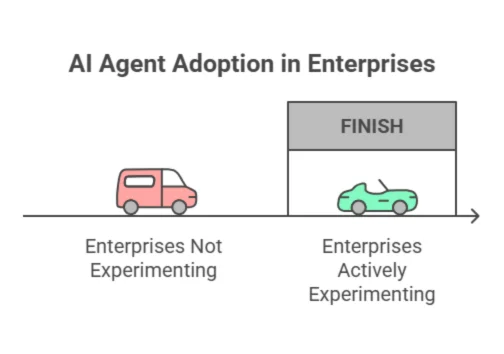
AI automation is driving efficiency, cost reduction, and decision-making improvements across major industries by applying workflow-level intelligence and predictive systems tailored to each sector.
| Industry | AI Automation Use Case |
|---|---|
| Healthcare | Diagnostics, patient workflow automation |
| Finance | Fraud detection, transaction processing |
| Retail | Personalization, sales automation |
| Manufacturing | Predictive maintenance, supply chain automation |
Beyond adoption, the next critical question is whether AI automation is delivering measurable financial returns.
In the GCC, the bar is even higher: only 11% of organizations qualify as ‘value realizers,’ meaning they have adopted AI, scaled it, and can attribute at least 5% of earnings to it.
These numbers are solid and trace back through Stanford HAI’s 2025 AI Index to McKinsey survey data:
| Function | Verified Outcome |
|---|---|
| Service Operations | 49% of respondents using AI in service operations report cost savings; most say savings are <10% |
| Supply Chain Management | 43% report cost savings; most say savings are <10% |
| Software Engineering | 41% report cost savings; most say savings are <10% |
| Marketing and Sales | 71% of respondents using AI in marketing and sales report revenue gains; the most common gain is <5% |
That last clause matters because it keeps the story honest: revenue uplift is real, but mostly incremental so far.
Enterprise data shows that AI automation can deliver measurable value within weeks, not months, when deployed effectively. In real-world deployments:
These outcomes indicate that time-to-value is compressed when AI is applied to high-volume, repeatable workflows.
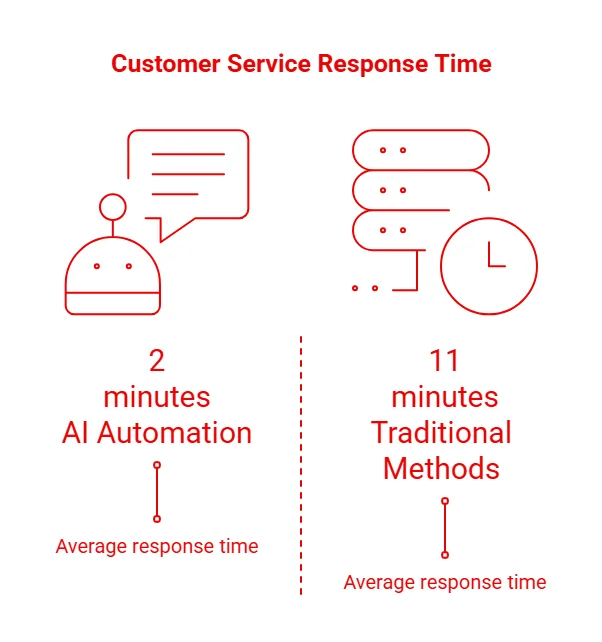
Speed of execution depends on how AI is implemented, not just whether it is adopted. Enterprises that achieve faster results typically:
Deploy narrow, high-impact use cases such as customer service and IT operations to achieve faster, measurable results.
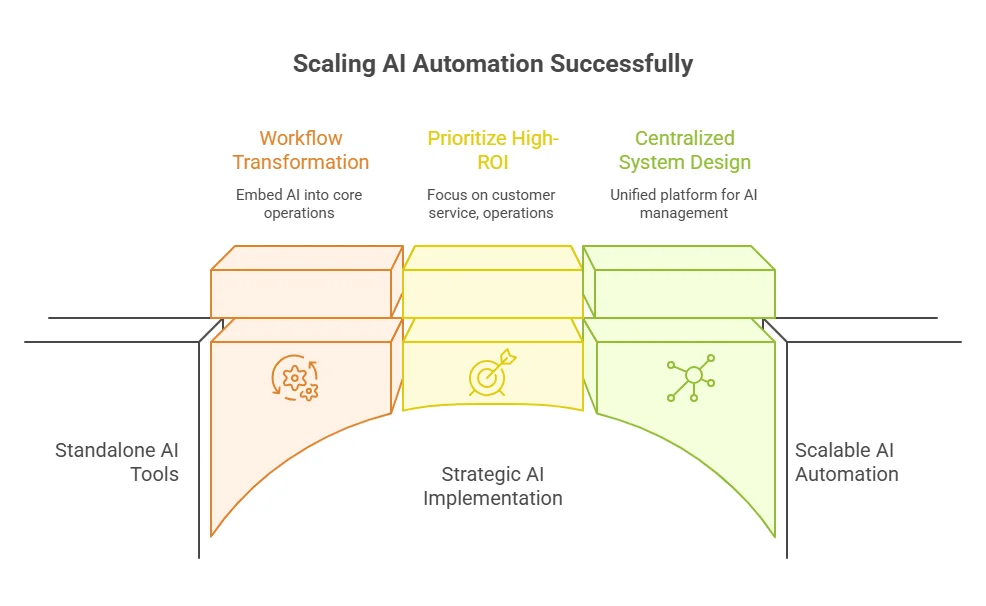
Focus on workflow automation rather than standalone tools to ensure AI is embedded into core business processes.
Prioritize high-volume, repeatable processes to maximize efficiency, reduce costs, and accelerate time-to-value.
Key Pattern: Focused AI implementations outperform broad, unfocused strategies in both speed and measurable ROI
There is no universal percentage for total enterprise automation, but function-level data provides a clear picture of progress.
| Scope | Stronger, Source-Backed Statement |
|---|---|
| Enterprise-wide task exposure | GenAI and related technologies could automate activities that absorb 60–70% of employees’ time; this is task exposure, not full-job automation |
| Customer service (current case) | Klarna said its AI assistant handled two-thirds of customer service chats, reduced resolution time from 11 minutes to under 2 minutes, and was expected to add $40M profit in 2024 |
| Customer service (forward-looking forecast) | Gartner predicts agentic AI could autonomously resolve 80% of common customer service issues by 2029, reducing operating costs by 30% |
| Service operations | 49% of organizations report cost savings from AI in service operations |
| Supply chain | 43% of organizations report cost savings from AI in supply chain management |
| Software engineering | 41% of organizations report cost savings from AI in software engineering |
| Marketing and sales | 71% of organizations report revenue gains from AI in marketing and sales, typically under 5% |
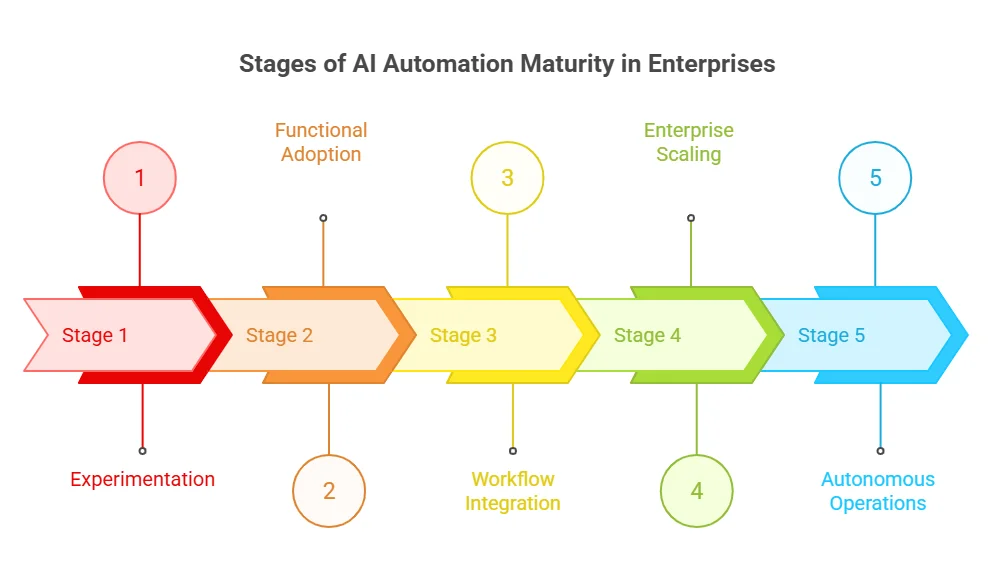
While ROI is still emerging, enterprises are simultaneously facing a shift in where AI costs are actually concentrated
AI automation reduces costs and improves productivity by improving accuracy, reducing processing time, and freeing employees from repetitive work.
| Area | Impact Metric |
|---|---|
| Cost Reduction | 62% higher fraud detection accuracy |
| 85% better collection accuracy | |
| 30–70% faster processing | |
| Productivity | 20% less time on routine tasks |
| ~4 hours saved per employee/week | |
| Efficiency | Reduced interruptions (every ~2 minutes) |
| Automation of repetitive tasks |
How are AI model costs changing enterprise spending?
Enterprises are now prioritizing system-level AI capabilities over model choice:
Organizations with centralized AI models are 2x more likely to move from pilot to production vs decentralized setups
This shift from implementation to system-level design is the key driver of scalable, enterprise-wide AI automation adoption.
At this stage, execution becomes the real differentiator, and this is where experienced partners like AppVerticals come in. Instead of focusing on isolated AI tools, teams that work with full-stack AI partners are able to design end-to-end systems, from data pipelines to workflow orchestration and deployment. This approach significantly increases the chances of moving from pilot to production, especially for enterprises struggling with integration, scalability, and measurable ROI.
Build, scale, and automate workflows with enterprise-grade AI solutions.
Klarna’s AI assistant demonstrates large-scale customer service automation impact.
IBM shows enterprise-wide AI automation across HR, IT, and customer support functions.
DTCC highlights AI automation in developer workflows and engineering operations.
AI automation investment is accelerating rapidly due to enterprise demand for infrastructure and scaling.
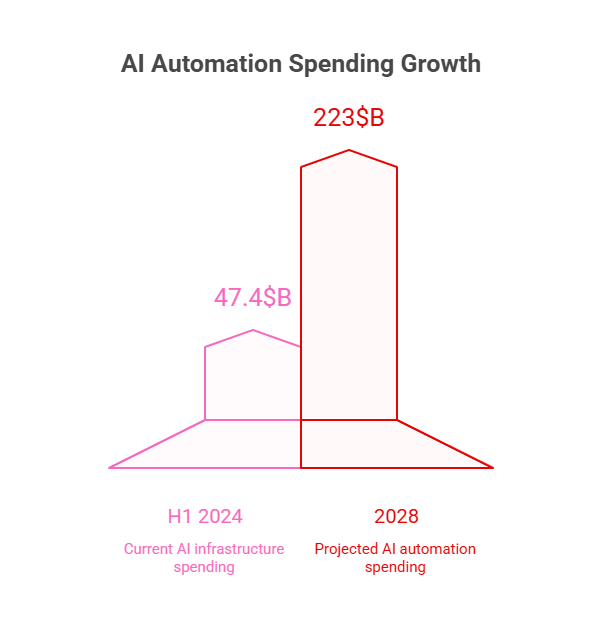
The United States dominates global AI automation spending.
AI automation growth varies by region: Asia-Pacific leads in investment and execution speed, while North America leads in proven enterprise value. Europe remains cautious due to compliance-heavy approaches, whereas the GCC is rapidly scaling with strong executive backing. Across all regions, workforce adoption is already high, ranging from 65% to 83%.
| Region | Investment Signal | Leadership Signal | Adoption / Value Signal |
|---|---|---|---|
| Asia-Pacific | 26% invest $400K–$500K in GenAI | 33% CEO-led AI strategy | 63% GenAI in IT ops; 25% faster time-to-market |
| North America | 19% invest $400K–$500K | 18% CEO-led | 16% report proven AI value |
| Europe | 17% invest $400K–$500K | 8% CEO-led | Slower, compliance-driven adoption |
| Latin America | — | — | 82% workforce AI usage |
| GCC | 89% plan to increase AI budgets | Strong executive alignment | High-growth, fast-follow market |
As deployment scales, governance and risk management are becoming central blockers to enterprise-wide adoption.
AI adoption is increasing, but risk exposure is also rising across organizations.
Security remains one of the biggest blockers to scaling AI automation.
Governance frameworks are still not fully implemented across most organizations.
Enterprises scale AI automation successfully by focusing on workflows, ROI-driven use cases, and centralized system design rather than standalone tools.
Enterprises moving beyond pilots need structured AI development services, scalable architecture, workflow integration, and data readiness to achieve faster deployment and consistent ROI.
The competitive advantage is now defined by:
Winners are not the ones adopting AI first, but the ones operationalizing it fastest.
verified expert
Writes stat-driven, expert-backed blogs that simplify complex AI products and forecast what’s next.
 We’re AppVerticals
AppVerticals is where innovative startups and Fortune 500s come for transformation.
View About Us AI
AI
Think of a workplace where mental wellness isn’t just a checkbox, but a priority. In the latest episode of AppTalk by AppVerticals, Dr. Farah Ahmed, F...

4 min read
 AI
AI
Looking for reliable Janitor AI alternatives? Many users have turned to other platforms after facing issues like server errors and disappearing chats....

17 min read
 AI
AI
Artificial Intelligence is no longer a pilot project; it’s a $2.52 trillion industry in 2026, with Big Tech investing $650 billion and enterprise GenA...

13 min read
Discover how our team can help you transform your ideas into powerful Tech experiences.
AppVerticals © 2026 | All Rights Reserved

Get In Touch.














 ChatGPT
 Perplexity
 Google AI