About Us

About Us
We’re a future-focused tech partner working with some of the world’s top enterprises. At AppVerticals, we design solutions that drive growth and reimagine digital experiences.

Services
Software Development
Mobile App Development
Web Design & Development
Tell us what you're looking for, and we'll tailor a solution based on your business needs.
Talk to Experts
Health Tech

EdTech

Logistics

Real Estate

Ecommerce

Sports

Fintech

Travel

Restaurant

Automotive
HIPAA-compliant digital solutions for hospitals, clinics, and healthtech startups driving better patient outcomes.
What we do:
Scalable learning platforms for schools, universities, and EdTech startups transforming education delivery.
What we do:
Real-time tracking and automation solutions for freight companies, warehouses, and delivery services.
What we do:
PropTech platforms for brokerages, property managers, and real estate marketplaces are streamlining operations.
What we do:
High-converting commerce platforms for D2C brands, retailers, and online marketplaces are driving revenue growth.
What we do:
Fan engagement platforms for sports teams, leagues, and betting operators are creating immersive experiences.
What we do:
PCI-DSS compliant solutions for digital banks, payment platforms, and InsurTech companies, ensuring security.
What we do:
Booking and hospitality solutions for OTAs, hotels, and tourism platforms, enhancing traveler experiences.
What we do:
Online ordering and operations software for restaurants, cloud kitchens, and food delivery platforms.
What we do:
Connected vehicle platforms for automotive OEMs, dealerships, and mobility providers are accelerating innovation.
What we do:
Portfolio
AppVerticals was featured in Inc. 5000 as
America’s Fastest Growing Tech Company
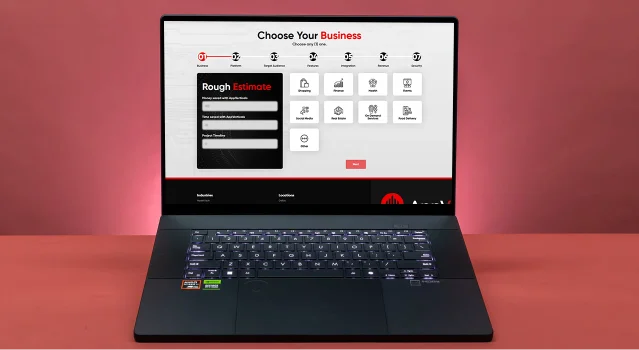
See what it might cost to bring your app idea to life. Our calculator gives you a quick, simple estimate based on what you need.


 verified expert
Technical Writer — Platforms, SaaS & Digital Products
Vareesha writes about platforms and SaaS with a clear, experience-led approach. With 3+ years in technical writing, she translates complex business and technical concepts into structured, actionable content for founders and product teams. Having worked...
See Full Bio15 minutes read
Sitecore implementation costs go far beyond licensing, covering hosting, integrations, and continuous support.
But, organizations often focus only on license fees, overlooking hosting, integrations, and support, which can account for 50%+ of total spend. A comprehensive Sitecore development services approach combining implementation, integrations, and optimization can reduce unexpected costs and accelerate ROI.
See exactly how licensing, integrations, and hosting scale with your number of sites, traffic, and user load.
Estimate Costs Now| Use Case Type | Key Needs | Core Features | Typical Cost (USD) | Factors Influencing Cost | Cost-Efficient Strategies |
|---|---|---|---|---|---|
| Basic / Standard | Single site, standard content, minimal integrations | Core CMS, hosting, content training | $90K–$140K | Integrations, basic personalization, content volume | Use out-of-the-box modules, limit customization, pre-define templates |
| Moderate / Multi-Site | Multiple sites/brands, moderate integrations | Multi-site governance, CRM/ERP integrations, personalization, migration | $140K–$320K | Sites count, integration complexity, content volume | Standardize components, plan integrations early, reuse templates |
| Complex / Enterprise | High traffic, multi-language, multi-brand | Advanced personalization, integrations, QA/staging environments | $300K–$1M+ | Architecture, integrations, compliance, SLA | Use accelerators, run discovery, prioritize integrations, modular rollout |
Sitecore’s pricing goes beyond licensing. Decision-makers need to consider five core cost drivers:
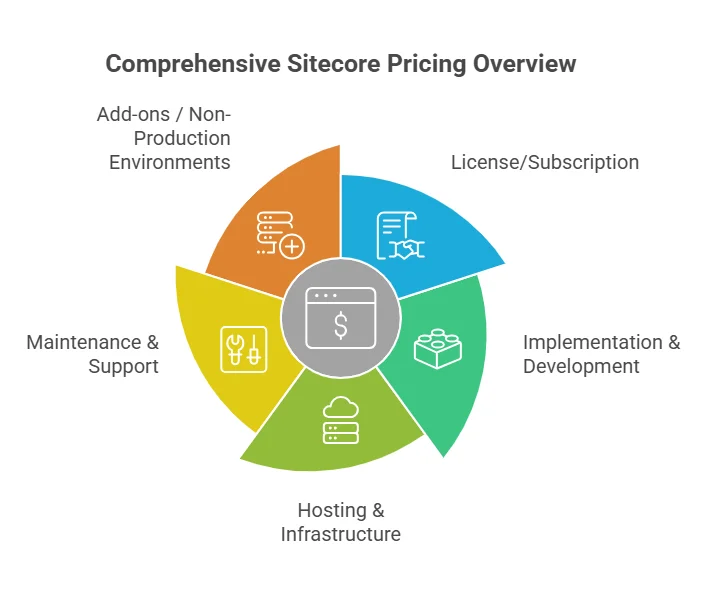
| Cost Component | Typical Range | % Contribution | What Impacts It |
|---|---|---|---|
| Licensing | $60K–$200K | 15–25% | XM Cloud vs XP/XM, users, traffic |
| Implementation | $90K–$300K+ | 35–50% | Integrations, customization, migration |
| Hosting | $12K–$55K | 10–20% | Azure sizing, traffic, environments |
| Maintenance / Support | $25K–$120K | 10–20% | SLA level, monitoring, updates |
| Add-ons / Environments | $15K–$110K+ | 5–15% | Personalization, testing, compliance |
Observations from advising executive teams show that these ranges are most valuable as a budgeting framework, helping CFOs approve investments and CTOs anticipate integration and operational needs.
While cost ranges are widely discussed, implementation complexity is often underestimated. The leading content management systems, like Sitecore, typically require:
Compared to open platforms, implementation effort can be multiple times higher, especially in enterprise environments.
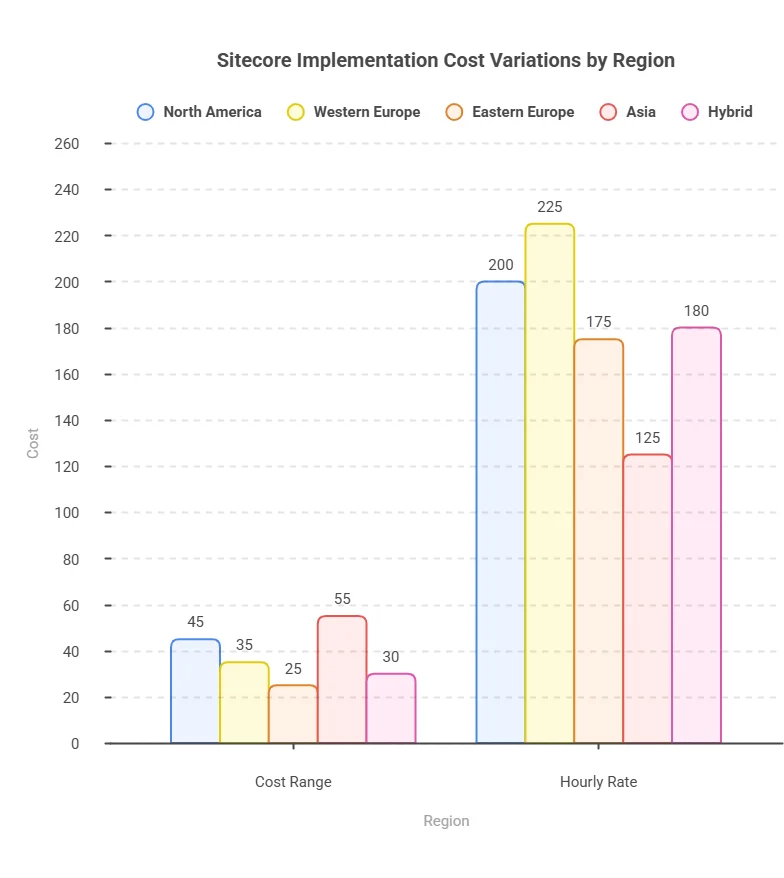
Sitecore implementation costs are not uniform globally. The same project can vary by 30–60%+ depending on region, partner rates, and delivery model.
Key regional differences:
Compliance is one of the most underestimated cost drivers in Sitecore implementations, especially for enterprise and global deployments.
Why compliance increases cost:
Typical cost impact:
The Sitecore license cost varies by deployment model:
Public partner estimates for annual licensing costs:
| Deployment Type | Sitecore License Cost / Year | Notes |
|---|---|---|
| Small / Mid-size | $60K–$80K | XM Cloud, limited modules/traffic |
| Mid-market | $100K–$150K | Moderate integrations and users |
| Enterprise | $150K–$200K | Multiple sites, premium modules, high concurrency |
Several operational and technical factors significantly affect implementation cost. Experience from advising enterprise teams suggests focusing on these seven areas:
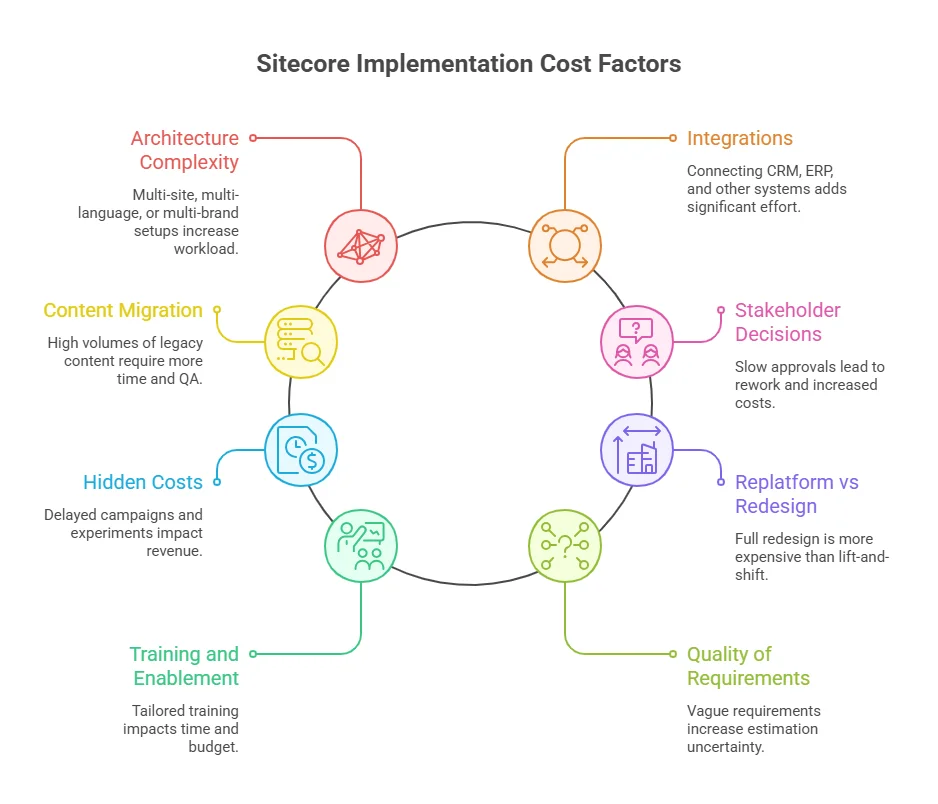
Hosting Sitecore on Azure or cloud typically costs $12K–$55K per year for mid-market deployments, scaling higher for enterprise-grade traffic and multi-site environments.
Hosting Sitecore adds another layer to total cost. Azure PaaS estimates provide illustrative guidance for decision-makers:
| Azure Hosting Size | Monthly Cost Estimate | Notes |
|---|---|---|
| XS | $1,061 | Small traffic, single site |
| S | $1,277 | Moderate traffic |
| M | $1,581 | Mid-market, multiple sites |
| L | $2,318 | High traffic, enterprise-grade |
| XXXL | $4,633 | Very large, high concurrency |
Maintenance and support costs include SLA commitments, software patches, monitoring, and ongoing operational support. Public estimates provide realistic guidance:
Across recent 2026 benchmarks and market analyses, Sitecore is consistently positioned as a high-investment enterprise DXP, with 3-year costs typically landing between:
| Cost Layer | Typical Range | What Drives It |
|---|---|---|
| Licensing / Subscription | $50K – $200K+/year | Traffic, modules, environments |
| Implementation | $300K – $1M+ | Architecture, integrations, customization |
| Hosting & Infrastructure | $20K – $100K+/year | Azure usage, scaling, environments |
| Maintenance & Support | $25K – $120K/year | Ongoing development + SLA |
| Talent Cost | $90 – $155/hour | Specialized Sitecore developers |
Compare mid-market and enterprise deployments to uncover which integrations, personalization modules, and hosting choices drive the most cost.
Analyze TCOUnderstanding the differences between XM Cloud and XP is essential for CTOs planning future architecture and operational budgets:
| Feature | XM Cloud | XP (Traditional) |
|---|---|---|
| Licensing Model | Subscription-based SaaS | Platform-based, customer-managed |
| Infrastructure Footprint | Lower operational overhead | Larger footprint, xConnect + marketing automation |
| Upgrade Cycles | Managed automatically | Requires manual version upgrades |
| Integration Needs | May require third-party analytics/personalization | Many marketing tools are native |
| Typical Cost Implications | Lower OpEx upfront; predictable monthly spend | Higher OpEx + CapEx; heavier maintenance |
When comparing Sitecore vs WordPress VIP and to Adobe Experience Manager (AEM, pricing transparency and deployment complexity stand out:
| Platform | Pricing Model | Starting Price | Notes |
|---|---|---|---|
| Sitecore | Quote-based | N/A | Licensing, implementation, hosting, and support vary widely |
| Adobe AEM | Quote-based | N/A | Similar quote-based approach; enterprise focus |
| WordPress VIP | Published starting point | $25,000/year | Transparent starting price, scaling depends on traffic and features |
| Platform | 3-Year TCO | Decision Snapshot |
|---|---|---|
| Sitecore | $700K–$2M+ | Enterprise-grade: personalization, multi-site, complex workflows |
| Adobe AEM | $750K–$2.2M+ | Similar to Sitecore; strong content marketing & analytics |
| WordPress VIP | $75K–$250K | Mid-market friendly; simpler deployment; less marketing automation |
Vendor-sponsored research and real-world examples suggest that well-executed Sitecore deployments can generate strong ROI:
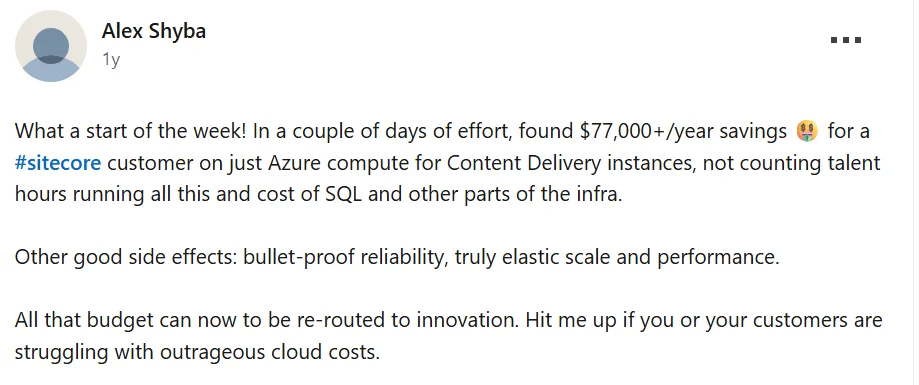
In these scenarios, the platform’s capabilities may outweigh actual requirements, leading to unnecessary cost.
Real-world insights from communities like Reddit provide practical context:
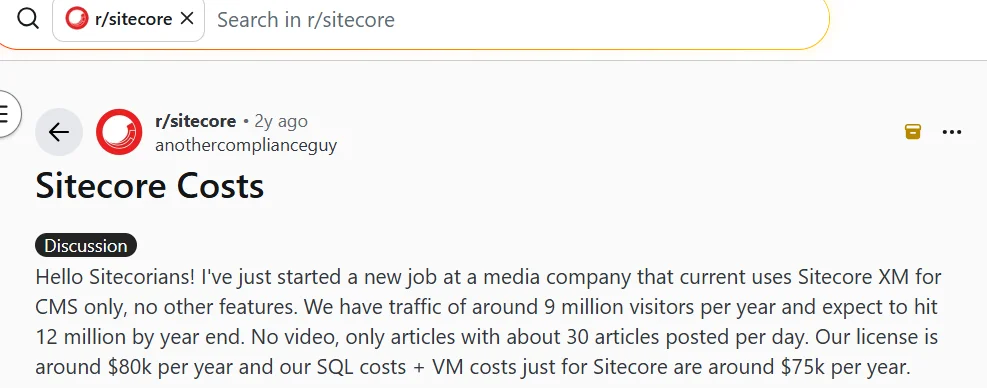
Key lessons from the community:
Implementation timelines are closely tied to scope, integrations, and multi-site complexity:
| Implementation Type | Typical Timeline | Budget Range |
|---|---|---|
| Simple XM Cloud | 3–6 months | $90K–$140K |
| Mid-market | 6–9 months | $140K–$320K |
| Large Enterprise / Upgrade-heavy | 9+ months | $300K+ |
Practical cost-optimization strategies:
Result: Clear planning and disciplined execution lower implementation costs while keeping the platform scalable and maintainable.
Complexity triggers for seeking consulting expertise:
Early involvement of a consulting partner, like AppVerticals, ensures cost efficiency, architectural robustness, and project predictability, without turning the blog into a sales pitch.
Sitecore projects involve multiple cost layers, including licensing, implementation, hosting, support, and optional modules. Understanding these components and planning for integrations, content migration, and multi-site complexity ensures accurate budgeting and avoids surprises.
Real-world examples show that disciplined execution, discovery phases, and standardized workflows can reduce costs and accelerate ROI. Businesses should align expected outcomes with investment size to make informed decisions about deploying Sitecore effectively.
AppVerticals helps you align costs, architecture, and workflows to maximize ROI.
Talk to Experts
verified expert
Vareesha writes about platforms and SaaS with a clear, experience-led approach. With 3+ years in technical writing, she translates complex business and technical concepts into structured, actionable content for founders and product teams. Having worked closely on platform implementation and documentation, she brings real-world insight into how these systems function beyond the surface.
 We’re AppVerticals
AppVerticals is where innovative startups and Fortune 500s come for transformation.
View About Us Platforms
Sitecore is a Digital Experience Platform (DXP) that unifies content management, customer data, marketing automation, and AI-driven personalization in...

19 min read
 Platforms
Choosing between Sitecore and WordPress depends on your organization’s scale, complexity, and digital experience goals. Sitecore provides an enterpris...
14 min read
Discover how our team can help you transform your ideas into powerful Tech experiences.
AppVerticals © 2026 | All Rights Reserved

Get In Touch.











 ChatGPT
 Perplexity
 Google AI