About Us

About Us
We’re a future-focused tech partner working with some of the world’s top enterprises. At AppVerticals, we design solutions that drive growth and reimagine digital experiences.

Services
Software Development
Mobile App Development
Web Design & Development
Tell us what you're looking for, and we'll tailor a solution based on your business needs.
Talk to Experts
Health Tech

EdTech

Logistics

Real Estate

Ecommerce

Sports

Fintech

Travel

Restaurant

Automotive
HIPAA-compliant digital solutions for hospitals, clinics, and healthtech startups driving better patient outcomes.
What we do:
Scalable learning platforms for schools, universities, and EdTech startups transforming education delivery.
What we do:
Real-time tracking and automation solutions for freight companies, warehouses, and delivery services.
What we do:
PropTech platforms for brokerages, property managers, and real estate marketplaces are streamlining operations.
What we do:
High-converting commerce platforms for D2C brands, retailers, and online marketplaces are driving revenue growth.
What we do:
Fan engagement platforms for sports teams, leagues, and betting operators are creating immersive experiences.
What we do:
PCI-DSS compliant solutions for digital banks, payment platforms, and InsurTech companies, ensuring security.
What we do:
Booking and hospitality solutions for OTAs, hotels, and tourism platforms, enhancing traveler experiences.
What we do:
Online ordering and operations software for restaurants, cloud kitchens, and food delivery platforms.
What we do:
Connected vehicle platforms for automotive OEMs, dealerships, and mobility providers are accelerating innovation.
What we do:
Our Odoo implementation brings financial discipline, operational visibility, and process control across departments. From accounting automation to manufacturing workflows, we design ERP systems that reduce operational leakage and provide real-time decision clarity.
We use Sitecore to drive measurable revenue growth through intelligent personalization and behavior-driven content delivery. By aligning marketing automation, data orchestration, and omnichannel engagement, we help brands turn digital touchpoints into retention engines.
We architect AWS environments that stay stable under scale, traffic spikes, and compliance pressure. From secure cloud migrations to CI/CD automation and cost governance, we engineer cloud foundations that protect performance while enabling rapid product evolution.
We implement Dynamics 365 to align systems with actual business operations, bringing clarity, control, and accountability across CRM, ERP, and service functions. From sales to finance, configurations eliminate inefficiencies and enable confident, real-time decisions.
Tell us what you're looking for, and we'll tailor a solution based on your business needs.
Talk to ExpertsPortfolio
AppVerticals was featured in Inc. 5000 as
America’s Fastest Growing Tech Company
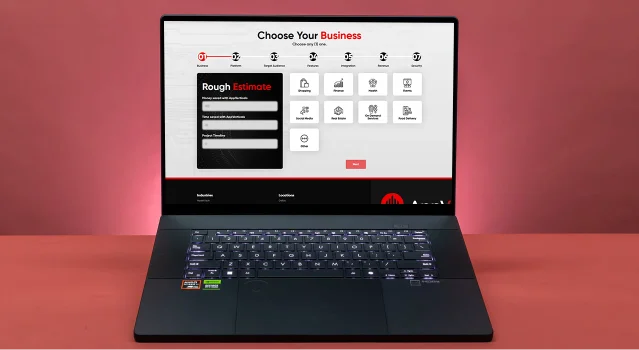
See what it might cost to bring your app idea to life. Our calculator gives you a quick, simple estimate based on what you need.


 verified expert
Senior Content Writer — Mobile & Software Development, AI
Zainab helps tech brands sound more human. She takes app ideas, features, and updates and turns them into content people actually want to read. Whether it’s for a launch, a campaign, or just making things...
See Full Bio30 minutes read
That range exists because Odoo implementation isn’t a software purchase; it’s an operational transformation project. Data migration, process re-engineering, internal resource allocation, and organizational change routinely cost more than the software licenses themselves. Most finance teams only realize this after they begin working with a certified Odoo development company.
Industry data reinforces this reality. According to Panorama Consulting Group’s 2023 ERP Report, the median ERP implementation cost is $625,000, and only slightly more than half of organizations stayed within their original budget—most often because internal staffing needs and execution effort were underestimated.
That’s the right lens for evaluating Odoo implementation cost as well. Licensing is rarely the budget problem. Execution is. In practice, most Odoo projects are scoped around time and delivery resources, typically ranging from $8,000–$12,000 per month per implementation resource, depending on customization depth and integration complexity.
This guide breaks down where capital actually gets deployed, why vendor quotes can vary by 300%+, and which cost categories most often blindside finance teams during rollout.
This guide shows that Odoo implementation cost is driven far more by execution than by software licenses.
Note: These ranges reflect implementation effort and complexity. Odoo implementations are not priced per user but based on modules, customization, integrations, and delivery duration. Final pricing is confirmed after discovery, once scope, customization depth, and delivery duration are validated.
Work with an Odoo development company that models real costs across data migration, integrations, customization, and long-term support, not just licenses.
Talk to Odoo SpecialistsThe cost of Odoo implementation in 2026 ranges from $15,000 for straightforward deployments to over $200,000 for complex multi-entity enterprise rollouts.
But these numbers obscure the real financial decision: you’re not buying software, you’re funding a capital project that restructures your chart of accounts, inventory logic, procurement workflows, and reporting architecture.
Here’s what drives the range:
Here’s a directional range by company size (implementation + rollout services, not just licenses):
| Company Profile | Users | Modules | Year-1 Total | Primary Cost Drivers |
|---|---|---|---|---|
| Small Business | 5–20* | 3–5 (Accounting, CRM, Inventory) | $15,000–$40,000 | Configuration, basic training, minimal customization |
| Mid-Market | 20–75* | 6–10 (Sales, Purchase, Manufacturing) | $50,000–$100,000 | Data migration, integrations, process redesign |
| Enterprise | 100+* | 10+ (Multi-company, MRP, PLM, custom modules) | $120,000–$250,000+ | Custom development, multi-site rollout, change management, integrations |
Critical insight: The Odoo implementation cost small business category ($15K–$40K) assumes the business has clean data, simple processes, and accepts out-of-the-box functionality. The moment you say “we need custom reports” or “our billing is unique,” costs escalate rapidly because you’re now funding software development, not software deployment.
*User counts are used here as a proxy for business complexity and scope. AppVerticals does not price Odoo implementation on a per-user basis; projects are scoped and quoted based on modules, integrations, data, customization effort, and delivery duration.
Odoo implementation process cost per module isn’t linear, because modules share data, workflows, and configuration dependencies. As a planning range, core modules (Accounting, CRM, Sales, Purchase) are usually part of a $15K–$40K baseline for small deployments.
Specialized modules like MRP/Manufacturing, PLM, Quality, and multi-warehouse typically push projects into $80K–$150K+ because they require deeper process design, testing, and often integrations.
The safest way to model “per module” is: each additional operational module increases scope, data rules, training, and UAT load, not just configuration hours.
Cost variability in Odoo ERP implementation comes from five compounding factors:
Godlan’s manufacturing ERP commentary cites scope creep as a recurring driver of overruns, especially when planning and requirements are weak.
Data migration for Odoo typically lands at $5K–$15K when you migrate a clean subset (masters + 1–3 years of transactions). It climbs to $30K–$70K when data lives across multiple systems, SKU/BOM structures are inconsistent, or inventory/accounting history must reconcile to the penny.
The real cost driver isn’t “moving data”; it’s remediation, validation, and reconciliation, so reports and financials match what leadership expects on day one.
Most Odoo integrations fall in the $8K–$25K range when APIs are mature, and data mapping is straightforward. Costs increase when middleware, custom transformations, or compliance testing is required; EDI is the usual multiplier. Ongoing maintenance also matters: plan roughly 10–15% of build cost per year for API changes, platform updates, and break/fix.
Light customization (new fields, layouts, automations using Odoo Studio or configuration) often fits into $2K–$8K. Custom Python modules usually start around $15K and can exceed $50K when they change core logic, add workflows, or require heavy testing and upgrade-proofing. Every customization becomes a long-term maintenance and upgrade cost, not just a one-time build.
Our Odoo consultants map your users, modules, data, and integrations to a realistic implementation budget.
Get My Cost RangeOdoo ERP pricing discussions often fixate on per-user license fees, but that represents only 20–30% of your 3-year cash outlay. The TCO framework forces visibility into the full capital structure:
TCO = Implementation + Licenses + Hosting + Support + Internal Labor + Opportunity Cost
For a 50-user company, that typically means:
| Cost Category | Year 1 | Year 2 | Year 3 | 3-Year Total | % of TCO |
|---|---|---|---|---|---|
| Implementation Services | $65,000 | $0 | $0 | $65,000 | 32% |
| Software Licenses (Enterprise) | $20,000 | $20,000 | $20,000 | $60,000 | 30% |
| Hosting & Infrastructure | $3,600 | $3,600 | $3,600 | $10,800 | 5% |
| Support & Enhancements | $12,000 | $15,000 | $15,000 | $42,000 | 21% |
| Internal Labor (Allocated) | $15,000 | $5,000 | $5,000 | $25,000 | 12% |
| Total 3-Year TCO | $115,600 | $43,600 | $43,600 | $202,800 | 100% |
The Odoo implementation cost one-time outlay breaks into five capital deployment categories:
| Phase | Cost Range | What You’re Buying | Failure Risks |
|---|---|---|---|
| Discovery & Gap Analysis | $5,000 – $18,000 | Process mapping, requirements documentation, gap analysis | Inadequate discovery leads to rework costing 5× more later |
| Configuration & Data Migration | $10,000 – $35,000 | Module setup, field mapping, ETL processes, data validation | Bad data creates permanent reporting and inventory issues |
| Customization & Integration | $15,000 – $80,000+ | Custom modules, API development, third-party connectors | Over-customization creates long-term maintenance and upgrade risk |
| Training & Change Management | $6,000 – $25,000 | Functional training, documentation, process coaching | Under-trained users create workarounds and adoption failure |
| Testing & Go-Live Support | $8,000 – $30,000 | UAT, performance testing, go-live war room, stabilization | Insufficient testing causes production failures at launch |
Key Insight: Companies with robust change management programs see better outcomes. Research from Harvard Business Review Analytic Services shows that 89% of executives consider driving adoption of employee-facing software essential (HBR Analytic Services), yet only 30% rate their organizations as highly effective at software adoption.
In practice, most partners price ongoing Odoo maintenance at roughly 6–7% of total implementation value annually, scaling with customization and integrations.
After go-live, your Odoo ERP pricing annual spend stabilizes around:
Annual Recurring Costs = Licenses + Hosting + Support + Continuous Improvement
For a 50-user deployment:
Total Annual Run Rate: $42,000–$82,000/year
The hidden cost here is internal operational overhead: someone must manage user permissions, run month-end close, troubleshoot integration failures, and prioritize enhancement requests. Budget 0.5–1.0 FTE for ongoing Odoo administration.
Most organizations should plan $1K–$2.5K per month ($12K–$30K per year) for bug fixes, small enhancements, and user support, depending on integrations and customization. Without a support budget, companies end up paying emergency rates when month-end issues, workflows, or integrations break under real usage.
Yes, hosting depends on the deployment model. For most mid-market systems, budget $3.6K–$9.6K per year for Odoo.sh or cloud infrastructure, depending on usage, storage, and environments. Self-hosting may look cheaper, but you then own backups, patching, monitoring, and security. For finance teams, the real question is who carries uptime and risk.
These cost categories rarely appear in vendor proposals but consistently emerge during rollout:
As one COO at a $45M distribution company told us: “We budgeted $70K for Odoo. We spent $115K because we didn’t account for our own time, and that time was when we learned our processes were broken.”
Our Odoo development company helps enterprises identify hidden costs before contracts are signed, including data cleanup, integrations, and internal workload.
Review My Odoo PlanUnderstanding Odoo pricing 2026 requires distinguishing between software licensing and total deployment cost. Odoo’s pricing model offers three paths, each with vastly different TCO implications.
According to Odoo’s official pricing page, Odoo Enterprise pricing per user 2026 is structured as follows:
| Edition | License Cost | Hosting | Support | Best For | Typical 3-Year TCO (50 Users) |
|---|---|---|---|---|---|
| Community | $0 | Self-hosted ($300–$1,000/month) | Third-party or internal | Technical teams with in-house developers | $90K – $170K |
| Enterprise Standard | ~$31/user/month ($18,660/year) | Odoo Online | Email & ticket | Single-entity, low-customization deployments | $150K – $230K |
| Enterprise Custom | ~$61/user/month ($36,600/year) | Odoo.sh or on-prem | Enhanced + SLA | Multi-entity, integrations, and custom workflows | $220K – $350K+ |
The counterintuitive reality: Community Edition often costs more to deploy because you’re funding all customization and support out of pocket. Enterprise licenses include Odoo Studio (low-code customization), automatic upgrades, and technical support, capabilities that save $18K–$45K in Year 1 alone.
“Free” Community Edition only means no license fee. It does not mean free ownership.
A typical Community deployment requires:
Because there is no Odoo support, no Studio, and no managed upgrades, every problem becomes a billable engineering task. Over three years, Community almost always costs more than Enterprise Standard for non-technical organizations.
Community only makes sense when:
Odoo Enterprise is sold in two functional tiers.
Includes:
Best for:
Includes everything in Standard plus:
This tier is required for:
Important:
Most mid-market and enterprise Odoo implementations fall into Enterprise Custom, even if sales quotes start at “Standard” pricing.
Decision logic for finance leaders:
Choose Community if:
Choose Enterprise Standard if:
Choose Enterprise Custom if:
Capital Allocation Rule of Thumb: Many mid-market ERP business cases model Year-1 spend as a low single-digit % of revenue, depending on operational complexity. A $40M company should plan $400K–$1.2M for a full-scale ERP transformation, including licenses, implementation, and first-year support.
The Odoo implementation cost structure follows a predictable five-phase capital deployment model. Understanding each phase helps prevent the ‘we’re 80% done but 200% over budget’ trap, a pattern that frequently turns ERP programs into over-budget, delayed projects. (Standish Group CHAOS Report).
Duration: 2–4 weeks
Deliverables: The functional consultant makes a requirements document, process maps, gap analysis, and project charter
This phase determines whether you spend $50K or $200K total. Poor discovery leads to scope creep, rework, and failed go-lives.
What you’re buying:
Cost drivers:
Where money gets burned: Skipping process re-engineering. If you automate broken processes, you’ve just built an expensive broken system.
Discovery is normally a paid phase because it defines scope, migration rules, integration architecture, and risk controls. Your $5K–$18K range reflects what it takes to produce a real project blueprint. When discovery is “free,” the cost is usually recovered later through change orders or inflated delivery hours.
This aligns with how most Odoo partners scope discovery: a paid gap analysis phase led by a functional consultant, typically ranging from $10K–$20K for mid-to-large implementations.
Duration: 3–6 weeks
Deliverables: Configured Odoo instance, chart of accounts, product catalog, and user roles
What you’re buying:
Cost drivers:
Configuration vs. Customization Decision Point: Out-of-the-box Odoo handles 80% of standard business processes. The temptation to customize “just this one thing” is where costs explode. Each customization adds technical debt that compounds during upgrades.
Duration: 4–10 weeks
Deliverables: Custom modules, third-party integrations, automated workflows
This is the highest-cost, highest-risk phase, accounting for about 90% of the total project cost. Odoo implementation cost variability stems primarily from customization scope.
What you’re buying:
Cost drivers:
Real-world example: A $30M medical device distributor needed EDI integration with 3 hospital systems. Initial quote: $25,000. Final cost: $68,000 because each hospital used different EDI standards, required separate testing environments, and had compliance documentation requirements not scoped upfront.
Risk mitigation: Allocate 30% contingency budget for customization phases. Customization always takes longer than estimated.
For projects with integrations and customization, finance teams should plan 25–30% contingency to cover data cleanup, scope clarification, and UAT discoveries. Zero contingency almost always turns into unplanned budget later. Disciplined, mostly out-of-the-box deployments can run lower, but never zero.
Duration: 2–4 weeks
Deliverables: Trained users, documentation, and change champions
What you’re buying:
Cost drivers:
The hidden ROI: Teams that fund training and super-user coverage consistently see faster adoption and fewer post-go-live tickets.
Common mistake: Training too early. Users forget. Train within 2 weeks of go-live for maximum retention.
Duration: 3–6 weeks
Deliverables: UAT sign-off, cutover plan, go-live support, stabilization
What you’re buying:
Cost drivers:
Risk profile: Many ERP failures occur during or shortly after go-live due to inadequate testing and premature cutover.
Go-live decision criteria:
Stabilization reality: Budget 2–4 weeks of intensive support post-go-live. Users will discover edge cases, data issues will surface, and integrations will fail under production load. This is normal. The question is whether you budgeted for it.
These scenarios reflect the actual cost of Odoo implementation projects, with costs and timelines based on engagements across manufacturing, distribution, and professional services sectors.
Profile: Regional e-commerce retailer, 15 employees, $3M annual revenue
Modules Implemented: Accounting, Sales, CRM, Inventory, eCommerce (Shopify integration)
Cost Breakdown:
Timeline: 10 weeks from kickoff to go-live
Key decisions that kept costs low:
CFO insight: “We almost customized our sales commission logic. That would have added $12K and 6 weeks. Instead, we changed our commission policy to match Odoo’s standard calculation. That policy change took 2 hours and saved us $12,000.”
Profile: Contract manufacturer, 50 employees, $28M annual revenue
Modules Implemented: Accounting, Inventory, Manufacturing (MRP), Purchase, Quality, PLM
Cost Breakdown:
Timeline: 16 weeks from kickoff to go-live
What drove costs:
COO insight: “The $14K we spent on custom BOM logic paid for itself in 4 months through reduced material waste. But the $8,500 we spent on custom quality workflows? In hindsight, we should have changed our quality process to match the Odoo standard. That customization creates a maintenance burden forever.”
Profile: Multi-entity healthcare distributor, 180 employees, $95M annual revenue
Modules Implemented: Accounting (multi-company), CRM, Sales, Purchase, Inventory (multi-warehouse), Rental, Field Service
Cost Breakdown:
Timeline: 28 weeks from kickoff to go-live
What drove costs:
CFO insight: “We initially budgeted $140K based on vendor estimates. We hit $225K because we underestimated three things: data cleanup, EDI complexity, and internal labor during testing. Our finance team spent 400 hours validating data migration, that is $60K in loaded labor we didn’t budget. Next time, we’d allocate 40% more for data and integration, 20% less for software and configuration.”
Common pattern across all scenarios: Customization and integration drive 60–70% of cost variability. Companies that constrain customization to <20% of the project scope finish on time and on budget significantly more often than those exceeding 30% customization.
“Is Odoo cheaper?” is the wrong question. The right question: “For our operational complexity and financial constraints, which ERP delivers the best risk-adjusted return?”
Here’s a quick overview of odoo vs sap to help you make an informed decision:
| Factor | SAP Business One | Odoo Enterprise (Standard to Custom) | Cost Advantage |
|---|---|---|---|
| Licensing (50 users) | $55,000 – $85,000 / year | $18,660 – $36,600 / year | Odoo: 50–60% lower |
| Implementation | $120,000 – $250,000 | $60,000 – $120,000 | Odoo: 40–50% lower |
| Customization Complexity | High (ABAP, Crystal Reports) | Medium (Python, JavaScript) | Odoo: easier to find developers |
| Hosting | On-premise or certified hosts | Odoo.sh or self-host | Odoo: more flexibility |
| 3-Year TCO (50 users) | $285,000 – $505,000 | $200,000 – $320,000 | Odoo: 45–55% lower |
When SAP makes sense: You’re a $500M+ manufacturing operation with complex global statutory reporting, multi-currency consolidation, and an existing SAP ecosystem (SAP already deployed elsewhere in the parent company).
When Odoo makes sense: You’re a $10M–$100M company prioritizing speed to value, operational agility, and lower total cost of ownership over brand-name ERP legacy.
According to a Nucleus Research report (Nucleus Research ERP Study), SMB companies switching from SAP Business One to Odoo reported 48% lower annual ERP costs while maintaining equivalent functionality for core financial and operational processes.
| Factor | Dynamics 365 Business Central | Odoo Enterprise (Standard to Custom) | Cost Advantage |
|---|---|---|---|
| Licensing (50 users) | $42,000 – $72,000 / year | $18,660 – $36,600 / year | Odoo: 35–55% lower |
| Implementation | $80,000 – $180,000 | $60,000 – $120,000 | Odoo: 20–35% lower |
| Microsoft Ecosystem Integration | Native (Office 365, Power BI, Azure) | Requires connectors | Dynamics: tighter integration |
| Customization | Power Apps, AL language | Python, Odoo Studio | Comparable complexity |
| 3-Year TCO (50 users) | $206,000 – $396,000 | $200,000 – $320,000 | Odoo: 25–40% lower |
When Dynamics 365 makes sense: You’re heavily invested in the Microsoft ecosystem (Azure, Office 365, Power Platform) and need seamless integration across productivity and business apps.
When Odoo makes sense: You’re platform-agnostic, prioritize open-source flexibility, or need deeper manufacturing/PLM capabilities that Dynamics requires third-party ISVs to deliver.
Traditional ERP vendors (SAP, Oracle, Microsoft) monetize through:
Odoo’s open-source model changes the equation:
No vendor lock-in: You can switch implementation partners mid-project without renegotiating licenses. This creates competitive pricing pressure on service delivery.
While custom modules are typically maintained by the implementation partner, Odoo’s open-source architecture ensures long-term access, extensibility, and portability of your system.
Community innovation: 40,000+ third-party modules exist in the Odoo App Store. Many common requirements (EDI, shipping integrations, advanced reporting) have pre-built solutions costing $0–$500 vs. $15,000–$40,000 for custom development.
Transparent pricing: Odoo’s per-user pricing is published. SAP and Oracle pricing require NDA’d negotiations and complex licensing audits.
Lower switching costs: If Odoo doesn’t fit after 2 years, your data export is straightforward (PostgreSQL database, standard formats). Switching from SAP typically requires significant data extraction, migration, and re-implementation effort, often costing six figures for mid-market organizations.
Total economic impact: Forrester’s Total Economic Impact studies consistently show that mid-market organizations selecting modern, open-architecture ERP platforms achieve lower implementation costs, faster time-to-value, and stronger long-term ROI than those deploying Tier-1 ERP stacks
But open-source introduces risk: You must select implementation partners carefully. Poor partner selection negates cost advantages through rework and project failure.
These strategies reflect patterns seen across hundreds of Odoo implementations in manufacturing, distribution, professional services, and healthcare.
1. Conduct Ruthless Process Simplification Before Configuration
The #1 cost driver is automating complexity. Before you configure Odoo to match your current workflows, ask: “Why do we do it this way?”
Action: Document current processes, then challenge every approval step, every custom field, every exception workflow. Eliminating one approval layer can save $5,000–$15,000 in customization and ongoing maintenance.
ROI example: A $40M distributor eliminated 3 approval steps in their purchase order process, reducing PO cycle time from 4 days to 6 hours and saving $22,000 in custom workflow development.
2. Adopt the 80/20 Rule: Accept Standard Functionality
If Odoo’s out-of-the-box logic handles 80% of your requirements, accept it. Customizing the remaining 20% often costs more than the operational friction of changing your process.
Decision framework:
Cost avoidance: Companies that tightly constrain customization consistently spend significantly less and deliver faster than those that allow scope to exceed core business needs.
3. Build a Full-Time Internal Project Team
The most underestimated cost reduction lever: dedicating internal resources. Companies that assign a full-time project manager and functional SMEs from each department spend 30–40% less on implementation partners because they provide:
Budget allocation: Expect 800–1,500 hours of internal labor during implementation. For a 6-month project, that’s 2–3 FTEs. Budget $80K–$150K in loaded internal labor costs.
4. Select Implementation Partners Based on Industry Expertise, Not Price
Hourly rates range from $40/hour (offshore) to $250/hour (US-based specialists). But the cheapest partner is rarely the least expensive project.
Partner evaluation criteria:
Real cost comparison:
Net outcome: The “expensive” partner cost 7% less and delivered 40% faster.
5. Phase Your Rollout: Start Small, Prove Value, Then Scale
Instead of implementing 12 modules across 4 locations simultaneously, implement 4 modules at 1 location, stabilize, then roll out.
Phased approach benefits:
Cost impact: Phased rollouts are widely recommended in ERP risk management because they limit blast radius and allow early learning before full-scale deployment.
6. Invest Heavily in User Training (Not Just Software Training)
Budget 12–15% of the total project cost for training. Most companies budget <8%.
Training approach:
ROI: Companies allocating >12% of budget to training achieve:
7. Establish a Realistic Support & Enhancement Budget
After go-live, budget $1,500–$3,000/month for ongoing support. This covers:
Common mistake: Assuming the implementation partner will provide free support post-go-live. They won’t. Either negotiate a support retainer or budget $30K–$50K/year for ad-hoc support billing.
Long-term cost control: Establish an internal Odoo administrator (0.5–1.0 FTE) who handles routine changes, user provisioning, and integration monitoring. This reduces reliance on external consultants by 60–70%.
Odoo implementation cost is not a software purchasing decision; it’s a capital investment in operational transformation. The companies that achieve ROI treat it as such: with rigorous business case development, disciplined scope management, allocated internal resources, and realistic risk assessment.
The core insight: You’re not buying Odoo licenses for $31/user/month. You’re funding a 4–18 month project to redesign how your company operates.
Most rollouts land in the 8–32 week band; 12–18 months typically show up when the program includes multi-site sequencing, heavy integrations, or deep process redesign.
That project will cost:
For finance teams building business cases, use this framework:
Year 1 Cash Outlay:
Years 2-3 Annual Run Rate:
Total 3-Year TCO Formula:
TCO = Implementation + (Annual Licenses × 3) + (Annual Support × 3) + (Hosting × 3) + Internal Labor + Upgrades
The variables that drive cost:
The question isn’t whether Odoo is affordable. The question is whether your organization has the operational maturity and financial discipline to execute ERP transformation successfully.
If you’re a CFO, CTO, or COO evaluating Odoo:
The difference between a $65K successful Odoo implementation and a $180K failed one often comes down to execution discipline: realistic scoping, dedicated internal resources, appropriate partner selection, and comprehensive change management.
In most cases, the cost difference comes down to execution duration and customization scope, not software licensing or user count.
When evaluating partners, look for firms that demonstrate financial literacy—those who speak your language of TCO, payback periods, and operational ROI rather than just technical features. The right partner prevents the cost overruns and failed implementations that plague ERP investments.
AppVerticals helps CFOs, COOs, and CTOs deploy Odoo with a controlled scope, predictable cost, and measurable ROI.
Start My Odoo ProjectSimple (3–5 modules, <20 users): 8–14 weeks
Moderate (5–8 modules, 20–75 users): 16–22 weeks
Complex (8+ modules, 75+ users, customizations): 24–32 weeks
Most mid-market Odoo projects complete in 4–6 months because Odoo uses modular configuration rather than full custom ERP builds.
Timeline inflation factors
Each additional location: +3–4 weeks
Each system integration (Shopify, EDI, WMS, etc.): +2–4 weeks
Dirty or legacy data: +4–8 weeks
Compliance (HIPAA, SOC-2, FDA, etc.): +6–10 weeks
DIY Odoo requires:
Technical skills: Python, PostgreSQL, Linux
ERP knowledge: Accounting, inventory, MRP, procurement
Time: 500–1,000 internal hours
Risk tolerance: No external validation of configuration
DIY cost reality
You may save $35K–$70K in partner fees
You will spend $45K–$90K in internal labor
Timelines increase 35–55%
Error risk rises sharply and compounds over time
DIY works when:
You have in-house developers
You use Odoo Community
You deploy ≤3 modules
DIY fails when:
You need integrations, manufacturing, or accounting controls
You lack ERP experience
You are on a fixed timeline
That usually includes:
Business analysis and requirements
Odoo configuration
Python/JavaScript development
Project management
Testing and documentation
Not included:
Odoo licenses
Hosting
Third-party integration fees
Travel
Post-go-live support
Why rates vary
$40–$70/hr: Offshore teams
$80–$130/hr: General US partners
$140–$200/hr: Manufacturing, healthcare, or Gold partners
Higher-rate partners usually require fewer hours, reducing total cost.
Updates are included:
Security patches
Feature updates
Annual major releases
Automated upgrades on Odoo Online
Software is free — upgrades are not.
You must pay for:
Migration of custom modules ($8K–$22K per upgrade)
Testing and bug fixes
Downtime during cutover
Hidden upgrade costs for all editions
Broken customizations: $5K–$12K
User retraining
Process adjustments
Most companies upgrade every 18–24 months.
Where ROI comes from
Labor efficiency (35–45%)
Less data entry, faster closes, fewer errors
Inventory optimization (25–35%)
Lower stockouts and carrying costs
Revenue acceleration (15–25%)
Faster quote-to-cash, better pipeline control
Cost elimination (10–15%)
Legacy systems and IT overhead removed
Example (50 users)
3-year cost: $155,000
Annual benefit: $82,000
Payback: 22.7 months
3-year ROI: 159%
Small (10–20 users): $15K–$35K
Mid-market (50 users): $50K–$100K
Enterprise (100+ users): $150K–$300K+
Licensing is usually only 20–30% of the total cost. The rest is implementation, data, and training.
Two companies both “installing Odoo” may differ by:
Data cleanup
Integrations
Custom workflows
Training depth
Multi-company setup
Those differences easily create 3–5x price variation.
For 50 users:
Odoo 3-year TCO: $150K–$300K
Dynamics 365: $200K–$400K
SAP Business One: $300K–$500K+
Odoo is cheaper because:
Lower licensing
Faster deployment
Open architecture
No vendor-locked consultants
Standard: ~$31/user/month
Custom: ~$61/user/month
But licenses are usually only 20–30% of total cost.
Implementation dominates TCO.
Most companies underestimate:
Testing time
Data reconciliation
Process redesign
User training
These can add $25K–$80K beyond vendor quotes.
Customization (keep it under 20%)
Data quality (clean before migration)
Internal ownership (dedicated project team)
These three alone determine most of the budget swing.
verified expert
Zainab helps tech brands sound more human. She takes app ideas, features, and updates and turns them into content people actually want to read. Whether it’s for a launch, a campaign, or just making things clearer, she’s all about simple words put together to form stories that stick.
 We’re AppVerticals
AppVerticals is where innovative startups and Fortune 500s come for transformation.
View About Us Platforms
Choosing between Sitecore and WordPress depends on your organization’s scale, complexity, and digital experience goals. Sitecore provides an enterpris...

14 min read
![Odoo_Implementation_Process__Complete_Step_by_Step_Guide[1]](https://www.appverticals.com/blog/wp-content/uploads/2026/01/Odoo_Implementation_Process__Complete_Step_by_Step_Guide1.png) Odoo
Odoo
I’ve led enough ERP implementations to know that most organizations don’t fail on software. They fail on data, process, and change management and the...

24 min read
 Odoo
Odoo
In 2026, Odoo ERP powers over 16 million users globally and 170,000+ active enterprises, making it a statistically validated growth engine reshaping t...

14 min read
Discover how our team can help you transform your ideas into powerful Tech experiences.
AppVerticals © 2026 | All Rights Reserved

Get In Touch.









 ChatGPT
 Perplexity
 Google AI