About Us

About Us
We’re a future-focused tech partner working with some of the world’s top enterprises. At AppVerticals, we design solutions that drive growth and reimagine digital experiences.

Services
Software Development
Mobile App Development
Web Design & Development
Tell us what you're looking for, and we'll tailor a solution based on your business needs.
Talk to Experts
Health Tech

EdTech

Logistics

Real Estate

Ecommerce

Sports

Fintech

Travel

Restaurant

Automotive
HIPAA-compliant digital solutions for hospitals, clinics, and healthtech startups driving better patient outcomes.
What we do:
Scalable learning platforms for schools, universities, and EdTech startups transforming education delivery.
What we do:
Real-time tracking and automation solutions for freight companies, warehouses, and delivery services.
What we do:
PropTech platforms for brokerages, property managers, and real estate marketplaces are streamlining operations.
What we do:
High-converting commerce platforms for D2C brands, retailers, and online marketplaces are driving revenue growth.
What we do:
Fan engagement platforms for sports teams, leagues, and betting operators are creating immersive experiences.
What we do:
PCI-DSS compliant solutions for digital banks, payment platforms, and InsurTech companies, ensuring security.
What we do:
Booking and hospitality solutions for OTAs, hotels, and tourism platforms, enhancing traveler experiences.
What we do:
Online ordering and operations software for restaurants, cloud kitchens, and food delivery platforms.
What we do:
Connected vehicle platforms for automotive OEMs, dealerships, and mobility providers are accelerating innovation.
What we do:
Portfolio
AppVerticals was featured in Inc. 5000 as
America’s Fastest Growing Tech Company
See what it might cost to bring your app idea to life. Our calculator gives you a quick, simple estimate based on what you need.



 verified expert
Editorial & Research Team
The AppVerticals Content Team brings together experienced writers, strategists, and technologists with deep expertise in technology, AI, software, and digital innovation. With hundreds of published articles and years of hands-on industry experience, the team focuses...
See Full Bio8 minutes read
Digital transformation has never been more ambitious, or more fragile.
Organizations are investing heavily in AI, new tools, and new operating models. Yet despite budgets, roadmaps, and executive buy-in, adoption stalls. Engagement drops. Teams comply, but don’t commit. The technology works, but the transformation doesn’t.
In a recent AppTalk podcast, Appverticals spoke with Ali and Juliane, co-founders of It’s Not About The Name, a human-centric coaching and transformation company. Before starting their own firm, both spent over a decade inside large corporate environments, working directly on transformation initiatives that looked successful on paper but quietly failed in practice.
As Ali put it early in the conversation:
“Every time we identified something missing in the process, it wasn’t a system flaw, it was the absence of the right human role behind it.” — Ali Cengiz, co-founder of It’s Not About The Name
That absence, they argue, is the single biggest reason why AI adoption and organizational transformation so often fail.
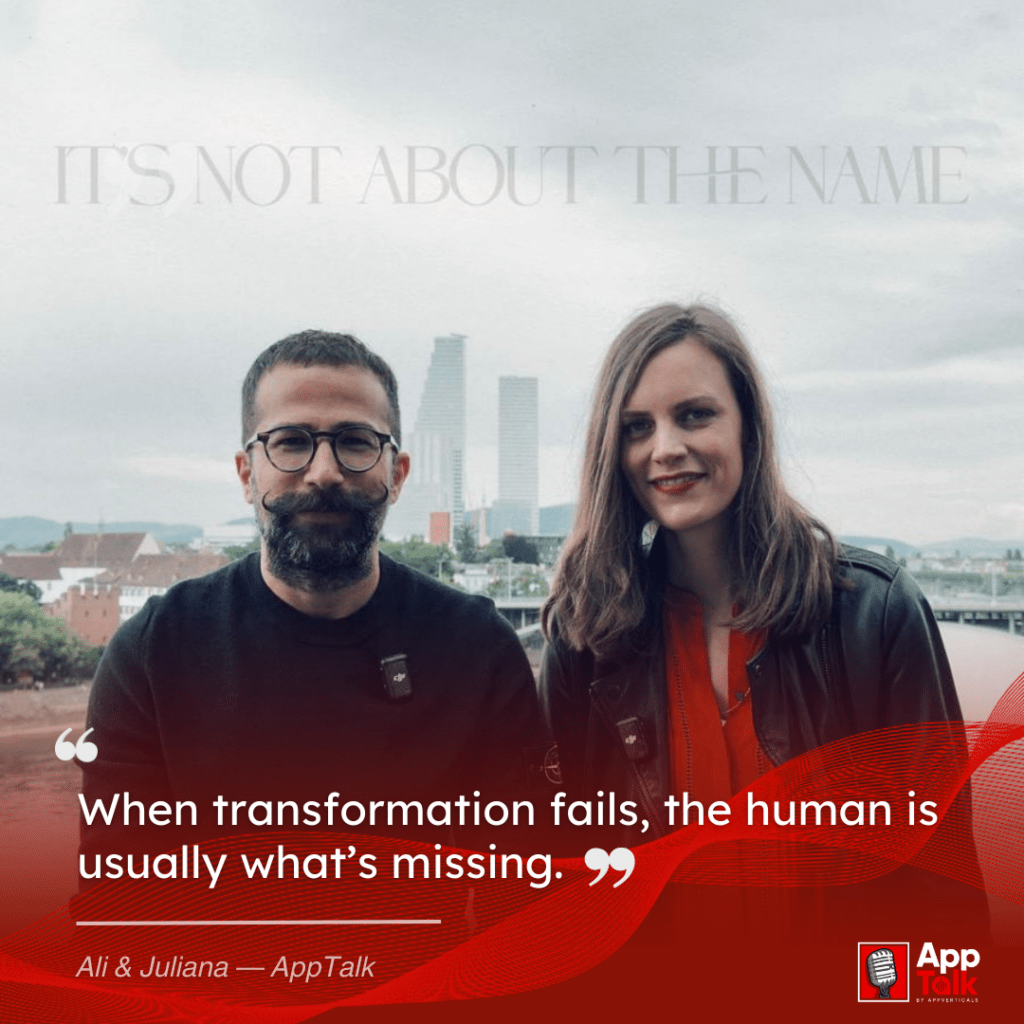
Over the past ten years, Ali and Juliane were involved in multiple large-scale transformation programs: digital, operational, and cultural. Different companies, different industries, same pattern.
Processes were redesigned.
Tools were rolled out.
KPIs were updated.
But the human experience of change was treated as an afterthought.
Juliane described the environment in which many organizations operate today:
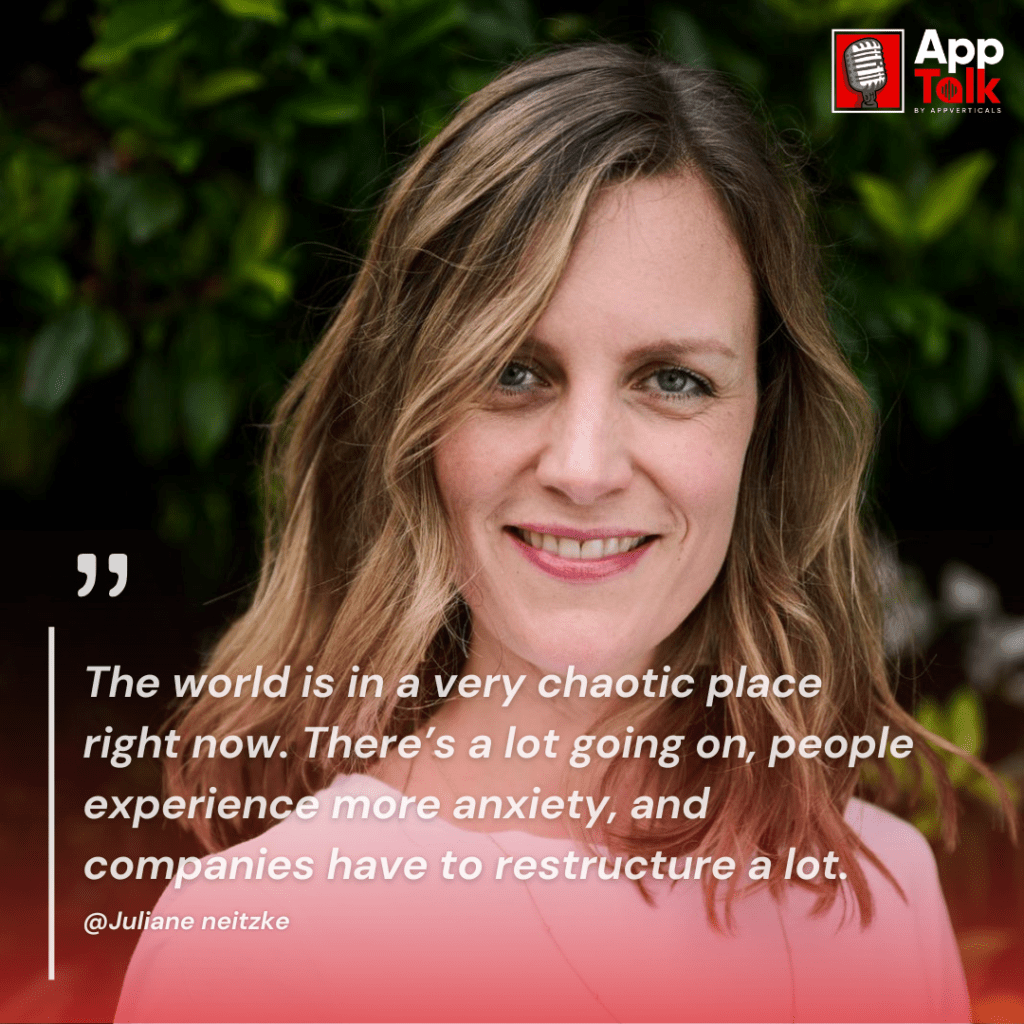
Layoffs, reorganizations, leadership churn, and constant uncertainty have created workplaces where fear is already high. Yet most transformation programs respond by pushing harder on efficiency and delivery, widening the emotional gap between leadership and teams.
That gap is where disengagement begins.
When the conversation turned to AI adoption, the founders were clear: most organizations are solving the wrong problem.
AI initiatives are typically framed as technical challenges: governance, infrastructure, compliance, and model performance. All of that matters. But resistance rarely starts there.
Juliane explained the real blocker:
“When people fear AI, when they fear losing their jobs, it becomes nearly impossible for them to see AI as an opportunity.”— Juliane Neitzke on AppTalk
Fear shuts down curiosity. And without curiosity, experimentation never happens.
Ali added that companies often skip the most important step entirely:
“But what about the part before? How do we get people AI-mind-ready?”
This reframes AI adoption away from tools and training sessions, and toward emotional readiness, something most enterprise AI roadmaps don’t even attempt to measure.
From Appverticals’ experience building and scaling AI-driven products, this pattern shows up consistently, even when the technology itself is solid.
As Rayaz, Chief Delivery Officer of Appverticals, shared during the discussion:

“We’ve seen teams invest heavily in AI systems that technically work, but struggle to gain real adoption because users were never prepared for how AI would change their roles. If you don’t bring people into the journey early, AI feels like something that’s being done to them, not built for them.”
This mirrors what Ali and Juliane emphasized throughout the conversation: successful AI adoption isn’t just about deployment speed or technical accuracy. It’s about whether people feel safe enough to engage, experiment, and adapt.
From a delivery standpoint, this is why Appverticals increasingly treats AI initiatives as organizational change programs, not just software builds, combining technical execution with enablement, readiness, and long-term adoption planning.
One of the most revealing insights from the podcast was the emotional gap between leadership and employees during transformation.
Executives often process change months, sometimes years, before the rest of the organization. They’ve accepted the future state and are already operating from it.
Ali described it like this:

That resistance isn’t about capability or mindset. It’s about identity, safety, and loss.
And those aren’t problems that can be solved with roadmaps or town halls.
The philosophy behind their work is embedded directly in the company’s name.
As Juliane explained:
“It doesn’t matter where you sit in the hierarchy, what your title is, or where you come from. This isn’t about the name, it’s about you.”
Titles, hierarchy, and seniority don’t change the fact that people share the same fundamental needs to feel seen, safe, and valued.
Ali reinforced this principle:
“If the answer to whatever we do is for people, not for politics, not for systems, not for agendas, then it’s probably the right approach.”
Even the name It’s Not About The Name reflects their belief that transformation doesn’t start with structure or labels, it starts with human behavior.
When asked to describe the “personality” of their company, Ali’s answer was telling:
“It’s a kind of human who walks into a room and the people immediately feel, ‘Okay, we can be honest here.’”
Not because the conversation will be easy, but because it will be real.
“They ask questions that land like, sometimes, a gentle punch.”
That balance is intentional: challenging deeply held patterns without stripping people of dignity.
Ali summarized it in four traits:

The moment that pushed Ali and Juliane to start their own company came from a realization they could no longer ignore:
“How many brilliant, deeply capable people are slowly disappearing inside successful companies.”
Not because they lack talent, but because the environment drains them.
Ali shared what he kept hearing from leaders and high performers:
“I’m paid well, but I feel that I’m not really part of this. I stopped a long time ago. I do my job and I leave my soul at the door.” — Ali Cengiz on AppTalk
Another core belief the founders emphasized is their rejection of quick fixes.
Juliane explained:
“We believe that change needs time. We need to change behaviors… especially the mindset of the people.”
That’s why their work focuses on:
Not one-off workshops or motivational sessions, but sustained behavioral change.
For organizations investing in AI, the takeaway is uncomfortable, but clear.
AI doesn’t replace human systems.
It amplifies them.
Fear scales.
Mistrust spreads.
Disengagement accelerates.
But so do curiosity, ownership, and innovation, when the environment allows it.
As Ali put it:
“We shouldn’t see this as something being taken away, but as something that helps us focus on higher-value work.”
Successful enterprise AI adoption requires two engines running together:
Ignore either, and the initiative stalls, regardless of how advanced the technology is.
The most important insight from this conversation wasn’t about AI tools or transformation frameworks.
It was this:
You can’t automate trust.
You can’t systematize courage.
You can’t scale technology faster than people are willing to grow.
That’s why conversations like this, and work like It’s Not About The Name, matter now more than ever.
To hear these insights directly from Ali and Juliane, watch the full AppTalk conversation below:
If this perspective on AI and human-centered transformation resonated, the full conversation goes deeper into the realities leaders and teams are navigating right now.
From AI anxiety and adoption challenges to leadership, trust, and change, the AppTalk episode with Ali and Juliana explores what transformation actually looks like when people are brought into the process, not pushed through it.
Because the future of AI isn’t just being built.
It’s being led.
Follow their work and insights, or explore their company to learn more about their perspective on leadership and transformation.
Juliana Neitzke
Ali Cengiz
Company
verified expert
The AppVerticals Content Team brings together experienced writers, strategists, and technologists with deep expertise in technology, AI, software, and digital innovation. With hundreds of published articles and years of hands-on industry experience, the team focuses on delivering clear, trustworthy insights.
 We’re AppVerticals
AppVerticals is where innovative startups and Fortune 500s come for transformation.
View About Us AI
AI
AI is transforming how we buy, sell, and manage properties. But what does "AI in real estate" really mean? It involves using smart algorithms and data...

16 min read
 AI
AI
Self-driving cars, which were once just a dream, are now becoming a reality. Big car companies and tech companies are working hard to make these cars...
13 min read
 AI
AI
Looking for reliable Janitor AI alternatives? Many users have turned to other platforms after facing issues like server errors and disappearing chats....

17 min read
Discover how our team can help you transform your ideas into powerful Tech experiences.
AppVerticals © 2026 | All Rights Reserved

Get In Touch.









 ChatGPT
 Perplexity
 Google AI