About Us

About Us
We’re a future-focused tech partner working with some of the world’s top enterprises. At AppVerticals, we design solutions that drive growth and reimagine digital experiences.

Services
Software Development
Mobile App Development
Web Design & Development
Tell us what you're looking for, and we'll tailor a solution based on your business needs.
Talk to Experts
Health Tech

EdTech

Logistics

Real Estate

Ecommerce

Sports

Fintech

Travel

Restaurant

Automotive
HIPAA-compliant digital solutions for hospitals, clinics, and healthtech startups driving better patient outcomes.
What we do:
Scalable learning platforms for schools, universities, and EdTech startups transforming education delivery.
What we do:
Real-time tracking and automation solutions for freight companies, warehouses, and delivery services.
What we do:
PropTech platforms for brokerages, property managers, and real estate marketplaces are streamlining operations.
What we do:
High-converting commerce platforms for D2C brands, retailers, and online marketplaces are driving revenue growth.
What we do:
Fan engagement platforms for sports teams, leagues, and betting operators are creating immersive experiences.
What we do:
PCI-DSS compliant solutions for digital banks, payment platforms, and InsurTech companies, ensuring security.
What we do:
Booking and hospitality solutions for OTAs, hotels, and tourism platforms, enhancing traveler experiences.
What we do:
Online ordering and operations software for restaurants, cloud kitchens, and food delivery platforms.
What we do:
Connected vehicle platforms for automotive OEMs, dealerships, and mobility providers are accelerating innovation.
What we do:
Portfolio
AppVerticals was featured in Inc. 5000 as
America’s Fastest Growing Tech Company
See what it might cost to bring your app idea to life. Our calculator gives you a quick, simple estimate based on what you need.


 verified expert
Technical Writer — Platforms, SaaS & Digital Products
Vareesha writes about platforms and SaaS with a clear, experience-led approach. With 3+ years in technical writing, she translates complex business and technical concepts into structured, actionable content for founders and product teams. Having worked...
See Full Bio19 minutes read
In my experience implementing enterprise platforms, the real challenge isn’t content creation. It’s delivering the right experience at the right moment across fragmented systems. Sitecore addresses this complexity through structured governance, behavioral targeting, and scalable architecture.
Whether implemented in-house or through specialized Sitecore development services, it empowers organizations to streamline omnichannel delivery and drive measurable digital impact.
Stop struggling with complex workflows and integrations. With expert guidance, turn Sitecore into a platform that delivers measurable ROI, personalized experiences, and scalable growth.
Get Expert Sitecore HelpFrom what I’ve seen in enterprise implementations, what truly differentiates Sitecore isn’t just content editing. It’s the depth of governance controls, multilingual management, behavioral personalization, and the flexibility to integrate with broader enterprise systems, all at scale.
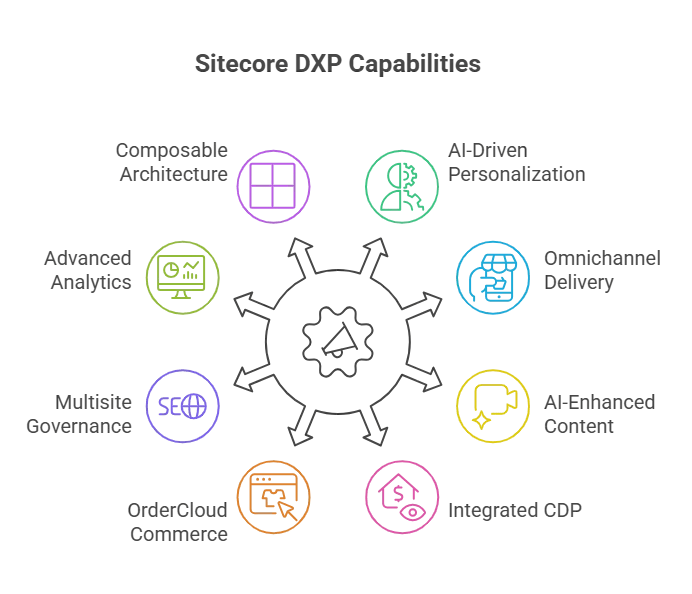
Sitecore drives measurable impact when scale, personalization, and integration align across enterprise operations:
I’ve worked with companies still running Sitecore XP, the legacy on-premises model. It was powerful, but infrastructure-heavy and DevOps-intensive.
The shift to XM Cloud and the broader DXP ecosystem reflects what modern enterprises now demand: cloud-native scalability, reduced infrastructure overhead, and faster innovation cycles.
This transition fundamentally changes how digital teams operate, from system maintenance to experience optimization.
While Sitecore CMS is a robust content management platform, Sitecore DXP goes a step further by offering a comprehensive suite of tools to streamline the entire customer experience.
The distinction lies in the fact that DXP integrates marketing automation, personalization, customer data management, and e-commerce into the CMS platform, creating a complete digital ecosystem.
| Feature | Sitecore CMS | Sitecore DXP |
|---|---|---|
| Core Focus | Content management and publishing | Comprehensive digital experience management (content + customer data + marketing automation) |
| Personalization | Limited personalization capabilities | Advanced AI-driven personalization across all touchpoints |
| Customer Data Management | No integrated CDP | Integrated CDP for a 360-degree customer view |
| Marketing Automation | Basic workflows | Full-scale marketing automation with omnichannel support |
| E-commerce | No e-commerce features | Integrated e-commerce with OrderCloud |
| Scalability | Suitable for mid-size enterprises | Designed for large-scale, multinational enterprises |
Organizations focused solely on publishing may find CMS sufficient, but businesses aiming for scalable personalization, automation, and revenue optimization benefit significantly from a full DXP approach.
The thing I can vouch for is that enterprises tend to adopt Sitecore when they need scalable personalization and consistent experiences across multiple regions.
In one multi-region implementation we supported at AppVerticals, the real value came from maintaining centralized governance while still enabling localized content delivery, an area where Sitecore proved especially effective.
Recent reports indicate that organizations using AI-driven personalization see up to a 20–30% increase in engagement metrics and higher conversion rates.
Sitecore enterprise licensing typically starts around $80,000–$150,000 per year, with large implementations reaching $360,000+ annually, depending on scale and modules selected.
When implementation, hosting, customization, and support are included, the total cost of ownership (TCO) can exceed $1 million over three years.
Understanding how Sitecore’s pricing works and the expected ROI can help CTOs, engineers, and decision-makers justify the investment and plan their budgets accordingly.
Sitecore’s pricing is generally structured based on annual site visits and the number of modules or add-ons needed. While Sitecore does not provide transparent pricing on its website, here’s what you can expect based on industry data:
| Plan Tier | Annual Visit Capacity | Key Modules |
|---|---|---|
| Standard | Up to 2M visits/year | XM/XP/XC base + JSS + Salesforce CRM Connect |
| Corporate | Up to 12M visits/year | XM/XP/XC base + JSS + Salesforce CRM Connect |
| Enterprise | Up to 240M visits/year | XM/XP/XC + JSS + Salesforce CRM Connect (included) |
Additional pricing variables include:
This one thing, which often stands out for me when evaluating Sitecore, is that the ROI conversation is usually backed by measurable outcomes rather than assumptions.
A Forrester Total Economic Impact™ study commissioned by Sitecore reports that organizations can achieve up to 371% ROI over three years, largely driven by stronger personalization, improved digital conversions, and more efficient marketing operations.
Key outcomes highlighted in the study include:
Sitecore has evolved from a monolithic, on-premises architecture (XP) to a composable, SaaS-native model (XM Cloud). This shift reduces infrastructure overhead but increases the importance of front-end architecture, API orchestration, and integration strategy.
In the Sitecore implementations I’ve been involved in, architecture decisions have had more impact than feature selection.
When working with legacy Sitecore XP, the architecture was tightly coupled. Rendering logic, personalization rules, content management, and infrastructure were deeply integrated within the same stack. This required:
XP provided significant control and deep personalization capabilities. But scaling it required operational maturity and dedicated infrastructure ownership.
With XM Cloud, the model changes entirely.
XM Cloud is SaaS-native and decoupled. Content is managed centrally but delivered through APIs. Front-end applications are built using frameworks like:
Sitecore now manages infrastructure, platform stability, and security updates. The DevOps burden shifts from server maintenance to:
From my experience, this transition reduces infrastructure friction but increases the importance of architectural clarity. Complexity doesn’t disappear, it moves to integration and front-end layers.
Sitecore rarely operates in isolation. In nearly every enterprise deployment I’ve seen, it must integrate with:
The integration layer becomes the real technical challenge.
Common risks include:
Additionally, Sitecore’s architecture demands specific expertise:
Without in-house capability or experienced implementation partners, these risks compound quickly.
From what I’ve observed, talent gaps are one of the most underestimated factors in Sitecore adoption.
Sitecore implementation typically takes 6–12 months for most enterprise deployments, depending on scope, integrations, and team readiness.
Implementing Sitecore, whether CMS or full DXP requires careful planning, skilled teams, and a clear understanding of the platform’s capabilities.
I’ve seen that Sitecore enables data-driven experience orchestration across distributed digital ecosystems.
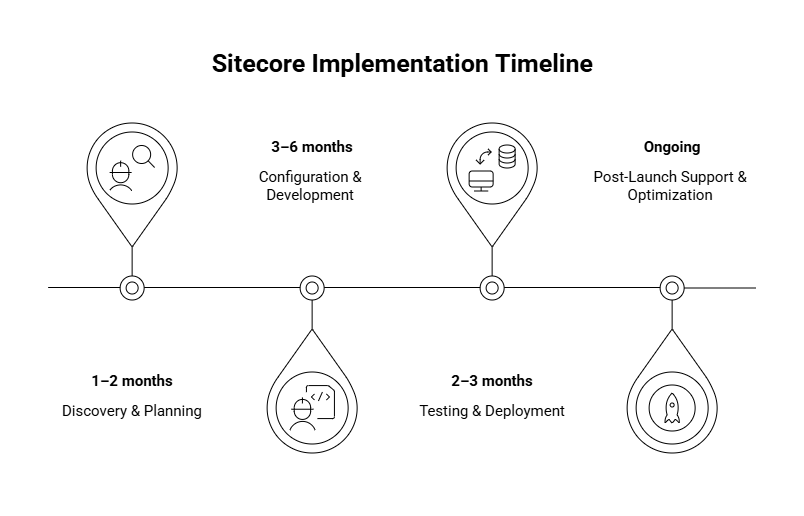
Typical Implementation Timeline:
Phase 1: Discovery & Planning (1–2 months) – Assess business needs, define content workflows, select modules, and align stakeholders.
Phase 2: Configuration & Development (3–6 months) – Configure Sitecore, build custom functionality, and integrate with CRM/ERP systems. Experienced developers or certified partners are essential here.
Phase 3: Testing & Deployment (2–3 months) – Test functionality, ensure seamless content migration, and preserve SEO and personalization rules. Phased rollouts help reduce risk.
Phase 4: Post-Launch Support & Optimization (Ongoing) – Continuous refinement of personalization, performance, and operational workflows using Sitecore’s APIs.
Implementing Sitecore delivers significant value, but enterprises often encounter several hurdles that require careful planning and expertise:
Annual licensing ranges from $80K–$150K, with large enterprise implementations reaching $360K/year plus infrastructure and development costs.
Solution: Build a 3-year TCO model including licensing, AI modules, support, and development to plan for full financial scope.
Connecting Sitecore to CRM, ERP, e-commerce, and CDP platforms, especially legacy systems can be complex.
Solution: Conduct a discovery phase to map integrations and dependencies; use experienced specialists to ensure seamless module and AI integration.
Headless architecture requires .NET and modern JavaScript expertise.
Solution: Upskill teams or hire certified developers. AI automates some tasks but technical expertise is still essential for configuration, customization, and long-term optimization.
Composable SaaS/XP architectures can be mismanaged, leading to over- or under-composition and added complexity, including AI features.
Solution: Define requirements, create a modular roadmap, and plan AI integration strategically to scale efficiently and avoid unnecessary modules.
Sitecore is powerful, but complex. Hiring certified Sitecore consultants ensures faster deployments, seamless integrations, and AI-driven personalization done right, saving time, avoiding costly mistakes, and boosting ROI from day one.
Talk to a Sitecore Expert TodayYes, Sitecore is good for developers. It provides development teams the ability to build highly customized solutions while maintaining full control over architecture.
With headless options like JSS, cloud-native deployment models, and robust APIs, developers can build scalable, maintainable, and future-proof digital experiences.
Key Developer Advantages:
These capabilities give developers freedom to optimize front-end performance, integrate diverse tech stacks, and maintain clean, future-proof architecture while supporting complex enterprise requirements.
Sitecore helps marketing teams deliver personalized, consistent experiences across channels, reducing manual effort while boosting engagement and conversions.
Key Benefits:
These capabilities allow marketing teams to run smarter campaigns, save time, and make data-driven decisions, maximizing ROI across enterprise deployments.
When evaluating Sitecore, many organizations compare it not only to enterprise DXPs like Adobe Experience Manager, but also to platforms like Contentful, Drupal, and WordPress.
Here’s how they differ at a strategic level:
| Dimension | Sitecore | WordPress | AEM (Adobe Experience Manager) | Contentful | Drupal |
|---|---|---|---|---|---|
| Platform Type | Composable DXP + CMS | Open-source CMS | Enterprise DXP | Headless CMS | Open-source CMS |
| Personalization | Advanced (CDP + AI-native) | Plugin-based (limited native depth) | Strong (Adobe Target) | Limited (requires 3rd-party) | Basic (modules) |
| AI Integration | Native AI layer (SitecoreAI) | Plugin-based | Adobe Sensei | Minimal native AI | Plugin-based |
| Architecture | SaaS-native + composable | Primarily monolithic (headless possible) | Cloud / Hybrid | API-first SaaS | Monolithic or headless |
| Commerce | OrderCloud | WooCommerce | Adobe Commerce | External tools | Modules |
| Scalability | Enterprise-grade, multi-region | Scales, but infrastructure-heavy at enterprise level | Enterprise-grade | High for digital products | Scalable with DevOps |
| Best Fit | Personalization-first enterprises | SMB to mid-market content publishing & marketing | Adobe ecosystem enterprises | Product-led SaaS teams | Structured, compliance-heavy projects |
| Total Cost of Ownership | High | Low–Moderate (can rise at scale) | Very High | Moderate | Low–Moderate |
The decision typically depends on whether personalization depth and data orchestration justify the higher total cost of ownership.
Across multiple deployments, several patterns consistently separate successful implementations from problematic ones:
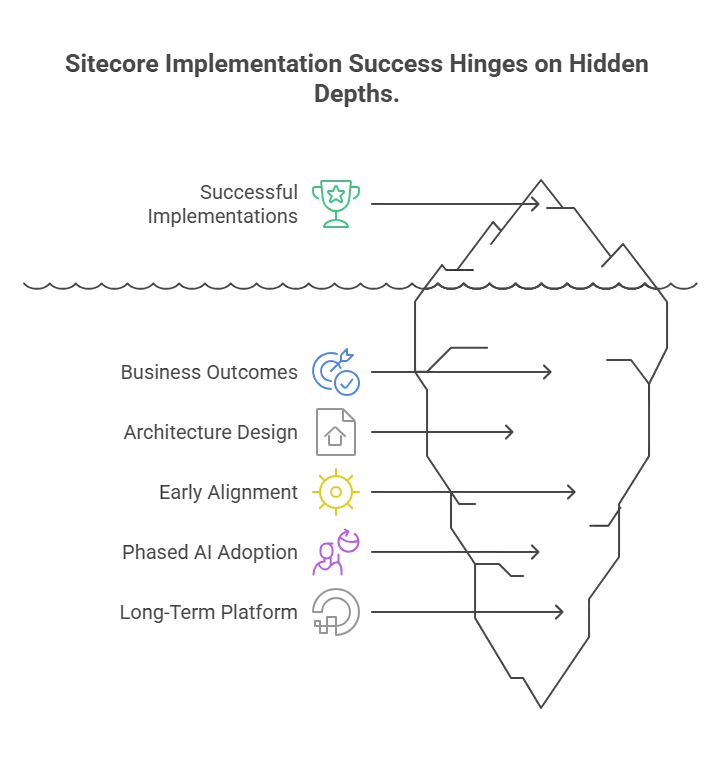
Avoid over-composition. Choose CDP, Personalize, or XC only when aligned with measurable business goals.
Clear content modeling and API boundaries reduce long-term technical debt.
Personalization logic and data flows must be mutually understood.
SitecoreAI delivers strong value, but integrating AI workflows requires governance and performance monitoring.
This is not a short-term publishing tool. It is a strategic digital infrastructure decision.
Sitecore delivers strong value in complex, personalization-driven enterprise environments, but it’s not the right fit for every organization.
Here’s when I typically advise decision-makers to pause:
If your needs are limited to blogs, landing pages, or straightforward CMS workflows, Sitecore is likely over-engineered. Platforms like WordPress or Contentful can meet those requirements with lower cost and faster setup.
Enterprise licensing often begins in the $80K–$150K annual range and increases with modules like CDP or OrderCloud. Once implementation and hosting are factored in, total cost of ownership rises significantly. If your digital platform budget is limited, lighter solutions may deliver better value.
Sitecore aligns closely with .NET architecture and modern headless frameworks such as Next.js. Without in-house expertise or a qualified partner, implementation complexity increases.
Sitecore is built for structured, scalable ecosystems, not rapid MVP launches or short-term microsites. Simpler CMS platforms often move faster when deep personalization isn’t required.
Sitecore’s core strength lies in orchestration, CDP integration, and AI-driven personalization. Without a defined personalization roadmap, much of its potential remains underutilized.
Sitecore’s capabilities are unmatched, but its complexity makes experienced consultants and custom developers essential for enterprises seeking real impact. From my experience at AppVerticals, having the right expertise ensures faster ROI, smoother deployments, and fewer risks.
Multi-region or DXP deployments demand precise configuration, integration, and testing. Expert consultants prevent common pitfalls and align the platform with business objectives.
Sitecore AI, personalization engines, and OrderCloud commerce deliver maximum value only when strategically implemented. Skilled developers turn these features into measurable engagement and efficiency gains.
Integrating CRM, ERP, CDP, and e-commerce systems can be complex. Certified experts maintain data consistency, prevent workflow disruptions, and enable end-to-end operational efficiency.
Internal teams often lack deep experience in .NET, headless frameworks, or advanced personalization. Consultants bridge that gap while training teams to manage Sitecore independently.
Misaligned module selection or licensing decisions can be costly. Experienced partners scope projects accurately, minimize rework, and ensure investments translate into real business outcomes.
I see Sitecore as a strategic infrastructure decision, not just a CMS upgrade. When personalization, governance, and multi-region orchestration are tied to revenue and growth, it delivers measurable enterprise impact.
Its real strength lies in unifying content, data, and experience activation, but results depend on disciplined architecture and a clear roadmap. Implemented strategically, Sitecore becomes a scalable growth engine rather than just a publishing platform.
However, Sitecore development can become a bottleneck without a clear strategy. Enterprises often benefit from partnering with certified Sitecore experts who understand architectural tradeoffs, integration complexities, and strategies for long-term scalability.
Sitecore delivers value when architecture, integrations, and personalization are aligned with real business goals. A strategic discussion can help clarify scope, reduce risk, and protect long-term ROI.
Book a Sitecore Strategy Discussion
verified expert
Vareesha writes about platforms and SaaS with a clear, experience-led approach. With 3+ years in technical writing, she translates complex business and technical concepts into structured, actionable content for founders and product teams. Having worked closely on platform implementation and documentation, she brings real-world insight into how these systems function beyond the surface.
 We’re AppVerticals
AppVerticals is where innovative startups and Fortune 500s come for transformation.
View About UsDiscover how our team can help you transform your ideas into powerful Tech experiences.
AppVerticals © 2026 | All Rights Reserved

Get In Touch.









 ChatGPT
 Perplexity
 Google AI