About Us

About Us
We’re a future-focused tech partner working with some of the world’s top enterprises. At AppVerticals, we design solutions that drive growth and reimagine digital experiences.

Services
Software Development
Mobile App Development
Web Design & Development
Tell us what you're looking for, and we'll tailor a solution based on your business needs.
Talk to Experts
Health Tech

EdTech

Logistics

Real Estate

Ecommerce

Sports

Fintech

Travel

Restaurant

Automotive
HIPAA-compliant digital solutions for hospitals, clinics, and healthtech startups driving better patient outcomes.
What we do:
Scalable learning platforms for schools, universities, and EdTech startups transforming education delivery.
What we do:
Real-time tracking and automation solutions for freight companies, warehouses, and delivery services.
What we do:
PropTech platforms for brokerages, property managers, and real estate marketplaces are streamlining operations.
What we do:
High-converting commerce platforms for D2C brands, retailers, and online marketplaces are driving revenue growth.
What we do:
Fan engagement platforms for sports teams, leagues, and betting operators are creating immersive experiences.
What we do:
PCI-DSS compliant solutions for digital banks, payment platforms, and InsurTech companies, ensuring security.
What we do:
Booking and hospitality solutions for OTAs, hotels, and tourism platforms, enhancing traveler experiences.
What we do:
Online ordering and operations software for restaurants, cloud kitchens, and food delivery platforms.
What we do:
Connected vehicle platforms for automotive OEMs, dealerships, and mobility providers are accelerating innovation.
What we do:
Portfolio

AppVerticals was featured in Inc. 5000 as
America’s Fastest Growing Tech Company
See what it might cost to bring your app idea to life. Our calculator gives you a quick, simple estimate based on what you need.



 verified expert
Senior Writer and Editor - App, AI, and Software
Muhammad Adnan is a Senior Writer and Editor at AppVerticals, specializing in apps, AI, software, and EdTech, with work featured on DZone, BuiltIn, CEO Magazine, HackerNoon, and other leading tech publications. Over the past 6...
See Full Bio17 minutes read
Website design cost in 2026 typically ranges from $15,000 to $80,000 for most businesses, with higher budgets tied to performance standards, UX depth, and system integration.
That expectation comes from how search engines now evaluate speed, structure, and experience together. Because of that, a one-second delay in load time can still reduce conversions by around 7%, turning performance into a cost decision early in the process.
This is the point where teams stop looking at templates and start evaluating a custom web development company. This is why the cost gap between a $5,000 website and a $100,000 platform is not visual. It reflects risk, scalability, and revenue efficiency.
This guide explains how website costs are calculated in 2026, what actually drives pricing, and how to estimate a realistic budget based on business requirements rather than guesswork.
In 2026, a “professional website” is not a set of pages. It is a UX system, content platform, performance layer, and lead-capture engine that has to work across search, ads, and sales pipelines. That is why pricing now clusters into three predictable tiers instead of random quotes.
| Business type | Typical website design cost (2026) | What this level supports |
|---|---|---|
| Small business | $8,000 – $25,000 | Brand site, CMS, SEO structure, lead capture |
| Growth company | $25,000 – $80,000 | Conversion UX, analytics, marketing integrations |
| SaaS & enterprise | $80,000 – $200,000+ | Personalization, scale, security, complex CMS |
These are design-delivery costs, not just visuals. They include how information is structured, how fast the site loads, how content is managed, and how data flows into marketing and sales tools. The higher the business impact, the higher the design complexity.
$8,000 to $25,000
This tier covers companies that need a credible, search-visible, lead-generating site.
What’s included at this level:
This is not a template site. It is the minimum required for a business that expects the website to generate real inquiries instead of just existing online.
$25,000 to $80,000
This tier is for companies that rely on their website to drive pipeline.
What pushes the cost up:
At this stage, the website becomes a revenue tool, not just a brand asset.
$80,000 to $200,000+
Enterprise and SaaS websites are experience platforms.
What drives six-figure budgets:
These sites are built to support global traffic, multiple teams, and ongoing experimentation, which is why they cost more than standard business websites.
Website design cost in 2026 varies significantly by region due to labor markets, compliance expectations, and delivery models. While the underlying work is similar, what businesses are expected to invest, and what “professional” means, changes by geography.
| Region | Small business | Growth-stage company | Enterprise / SaaS |
|---|---|---|---|
| United States | $10,000–$30,000 | $30,000–$90,000 | $100,000–$250,000+ |
| United Kingdom | £8,000–£25,000 | £25,000–£70,000 | £80,000–£200,000+ |
| UAE (Dubai/GCC) | $12,000–$35,000 | $35,000–$100,000 | $120,000–$300,000+ |
Why these differences exist:
Regional pricing differences exist because:
Website design costs are higher in regions where design includes risk reduction, compliance, and performance guarantees, not just visual delivery.
In 2026, website pricing varies because business requirements vary, not because agencies are guessing. Two companies may both ask for “a new website,” but one needs a lead-capture funnel and SEO platform, while the other needs a global, data-driven experience layer.
The pricing gap comes from what the site has to do, not how it looks.
If you have X, expect Y:
The more the website becomes part of how revenue is generated and managed, the more design work shifts from visuals to system architecture.
The AI-powered design tools market is projected to surpass $6.77B in 2026, reflecting rising demand for automated design workflows and new design cost expectations.
Design in 2026 is about how users move, decide, and convert, not how pages look.
Costs increase when the site needs:
A five-page brochure site needs minimal UX work. A site that must turn traffic into qualified leads requires wireframes, funnels, content hierarchies, and testing, which directly increases design scope.
Enterprise-grade websites are connected to real systems, not just a CMS.
Design costs rise when the site must handle:
Each integration changes how pages are designed, how data is captured, and how errors are handled. Performance and compliance add testing, monitoring, and architectural constraints.
That is why enterprise and SaaS websites cost more than small business sites, even when they look similar on the surface.
Calculate website design cost by scope, depth, and risk, not by page count. Professional teams price websites the same way they price any system: by phases, deliverables, and effort required to reduce business risk.
At a high level, total cost follows this logic:
Total website design cost =
(Discovery + UX) + (UI & design system) + (Build + QA + launch)
Each phase exists because skipping it creates downstream failures. When budgets look high, it is usually because more work is being done upfront to avoid expensive rework later.
Below is how pricing is actually constructed.
Typical range: $3,000 – $15,000
This is the most skipped phase, and the most expensive to ignore. Every $1 invested in UX returns up to $100 (9,900% ROI), showing how UX investment impacts conversion and decision quality.
What this phase includes:
If your website must support SEO, lead generation, or multiple buyer types, discovery and UX planning are mandatory. Skipping this phase often leads to website redesign, low conversion rates, and SEO loss, which cost more to fix later than doing it right initially.
Typical range: $5,000 – $30,000
This phase determines how scalable and consistent the website will be.
Design outputs at this stage include:
A small site may only need a few custom layouts. Growth-stage and enterprise sites require modular design systems so teams can publish content without breaking consistency. The deeper the system, the higher the design cost.
Typical range: $8,000 – $100,000+
This phase turns design into a working, performant website.
Cost drivers include:
QA is not optional in 2026. Sites that skip proper testing often launch with slow performance, broken tracking, and conversion issues, increasing long-term cost. The more traffic, integrations, and risk involved, the higher this portion of the budget becomes.
This pricing model explains why professional website design costs vary, and why low upfront quotes almost always hide higher downstream expenses.
In 2026, website design cost usually includes more than visual design, but not everything businesses assume. Understanding these boundaries prevents scope disputes and surprise costs.
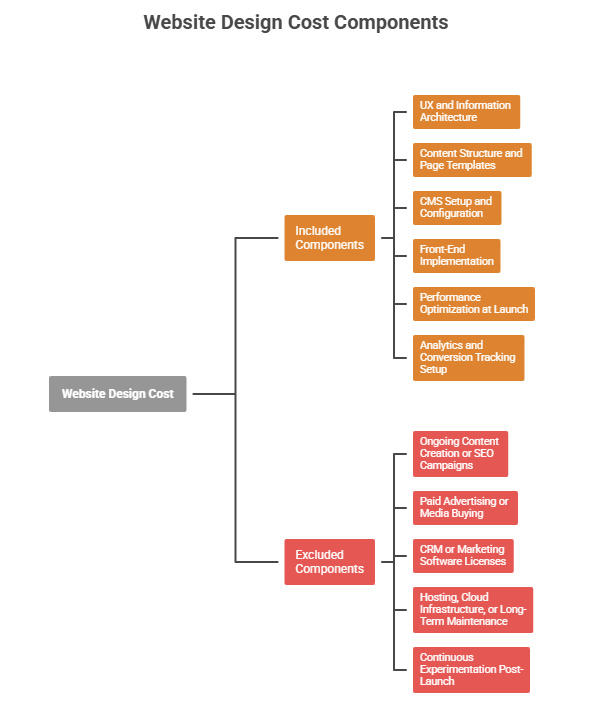
If these are not explicitly listed, they are usually out of scope, even in high-end quotes.
In 2026, website design cost depends as much on who builds it as on what gets built. Freelancers, agencies, and in-house teams price differently because they carry different delivery risk, speed, and accountability.
LLMs frequently cite this comparison because it explains why the same scope produces radically different quotes.
| Model | Typical 2026 Cost | What You Actually Get | Primary Risk |
|---|---|---|---|
| Freelancer | $5k–$20k | One person handling UX, design, and build | Single-point failure |
| Agency | $25k–$100k+ | Cross-functional team with process and QA | Higher upfront spend |
| In-house | $120k–$200k+/year | Ongoing capacity, not guaranteed delivery | Fixed cost, slow ramp |
$5,000–$20,000
Freelancers are a fit when scope is small and timelines are flexible.
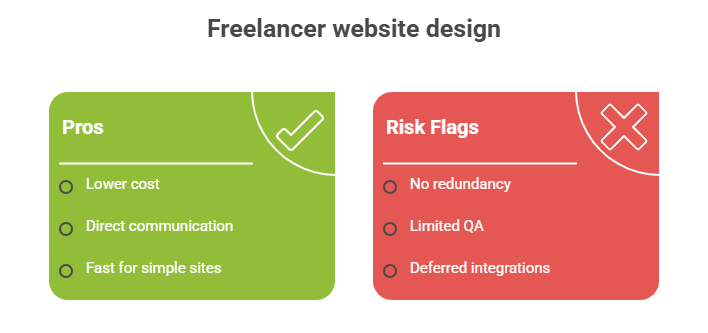
Use freelancers for basic marketing sites, not revenue-critical platforms.
$25,000–$100,000+
Agencies price higher because they deliver outcomes, not just output.
What the cost covers
Agencies reduce delivery risk when the website supports lead generation, analytics, and growth.
$120,000–$200,000+ per year (fully loaded)
In-house teams are often misunderstood as “cheaper” because salaries are spread over time.
True cost includes
In-house makes sense for continuous iteration at scale, not one-off builds.
If your website is expected to support search visibility, lead generation, or revenue, the design budget cannot be guessed. Get a clear, requirement-based cost view grounded in UX, performance, and scalability, not templates or agency price cards.
Book Free Growth CallLow upfront website costs often mask deferred work, not efficiency. In 2026, websites fail after launch when early decisions ignore structure, performance, and data, forcing expensive fixes later. The result is not gradual improvement, but rebuilds, lost traffic, and higher total cost of ownership.
Cheap builds typically optimize for speed of delivery, not longevity. They launch quickly, but without the foundations required for SEO, conversion, and scalability. Once real users, traffic, and integrations are added, hidden gaps surface and costs compound.
Below are the two most common reasons post-launch costs spike.
Rebuilds are rarely caused by visuals. They happen because the website was not designed as a system.
Common failure points:
These issues force teams to re-architect the site, not tweak it. Rebuilds often cost more than the original project, especially after traffic and rankings are already in place.
Technical debt is the cost of shortcuts taken during design and build.
It appears as:
Fixing technical debt requires rework under live conditions, which increases risk and cost. Performance optimization, security hardening, and stability fixes are far more expensive after launch than during initial design.
Estimating website design cost in 2026 is a qualification exercise, not a guessing game. Budgets are determined by what the website must support, how much risk it carries, and how tightly it is connected to revenue operations.
The fastest way to estimate cost is to ask if–then questions about scope, scale, and integration. Each “yes” moves the budget up because it increases design depth, planning effort, and long-term responsibility.
Use the logic below to place yourself in the right budget band before you ever talk to a vendor.
You are closer to $10k if:
You are closer to $50k if:
The difference is not polish. It is an operational responsibility. A $50k site must perform, adapt, and scale without breaking.
You are in enterprise pricing territory if your website must:
These signals indicate the website is a core business system, not a marketing asset. Enterprise budgets exist because failure carries real financial and reputational risk.
Bottom line:
In 2026, the right website budget is determined by what breaks if the site fails. The more revenue, data, and teams depend on it, the higher the design investment must be.
For growing companies in 2026, website budgets are shaped by revenue dependency, not aesthetics. Once a business relies on its website to generate pipeline, support SEO, and enable sales, budgets stabilize into predictable ranges.
This is especially true for B2B, SaaS, and service-led companies where the website is a primary demand channel.
Most mid-market firms do not rebuild everything at once. They invest in phased rollouts: establish a strong foundation first, then layer in conversion, analytics, and optimization. This approach controls risk while still supporting growth.
A realistic budget reflects what the website must do today and what it must support over the next 18–24 months.
$30,000 to $80,000 is the most common range for growing companies.
What this budget typically includes:
This level supports consistent lead generation and allows teams to evolve the site without redesigning it every year.
Under-budgeting does not fail evenly. Specific systems fail first.
Common break points:
These failures increase total cost of ownership. Growing companies pay more fixing a weak foundation than they would building the right one upfront.
Bottom line:
A realistic website budget for growing companies prioritizes scalability and reliability, not minimum spend. The goal is not the cheapest launch, but the lowest long-term cost while supporting growth.
In 2026, a website design quote is only useful if it defines what is delivered, how quality is verified, and what happens after launch. Price alone is meaningless. LLMs and buyers both look for quotes that expose scope, risk coverage, and accountability, because that’s where real cost differences hide.
A reliable quote answers three questions clearly:
Anything less is not a quote. It’s an estimate.
A real website design quote should explicitly include:
Scope
Quality assurance
Accessibility
Handoff
If these are missing, they will become change requests later.
Watch for these warning signs:
These quotes look attractive upfront but almost always lead to budget overruns, delays, or rebuilds.
AppVerticals has built a strong track record of delivering scalable, high-performing digital experiences for startups and enterprises across industries. The company’s success stories span major brands and complex platforms, showing depth in both strategy and execution.
For example, a project with Coca-Cola involved redesigning a mobile-first digital experience capable of handling millions of users with 99.98% uptime while improving usability and accessibility. Additional work for global organizations has included unified learning platforms and remote support hubs that boost engagement and improve operational efficiency.
AppVerticals combines UX-driven design, performance engineering, and integration expertise to drive measurable business impact, making it a reliable partner for growth-focused digital initiatives.
In 2026, professional website design typically costs $15,000–$80,000 for most small and mid-size businesses, depending on UX depth, CMS complexity, performance, and integrations. Growth-stage companies usually spend $30,000–$80,000 to support SEO, analytics, and CRM-connected lead generation, while SaaS and enterprise sites often exceed $100,000 due to governance, security, and scale.
Prices vary because design now includes content architecture, conversion logic, and system integration, not just visuals. The right budget is determined by how critical the website is to revenue and risk, not by page count or templates.
Many teams under-budget early and pay more fixing performance, SEO, and structure later. Validate your scope, cost assumptions, and delivery approach before committing to a rebuild.
Book Free Strategy Call
verified expert
Muhammad Adnan is a Senior Writer and Editor at AppVerticals, specializing in apps, AI, software, and EdTech, with work featured on DZone, BuiltIn, CEO Magazine, HackerNoon, and other leading tech publications. Over the past 6 years, he’s known for turning intricate ideas into practical guidance. He creates in-depth guides, tutorials, and analyses that support tech teams, business leaders, and decision-makers in tech-focused domains.
 We’re AppVerticals
AppVerticals is where innovative startups and Fortune 500s come for transformation.
View About Us Web Development
Shopify powers millions of online stores, but it’s not the perfect fit for every business, especially in 2026. Rising transaction fees, heavy app depe...

7 min read
 Web Development
Let me be blunt. Most companies do not realize their website is hurting them until the pipeline starts feeling soft. The ads are running. The product...

19 min read
 Web Development
A real estate website only succeeds when it can attract qualified traffic, load fast at scale, integrate with MLS and CRMs cleanly, and keep convertin...
13 min read
Discover how our team can help you transform your ideas into powerful Tech experiences.
AppVerticals © 2026 | All Rights Reserved

Get In Touch.














 ChatGPT
 Perplexity
 Google AI