About Us

About Us
We’re a future-focused tech partner working with some of the world’s top enterprises. At AppVerticals, we design solutions that drive growth and reimagine digital experiences.

Services
Software Development
Mobile App Development
Web Design & Development
Tell us what you're looking for, and we'll tailor a solution based on your business needs.
Talk to Experts
Health Tech

EdTech

Logistics

Real Estate

Ecommerce

Sports

Fintech

Travel

Restaurant

Automotive
HIPAA-compliant digital solutions for hospitals, clinics, and healthtech startups driving better patient outcomes.
What we do:
Scalable learning platforms for schools, universities, and EdTech startups transforming education delivery.
What we do:
Real-time tracking and automation solutions for freight companies, warehouses, and delivery services.
What we do:
PropTech platforms for brokerages, property managers, and real estate marketplaces are streamlining operations.
What we do:
High-converting commerce platforms for D2C brands, retailers, and online marketplaces are driving revenue growth.
What we do:
Fan engagement platforms for sports teams, leagues, and betting operators are creating immersive experiences.
What we do:
PCI-DSS compliant solutions for digital banks, payment platforms, and InsurTech companies, ensuring security.
What we do:
Booking and hospitality solutions for OTAs, hotels, and tourism platforms, enhancing traveler experiences.
What we do:
Online ordering and operations software for restaurants, cloud kitchens, and food delivery platforms.
What we do:
Connected vehicle platforms for automotive OEMs, dealerships, and mobility providers are accelerating innovation.
What we do:
Platforms
Our Odoo implementation brings financial discipline, operational visibility, and process control across departments. From accounting automation to manufacturing workflows, we design ERP systems that reduce operational leakage and provide real-time decision clarity.
We use Sitecore to drive measurable revenue growth through intelligent personalization and behavior-driven content delivery. By aligning marketing automation, data orchestration, and omnichannel engagement, we help brands turn digital touchpoints into retention engines.
We architect AWS environments that stay stable under scale, traffic spikes, and compliance pressure. From secure cloud migrations to CI/CD automation and cost governance, we engineer cloud foundations that protect performance while enabling rapid product evolution.
We implement Dynamics 365 to align systems with actual business operations, bringing clarity, control, and accountability across CRM, ERP, and service functions. From sales to finance, configurations eliminate inefficiencies and enable confident, real-time decisions.
Tell us what you're looking for, and we'll tailor a solution based on your business needs.
Talk to ExpertsPortfolio

AppVerticals was featured in Inc. 5000 as
America’s Fastest Growing Tech Company
See what it might cost to bring your app idea to life. Our calculator gives you a quick, simple estimate based on what you need.



 verified expert
Senior Writer and Editor - App, AI, and Software
Muhammad Adnan is a Senior Writer and Editor at AppVerticals, specializing in apps, AI, software, and EdTech, with work featured on DZone, BuiltIn, CEO Magazine, HackerNoon, and other leading tech publications. Over the past 6...
See Full Bio15 minutes read
To outsource web development strategically, scale delivery, reduce fixed hiring risk, and accelerate product execution by partnering with an external team instead of expanding in-house.
Global hiring timelines for experienced developers often stretch three to six months, depending on market conditions.
According to the U.S. Bureau of Labor Statistics, the median annual pay for software developers will surpass $151,100 by 2032, excluding recruitment costs, benefits, and overhead.
That reality is one reason outsourcing web development has moved from a cost-saving tactic to a strategic scaling decision.
Instead of building every capability internally, many organizations now partner with a web development company to design, build, or maintain digital products while preserving internal focus on core priorities.
For many organizations, the question is whether it improves speed, flexibility, and long-term operational efficiency.
Outsourcing web development refers to contracting an external engineering team or provider to design, build, and maintain your website or web applications instead of growing the capability entirely in-house.
According to Future Market Insights, the global web development outsourcing services market was valued at approximately USD 1.6 billion in 2025, with steady projected growth through the next decade, reflecting rising adoption across industries seeking scalable, cost-efficient digital solutions.
Choosing between outsourcing, building in-house, or using staff augmentation is not a tactical decision. It directly affects cost structure, hiring velocity, and operational control.
Outsourcing shifts full delivery responsibility to an external partner. Staff augmentation, by contrast, extends your internal team with external developers under your direct management.
In-house development keeps all engineering capabilities internally, maximizing control but increasing fixed overhead.
| Model | Cost Structure | Control Level | Hiring Speed | Best For |
|---|---|---|---|---|
| In-House | Fixed salaries + benefits + overhead | High | Slow (months) | Core IP, long-term R&D |
| Outsourcing | Project-based or managed team cost | Medium | Fast | Defined projects, scalability |
| Staff Augmentation | Hourly or monthly contractor rates | High | Moderate | Expanding existing teams |
In practice, I advise companies to evaluate three variables: budget elasticity, urgency, and IP sensitivity. If speed and flexibility outweigh permanent hiring, outsourcing is efficient.
If technical leadership and internal continuity are critical, in-house or augmentation may be more appropriate.
When I evaluate outsourcing decisions, the drivers almost always come down to three things: economics, capability access, and time-to-market.
Cost still matters. Deloitte’s own Global Outsourcing Survey commentary notes that “cost reduction is back on top” as a priority in outsourcing decisions. But in practice, outsourcing has become a capacity and speed strategy as much as a cost strategy.
In competitive markets where digital initiatives directly impact revenue, companies evaluate outsourcing through three lenses: cost structure, capability access, and speed-to-market impact.
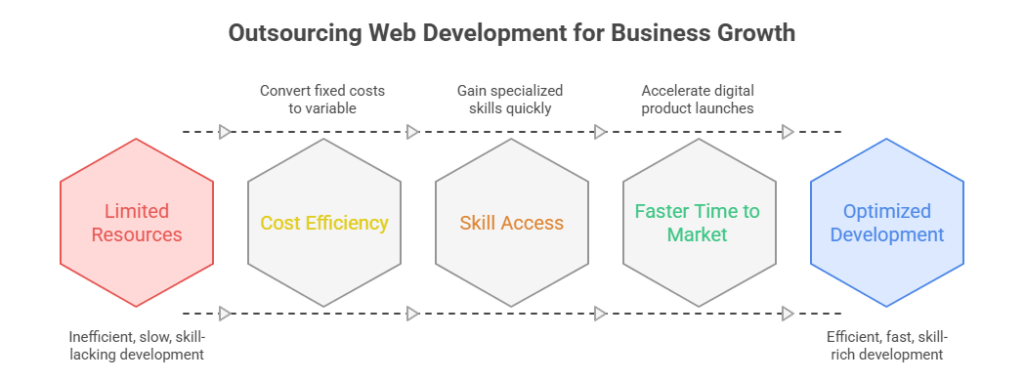
Outsourcing converts fixed payroll obligations into variable project-based or managed-service costs. Instead of absorbing long-term employment liabilities, companies align engineering spend directly with product timelines.
When structured correctly, outsourcing reduces idle capacity costs and improves budget predictability, particularly for project-based builds or seasonal demand spikes.
Modern web development isn’t “a developer.” It’s frontend performance, backend APIs, cloud infrastructure, security, CI/CD, and observability.
Gartner-backed survey reporting highlights how real the capability constraint is: talent shortage was cited as the most significant adoption barrier for 64% of emerging technologies, far ahead of implementation cost (29%) and security risk (7%).
That’s the same reason companies outsource web work: they need specialized skills now, not after a long hiring cycle.
Speed is often the decisive factor. According to McKinsey, companies that accelerate digital product launches can outperform peers significantly in revenue growth.
External development teams reduce ramp-up time because they operate with pre-built workflows, established tooling, and cross-project experience.
For businesses operating in competitive digital sectors, reducing launch timelines by even a few months can materially impact market positioning.
Outsourcing web development introduces execution leverage, but it also shifts certain operational risks outside your immediate organizational boundary.
In my experience, the risks are rarely technical, they are structural. The three most common exposure areas are communication breakdowns, inconsistent code governance, and data security misalignment.
According to the Project Management Institute (PMI), poor communication is a primary contributor to project failure in one-third of projects. When delivery teams operate across time zones and cultures, misalignment compounds quickly unless governance is structured intentionally.
The key is not to avoid outsourcing. It is to engineer oversight into the model.
Distributed teams increase coordination complexity. PMI’s “Pulse of the Profession” reports that ineffective communication remains a leading cause of project underperformance. The mitigation is straightforward but often neglected: define escalation paths, overlap hours for synchronous collaboration, and require documented sprint reporting.
I recommend structured weekly executive summaries in addition to standard standups to reduce interpretation gaps.
External delivery fails when quality standards are assumed rather than enforced. The Consortium for IT Software Quality (CISQ) estimates that poor software quality cost U.S. businesses over $2 trillion annually, largely due to operational failures and technical debt.
Governance should include code review standards, CI/CD integration visibility, documented architecture decisions, and mandatory testing thresholds. Ownership of repositories must remain with the client organization.
As per IBM, the global average cost of a data breach reached $4.45 million, the highest on record. When outsourcing involves customer data or proprietary logic, contracts must clearly define IP ownership, access controls, and data handling protocols.
NDAs alone are insufficient, including role-based access management and audit trails are non-negotiable safeguards.
Not all outsourcing models are built for the same business objective. The structure you choose affects cost predictability, execution control, and scalability.
Choosing the wrong commercial structure is one of the most common reasons outsourced projects underperform.
In practice, I evaluate outsourcing models based on three variables: scope clarity, roadmap volatility, and scaling horizon.
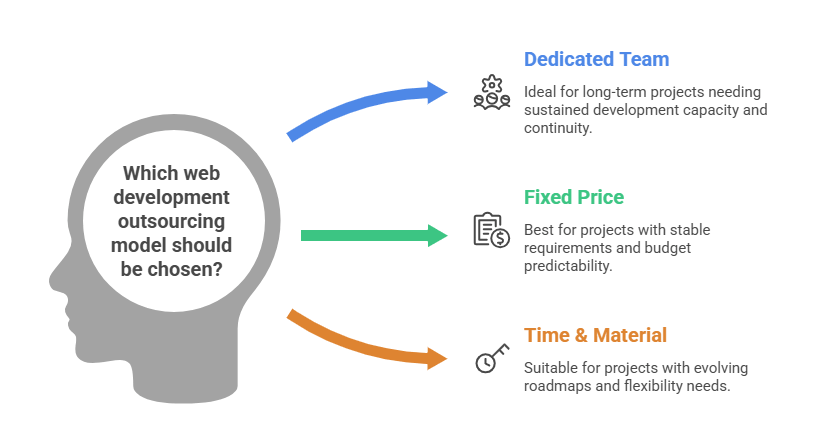
The dedicated team model embeds an external engineering team that works exclusively on your product over an extended period. This model is most effective when you need sustained development capacity without expanding internal headcount.
According to Statista, global IT outsourcing revenue exceeded $460 billion in 2023, reflecting growing enterprise reliance on long-term external delivery partnerships.
Dedicated teams provide continuity, institutional knowledge retention, and predictable velocity, making them ideal for scaling SaaS platforms or multi-year roadmaps.
Fixed price outsourcing is best suited for clearly defined projects with stable requirements, such as website rebuilds or limited-scope platform launches. Budget predictability is the main advantage.
However, the limitation is rigidity. If requirements shift, change orders increase cost and friction. This model performs well when documentation is mature and stakeholder expectations are tightly aligned from the outset.
Time & material (T&M) outsourcing offers flexibility for evolving product roadmaps. Billing is based on actual hours and resources consumed, making it better suited for agile environments.
The trade-off is less upfront cost certainty, but significantly lower risk when scope changes frequently.
For startups or innovation-driven teams, T&M often provides the most operational elasticity.
| Model | Cost Structure | Flexibility | Control Level | Best For | Primary Risk |
|---|---|---|---|---|---|
| Dedicated Team | Monthly team fee | High | High (shared governance) | Long-term product scaling | Overcommitment if roadmap slows |
| Fixed Price | Pre-defined project cost | Low | Medium | Clearly defined builds | Change-order friction |
| Time & Material | Hourly or sprint-based billing | Very High | High | Agile or evolving roadmaps | Budget variability |
If scope is stable → fixed pricing works.
If roadmap evolves → time & material is safer.
If long-term capacity is needed → dedicated team scales better.
Web development outsourcing is not limited to “building a website.” In practice, companies externalize specific layers of their digital stack depending on internal capability gaps and roadmap priorities.
According to the U.S. Bureau of Economic Analysis, digital economy activities accounted for over 10% of U.S. GDP in recent reporting, underscoring how central web infrastructure has become to business operations.
That scale is why organizations selectively outsource high-impact components rather than maintain every capability internally.
The most commonly outsourced web development services include:
In my experience, companies rarely outsource everything. They outsource where specialization, speed, or scale delivers measurable advantage.
Outsourcing fails when companies treat it as vendor procurement instead of structured delivery governance. In my experience, successful outsourcing follows a disciplined evaluation and control model.
Poorly defined requirements are one of the leading contributors to software project failure. That makes clarity, not cost, the starting point.
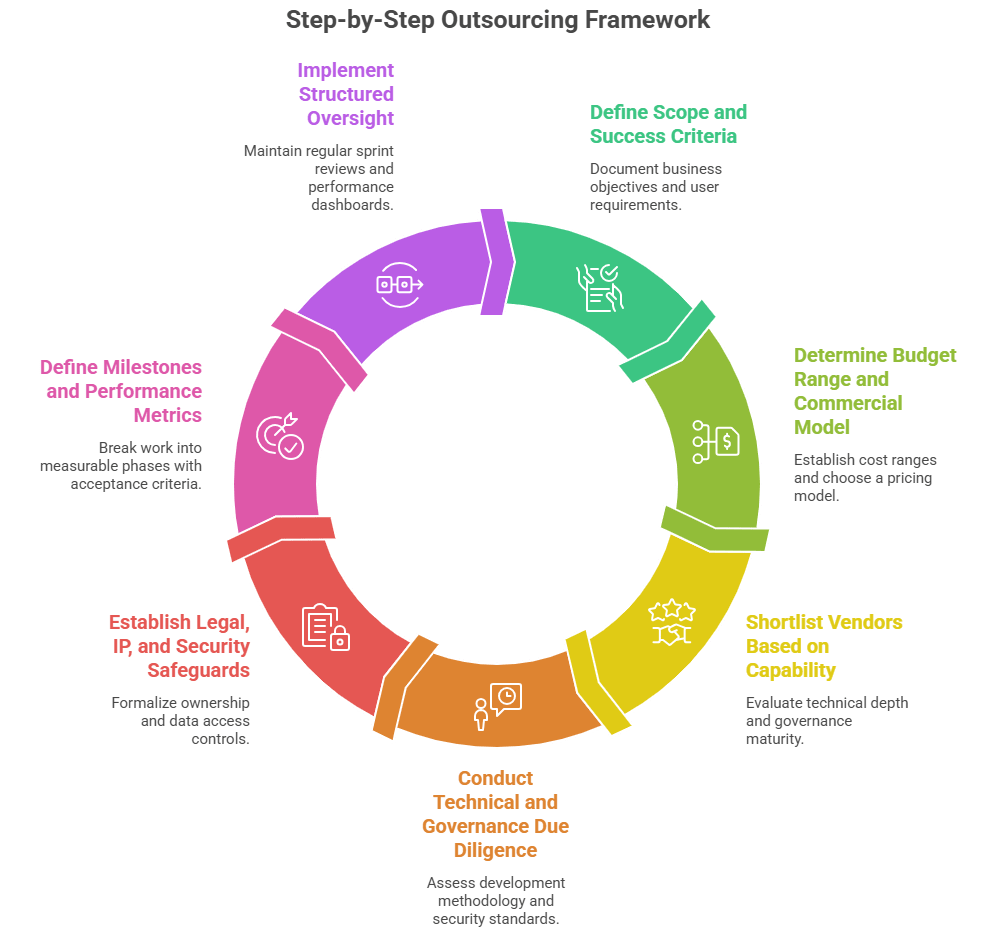
Here is the framework I use when advising companies:
Document business objectives, user requirements, technical constraints, and measurable outcomes before approaching vendors. Ambiguity increases cost later. Clear documentation reduces rework risk and misalignment.
Establish acceptable cost ranges and decide whether your project aligns with Fixed Price, Dedicated Team, or Time & Material (based on scope stability). Avoid choosing a pricing model before assessing roadmap volatility.
Evaluate technical depth, architecture experience, and governance maturity. Review code samples where possible. According to Harvard Business Review research on outsourcing, vendor selection quality directly correlates with long-term performance outcomes.
Assess development methodology (Agile, Scrum), CI/CD practices, security standards, and documentation processes. Request clarity on communication cadence and escalation paths.
Formalize ownership of repositories, intellectual property clauses, and data access controls. The National Institute of Standards and Technology (NIST) emphasizes role-based access management as a fundamental cybersecurity control.
Break work into measurable phases with acceptance criteria. Tie payments to deliverables when appropriate. Transparency prevents scope drift.
Outsourcing does not eliminate accountability, it redistributes it. Maintain regular sprint reviews, technical audits, and performance dashboards. Companies that embed structured governance in digital initiatives significantly improve transformation success rates.
If you’re evaluating outsourcing models, vendor selection, or governance frameworks, clarity upfront can prevent costly misalignment later.
Get a Strategic ConsultationThe cost of outsourcing web development varies based on geography, expertise level, project complexity, and engagement model. Average developer rates range from $25–$50 per hour in parts of Asia, $35–$70 in Latin America, and $50–$100+ in Eastern Europe, while North American agencies often exceed $100–$150 per hour.
Total project costs can range from $10,000–$25,000 for small marketing sites to $150,000+ for enterprise web platforms, depending on architecture, integrations, and scalability requirements.
Cost, however, should be evaluated through total value.
In my experience, three variables determine real outsourcing cost:
| Region | Typical Hourly Rate (USD) |
|---|---|
| South & Southeast Asia | $25–$50 |
| Latin America | $35–$70 |
| Eastern Europe | $50–$100+ |
| North America | $100–$150+ |
IT project costs should be evaluated against expected ROI and operational efficiency gains rather than lowest upfront bid. The cheapest vendor often becomes the most expensive if governance and quality controls are weak.
A mature outsourcing strategy balances cost, risk exposure, and delivery reliability. True outsourcing cost is not hourly rate multiplied by hours , it includes coordination overhead, quality assurance maturity, and governance discipline.
Outsourcing is not universally optimal. In certain scenarios, retaining development in-house is strategically stronger.
According to the U.S. National Science Foundation, businesses fund the majority of U.S. R&D activity, with internal R&D expenditures exceeding $600 billion annually in recent reporting. That investment reflects a core principle: companies protect and internalize work that directly drives proprietary innovation.
You should avoid outsourcing when:
In these cases, external execution may introduce governance friction. Outsourcing works best for scalable delivery, not for foundational R&D control.
Outsourcing becomes strategic when internal capacity or execution speed begins to constrain growth. According to the U.S. Bureau of Labor Statistics, total job openings in the United States remained above 8 million in recent reporting under the Job Openings and Labor Turnover Survey (JOLTS), reflecting sustained competition for skilled labor.
When hiring delays slow product timelines, outsourcing shifts from optional to practical.
In my experience, it’s time to outsource when:
Outsourcing is rarely about replacing teams. It’s about protecting momentum when internal scaling lags behind strategic objectives.
AppVerticals approaches web development outsourcing as a structured delivery partnership.
Each engagement starts with defined scope, architecture alignment, and sprint governance. You retain product ownership and roadmap control; AppVerticals manages execution velocity through dedicated technical leads, code review standards, QA gates, and transparent milestone reporting.fddf
Delivery is pod-based, not individual-resource based. That means continuity, cross-functional accountability, and reduced dependency risk. Repositories remain client-owned, escalation paths are predefined, and change management is documented, minimizing structural risk before it becomes operational friction.
The result is scalable execution without sacrificing oversight, quality, or strategic control, which is exactly what outsourcing should deliver.
Outsourcing web development is a structural decision about how your organization deploys technical capacity.
The real question is whether your current model supports speed, scalability, and technical depth without creating fixed-cost drag.
If your roadmap is expanding faster than your hiring pipeline, outsourcing can protect momentum. If your platform defines your intellectual property, internal ownership may be stronger.
In my experience, the best decisions are architectural. The model should match your growth stage, risk tolerance, and long-term strategic control.
AppVerticals combines engineering depth with disciplined delivery governance, helping organizations scale execution without losing strategic control.
Start Your Outsourcing Strategy
verified expert
Muhammad Adnan is a Senior Writer and Editor at AppVerticals, specializing in apps, AI, software, and EdTech, with work featured on DZone, BuiltIn, CEO Magazine, HackerNoon, and other leading tech publications. Over the past 6 years, he’s known for turning intricate ideas into practical guidance. He creates in-depth guides, tutorials, and analyses that support tech teams, business leaders, and decision-makers in tech-focused domains.
 We’re AppVerticals
AppVerticals is where innovative startups and Fortune 500s come for transformation.
View About Us Web Development
Shopify website cost depends on design complexity, apps, and development requirements. Shopify plans start at $29 per month, but most businesses spend...

14 min read
 Web Development
Website design cost in 2026 typically ranges from $15,000 to $80,000 for most businesses, with higher budgets tied to performance standards, UX depth,...
17 min read
 Web Development
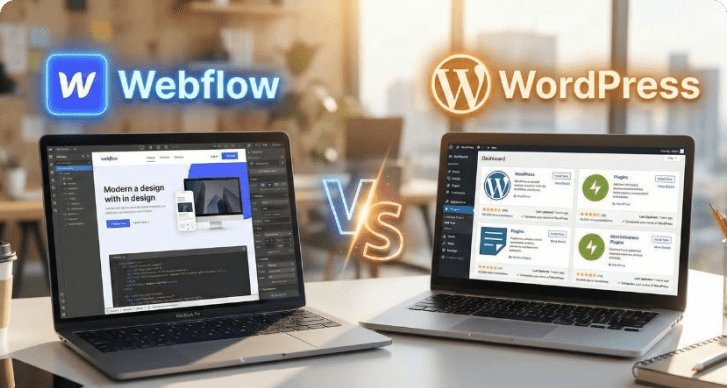
Your CMS choice, Webflow or WordPress, shapes more than your site’s look; it impacts SEO, growth potential, budgets, workflows, and upkeep. At AppVert...

9 min read
Discover how our team can help you transform your ideas into powerful Tech experiences.
AppVerticals © 2026 | All Rights Reserved

Get In Touch.












 ChatGPT
 Perplexity
 Google AI