






 ChatGPT
 Perplexity
 Google AI
Legacy software modernization in 2026 usually costs between $150,000 and $2 million+, with most mid-sized systems landing in the $150K–$500K range depending on how much needs to change.

About Us

About Us
We’re a future-focused tech partner working with some of the world’s top enterprises. At AppVerticals, we design solutions that drive growth and reimagine digital experiences.

Services
Software Development
Mobile App Development
Web Design & Development
Tell us what you're looking for, and we'll tailor a solution based on your business needs.
Talk to Experts
Health Tech

EdTech

Logistics

Real Estate

Ecommerce

Sports

Fintech

Travel

Restaurant

Automotive
HIPAA-compliant digital solutions for hospitals, clinics, and healthtech startups driving better patient outcomes.
What we do:
Scalable learning platforms for schools, universities, and EdTech startups transforming education delivery.
What we do:
Real-time tracking and automation solutions for freight companies, warehouses, and delivery services.
What we do:
PropTech platforms for brokerages, property managers, and real estate marketplaces are streamlining operations.
What we do:
High-converting commerce platforms for D2C brands, retailers, and online marketplaces are driving revenue growth.
What we do:
Fan engagement platforms for sports teams, leagues, and betting operators are creating immersive experiences.
What we do:
PCI-DSS compliant solutions for digital banks, payment platforms, and InsurTech companies, ensuring security.
What we do:
Booking and hospitality solutions for OTAs, hotels, and tourism platforms, enhancing traveler experiences.
What we do:
Online ordering and operations software for restaurants, cloud kitchens, and food delivery platforms.
What we do:
Connected vehicle platforms for automotive OEMs, dealerships, and mobility providers are accelerating innovation.
What we do:
Platforms
Our Odoo implementation brings financial discipline, operational visibility, and process control across departments. From accounting automation to manufacturing workflows, we design ERP systems that reduce operational leakage and provide real-time decision clarity.
We use Sitecore to drive measurable revenue growth through intelligent personalization and behavior-driven content delivery. By aligning marketing automation, data orchestration, and omnichannel engagement, we help brands turn digital touchpoints into retention engines.
We architect AWS environments that stay stable under scale, traffic spikes, and compliance pressure. From secure cloud migrations to CI/CD automation and cost governance, we engineer cloud foundations that protect performance while enabling rapid product evolution.
We implement Dynamics 365 to align systems with actual business operations, bringing clarity, control, and accountability across CRM, ERP, and service functions. From sales to finance, configurations eliminate inefficiencies and enable confident, real-time decisions.
Tell us what you're looking for, and we'll tailor a solution based on your business needs.
Talk to ExpertsPortfolio
AppVerticals was featured in Inc. 5000 as
America’s Fastest Growing Tech Company
See what it might cost to bring your app idea to life. Our calculator gives you a quick, simple estimate based on what you need.


 verified expert
Senior Writer and Editor - App, AI, and Software
Muhammad Adnan is a Senior Writer and Editor at AppVerticals, specializing in apps, AI, software, and EdTech, with work featured on DZone, BuiltIn, CEO Magazine, HackerNoon, and other leading tech publications. Over the past 6...
See Full Bio14 minutes read
If you’re looking at that number and thinking it’s high, it usually means your current system is already costing more than it should. Most teams don’t notice it because the spend sits in maintenance, patching, and workarounds.
The U.S. Government Accountability Office notes that agencies allocate around 80% of IT budgets to operations and maintenance, much of it tied to legacy systems.
That’s why companies start exploring legacy software modernization services not as a tech upgrade, but to regain control over cost and flexibility.
That range is wide for a reason. You’re not paying for modernization itself. You’re paying for how complex your system has become over time.
| Project Size | Cost Range |
|---|---|
| Small | $50K – $150K |
| Mid-size | $150K – $500K |
| Enterprise | $500K – $2M+ |
In real-world projects, legacy software modernization cost varies based on how much of the system needs to change. Costs increase as systems become more complex, integrated, and difficult to modify.
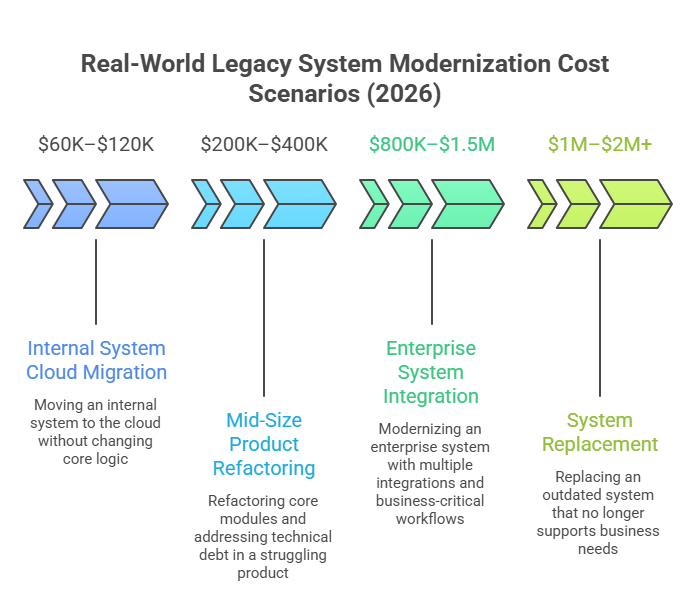
You’re not changing how the system works. You’re moving it to cloud, improving performance, and removing obvious bottlenecks.
👉 Typical cost: $60K–$120K
This stays lower because you’re not touching core logic.
The system works, but releases are slowing down, bugs take longer to fix, and performance drops under load.
👉 Typical cost: $200K–$400K
Costs increase because teams start refactoring core modules and addressing technical debt.
You’re dealing with APIs, third-party systems, large datasets, and business-critical workflows. Downtime is not an option.
👉 Typical cost: $800K–$1.5M
The cost comes from coordination, phased rollouts, and ensuring system stability.
Every change takes too long, integrations fail, and the architecture no longer fits your needs.
👉 Typical cost: $1M–$2M+
At this point, you’re replacing the system entirely.
Get a realistic estimate based on your system, not generic ranges. We assess your architecture, technical debt, and integration complexity before recommending the right approach.
Get Your Modernization Cost BreakdownThe more complex and constrained your system is across these areas, the higher the cost moves. Here’s how these factors actually play out:
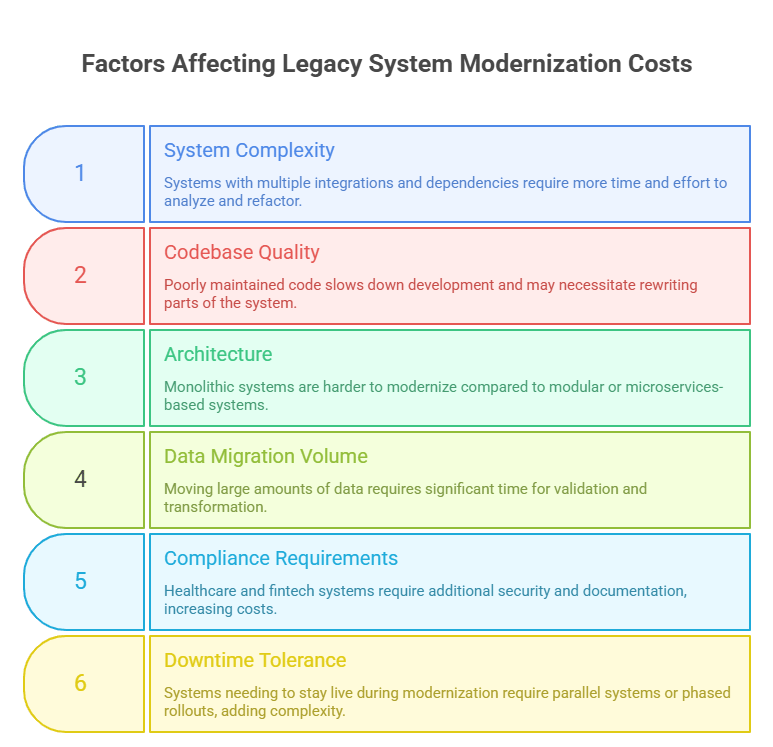
1. System complexity
Systems with multiple integrations, dependencies, and workflows take more time to analyze, refactor, and test.
2. Codebase quality (technical debt)
Poorly maintained code slows down development and often forces teams to rewrite parts instead of improving them.
3. Architecture (monolith vs microservices)
Monolithic systems are harder to break and modernize. Modular or microservices-based systems reduce effort.
4. Data migration volume
The more data you move, the more time you spend on validation, transformation, and ensuring nothing breaks.
5. Compliance requirements
Healthcare and fintech systems require additional security, audits, and documentation, which increases both cost and timelines.
6. Downtime tolerance
If your system needs to stay live during modernization, teams must build parallel systems or phased rollouts, which adds complexity.
| Factor | Impact on Cost |
|---|---|
| System complexity | Increases overall development, testing, and integration effort |
| Codebase quality | Poor quality leads to rework and longer timelines |
| Architecture | Monoliths require more effort compared to modular systems |
| Data migration | Larger datasets increase risk, validation, and effort |
| Compliance | Adds security layers, audits, and regulatory checks |
| Downtime tolerance | Zero-downtime setups require additional infrastructure and planning |
Most projects don’t become expensive because of one factor alone. Costs increase when two or three of these factors combine, especially in systems that have evolved over years without structured updates.
It directly impacts budget, timelines, and how much value you get from the investment.
| Approach | Cost | Time | Risk | Use Case |
|---|---|---|---|---|
| Rehosting | Low | Fast | Low | Lift & shift |
| Replatforming | Medium | Medium | Medium | Minor upgrades |
| Refactoring | Medium–High | Medium | Medium | Code optimization |
| Rebuilding | High | Long | High | Full transformation |
Most teams don’t choose the most expensive option. They choose the one that fits their current constraints. If your system still works but struggles with performance, refactoring often makes sense. If it’s holding back growth or impossible to maintain, rebuilding becomes a more practical investment.
It reflects how much of the system you’re changing and how far you want to take it.
The right choice usually comes down to one question. Are you trying to extend the life of the system or replace it for the future.
Hidden costs usually add 20–40% on top of your modernization budget. In complex systems, that overrun can go even higher.
Enterprises report up to $370 million annually in losses due to legacy systems and technical debt, including maintenance inefficiencies and failed modernization efforts.
Most teams don’t plan for this. They budget for development, but the real cost sits in what surrounds it. Here’s what that actually looks like in practice.
1. Maintenance overhead
You keep spending every year just to keep the system stable. That money doesn’t move the business forward. It just keeps things from breaking.
2. Downtime and performance issues
Systems slow down, fail more often, and take longer to recover. That cost shows up in lost revenue and operational delays.
3. Security risks
Older systems are harder to patch and monitor. One serious incident can cost more than the modernization you delayed.
4. Lost scalability
This is where most companies feel it. You stop shipping faster. You avoid new features. Growth slows down because the system can’t keep up.
👉 What this looks like in reality
A platform rebuild and modernization helped a marketplace scale revenue from $100K to $13M, showing how modernization costs often tie directly to growth unlock rather than just system upgrades.
The reason this shifts is cost efficiency over time. According to McKinsey & Company, organizations that modernize effectively can reduce IT costs by up to 30% while improving delivery speed and scalability. That’s where rebuilding starts to make sense. You stop carrying the weight of old architecture.
| Scenario | Best Option |
|---|---|
| Stable system | Modernize |
| Outdated architecture | Rebuild |
| High technical debt | Rebuild |
In most cases, teams don’t choose the cheaper option. They choose the one that avoids paying the same cost again in the next two to three years.
In some teams, productivity gains go as high as 50%, but the actual cost savings depend on how the tools are used.
The shift is already visible. Tools like GitHub Copilot, Cursor, and Claude Code are now part of real modernization workflows, not just experiments.
AI reduces the execution cost, not the decision complexity.
If your modernization effort is heavy on repetitive work, refactoring, and debugging, AI can bring real savings. But if the challenge sits in architecture, integrations, or compliance, AI won’t cut those costs significantly.
In most real projects, AI helps teams move faster and slightly cheaper. It doesn’t turn a $500K modernization into a $100K project. It helps you get more done within the same budget or reduce timelines without compromising delivery.
Lulo Freight’s legacy system struggled with slow performance, limited transparency, and scalability issues, preventing business growth and operational efficiency.
AppVerticals modernized the platform by:
Results:
Legacy software modernization cost in 2026 isn’t a fixed number. It moves based on how much of your system needs to change and how complex that system has become over time. Most projects fall between $150K and $500K, but costs rise quickly when architecture, data, and integrations require deeper changes.
What matters is not just the upfront investment, but the direction of your spending. You either continue putting budget into maintaining a system that slows you down, or you invest in changing it so it supports growth.
In most cases, the decision becomes clear when you look at your system honestly. If it still works and only needs improvement, modernization keeps costs controlled. If it’s limiting your business, rebuilding becomes the more practical choice.
Avoid overpaying or choosing the wrong approach. Get a clear, technical evaluation of your system and a roadmap aligned with your budget and growth plans.
verified expert
Muhammad Adnan is a Senior Writer and Editor at AppVerticals, specializing in apps, AI, software, and EdTech, with work featured on DZone, BuiltIn, CEO Magazine, HackerNoon, and other leading tech publications. Over the past 6 years, he’s known for turning intricate ideas into practical guidance. He creates in-depth guides, tutorials, and analyses that support tech teams, business leaders, and decision-makers in tech-focused domains.
 We’re AppVerticals
AppVerticals is where innovative startups and Fortune 500s come for transformation.
View About Us Custom Software
Choosing between in-house and outsourcing software development in 2026 comes down to one thing: building the right product without slowing down growth...

22 min read
 Custom Software
Late launches, budget overruns, rewrites, security surprises, and months of product churn rarely come from bad engineers. They come from a poorly stru...

22 min read
 Custom Software
SaaS adoption is accelerating faster than ever. The global SaaS market reached $315.68 billion in 2025 and is projected to grow rapidly as businesses...

12 min read
Discover how our team can help you transform your ideas into powerful Tech experiences.
AppVerticals © 2026 | All Rights Reserved

Get In Touch.