About Us

About Us
We’re a future-focused tech partner working with some of the world’s top enterprises. At AppVerticals, we design solutions that drive growth and reimagine digital experiences.
Services
Software Development
Mobile App Development
Web Design & Development
Tell us what you're looking for, and we'll tailor a solution based on your business needs.
Talk to Experts
Health Tech

EdTech

Logistics

Real Estate

Ecommerce

Sports

Fintech

Travel

Restaurant

Automotive
HIPAA-compliant digital solutions for hospitals, clinics, and healthtech startups driving better patient outcomes.
What we do:
Scalable learning platforms for schools, universities, and EdTech startups transforming education delivery.
What we do:
Real-time tracking and automation solutions for freight companies, warehouses, and delivery services.
What we do:
PropTech platforms for brokerages, property managers, and real estate marketplaces are streamlining operations.
What we do:
High-converting commerce platforms for D2C brands, retailers, and online marketplaces are driving revenue growth.
What we do:
Fan engagement platforms for sports teams, leagues, and betting operators are creating immersive experiences.
What we do:
PCI-DSS compliant solutions for digital banks, payment platforms, and InsurTech companies, ensuring security.
What we do:
Booking and hospitality solutions for OTAs, hotels, and tourism platforms, enhancing traveler experiences.
What we do:
Online ordering and operations software for restaurants, cloud kitchens, and food delivery platforms.
What we do:
Connected vehicle platforms for automotive OEMs, dealerships, and mobility providers are accelerating innovation.
What we do:
Portfolio
AppVerticals was featured in Inc. 5000 as
America’s Fastest Growing Tech Company
See what it might cost to bring your app idea to life. Our calculator gives you a quick, simple estimate based on what you need.



 verified expert
Founder Emmeline AI, AI Readiness Architect, Barrister
Carolyn Shepherd is an AI workforce transformation expert, keynote speaker and author known for helping leaders and organisations embed human‑centred AI adoption. A former barrister who moved into senior HR leadership, she combines legal judgement,...
See Full Bio6 minutes read
We all agree that AI is advancing fast, and we read that what Microsoft calls ‘Frontier firms’ are already shifting from AI Assistants to increasingly autonomous AI Agents; indeed, some are even testing the potential of human-free business.
However, these hyped headlines don’t reflect what we see on the ground, where the majority of organisations are still trying to embed basic usage of tools like MS Copilot across their workforce. The reality is a widening capability gap, not because the technology isn’t ready, but because the people who need to use it aren’t.
‘Skills are the constraint, not tools.’
(Gartner AI Hype Cycle for Artificial Intelligence was published in late 2025.)
For CTOs, this means AI adoption is now a capability race. Technology, HR, and L&D must work as a unified engine; humans will slow AI rollout and limit value creation.
A CTO’s first responsibility is to understand the organisation’s true AI readiness. While technical foundations, including data quality, infrastructure, integration, and security, remain essential, they are no longer the main point of failure. The real friction now lies in workforce readiness.
This mismatch creates the “hollow middle”: a scenario where agent‑level technology is deployed into an organisation that is not psychologically, ethically, or practically ready to work with it.
To prevent this, CTOs must partner closely with HR and L&D to evaluate skills, confidence, and behavioural readiness. At the same time, the tri‑team must define clear ethical guardrails, so employees know exactly what responsible AI use looks like. When people understand the boundaries, adoption moves faster. Without them, uncertainty becomes the primary brake.
Even world‑class AI systems fail when employees are unsure how to use them. Building capability and confidence is not “nice to have,” it’s the foundation for scaling AI safely and effectively.
CTOs must champion a capability‑building programme designed jointly with HR and L&D. This should include shared AI language, role‑specific training, practical use of MS Copilot, and clarity on ethical expectations. Psychological safety matters: employees need permission to experiment, question, and refine their understanding.
The payoff is enormous. Confident employees embed organisational expertise into AI‑supported workflows. Hesitant employees disengage or defer blindly to the tool. One accelerates adoption; the other slows it.
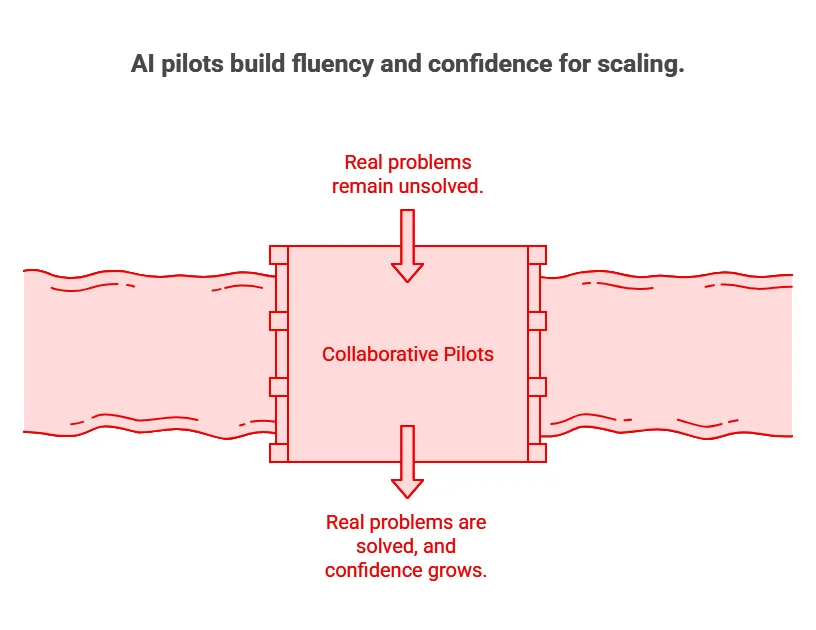
Strong early use cases solve real business problems while simultaneously raising the organisation’s AI fluency. The most effective pilots act as learning engines, i.e., collaborative environments where Tech, HR, L&D, and business teams observe, experiment, and refine together.
AI will not scale without AI‑fluent leadership. Managers must be able to evaluate AI outputs, challenge flawed recommendations, and ensure teams apply ethical and safe practices. L&D should embed these competencies into leadership development so that leaders model responsible use and build confidence across their teams.
When leaders are confident, adoption accelerates. When they are hesitant, adoption freezes regardless of how advanced the tools are.
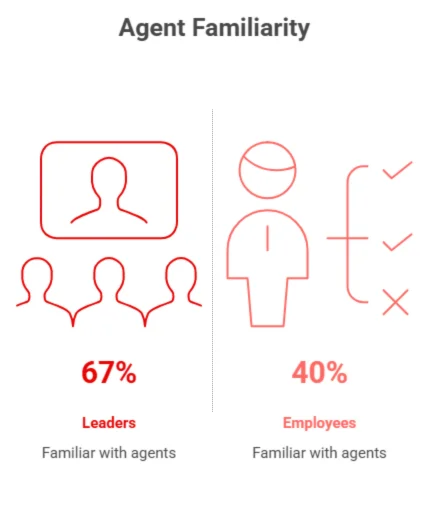
AI Assistants are already widespread, and AI Agents are rapidly entering enterprise systems. Microsoft’s latest research shows that ‘81% of leaders expect to integrate agents into their strategy within 12–18 months.’ Yet employees remain drastically less prepared: ‘only 40% are familiar with agents’, and I would say in the case of the average workforce, the true figure is far smaller.
This is the challenge. And it is also an opportunity.
A sustainable AI roadmap requires:
Robust infrastructure, secure data management, and strong integrations that enable scalable AI systems.
A workforce that continuously develops its skills and adapts at the same pace as evolving technology.
Clear, values-aligned governance and policies that ensure responsible AI use and build long-term trust.
For CTOs, the path forward is unmistakable: lead the technical strategy, co‑lead the capability strategy, and anchor everything in transparent, values‑aligned governance.
Because the future of AI isn’t just about deploying agents; it’s about building a workforce that is ready to lead them.
verified expert
Carolyn Shepherd is an AI workforce transformation expert, keynote speaker and author known for helping leaders and organisations embed human‑centred AI adoption. A former barrister who moved into senior HR leadership, she combines legal judgement, organisational insight and practical technology expertise to guide inclusive, sustainable change. Recognised on the UK AI 100 Leaders list and ranked #12 on HR Magazine’s Most Influential Thinkers, she is the inventor of Schema Shift Analytics and the patent‑pending SYMBA framework.
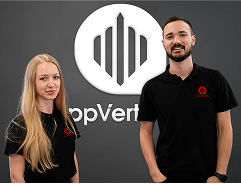 We’re AppVerticals
AppVerticals is where innovative startups and Fortune 500s come for transformation.
View About Us AI
AI
They are one of the most visible forms of artificial intelligence in modern organizations. In contrast to previous AIs, which sat silently in the back...

7 min read
 AI
AI
Looking for reliable Janitor AI alternatives? Many users have turned to other platforms after facing issues like server errors and disappearing chats....

17 min read
 AI
AI
70% of the app development professionals are exploring AI-driven tools to cut-down coding times, reduce repetitive tasks and automate workflows in 202...

14 min read
Discover how our team can help you transform your ideas into powerful Tech experiences.
AppVerticals © 2026 | All Rights Reserved

Get In Touch.










 ChatGPT
 Perplexity
 Google AI