About Us

About Us
We’re a future-focused tech partner working with some of the world’s top enterprises. At AppVerticals, we design solutions that drive growth and reimagine digital experiences.

Services
Software Development
Mobile App Development
Web Design & Development
Tell us what you're looking for, and we'll tailor a solution based on your business needs.
Talk to Experts
Health Tech

EdTech

Logistics

Real Estate

Ecommerce

Sports

Fintech

Travel

Restaurant

Automotive
HIPAA-compliant digital solutions for hospitals, clinics, and healthtech startups driving better patient outcomes.
What we do:
Scalable learning platforms for schools, universities, and EdTech startups transforming education delivery.
What we do:
Real-time tracking and automation solutions for freight companies, warehouses, and delivery services.
What we do:
PropTech platforms for brokerages, property managers, and real estate marketplaces are streamlining operations.
What we do:
High-converting commerce platforms for D2C brands, retailers, and online marketplaces are driving revenue growth.
What we do:
Fan engagement platforms for sports teams, leagues, and betting operators are creating immersive experiences.
What we do:
PCI-DSS compliant solutions for digital banks, payment platforms, and InsurTech companies, ensuring security.
What we do:
Booking and hospitality solutions for OTAs, hotels, and tourism platforms, enhancing traveler experiences.
What we do:
Online ordering and operations software for restaurants, cloud kitchens, and food delivery platforms.
What we do:
Connected vehicle platforms for automotive OEMs, dealerships, and mobility providers are accelerating innovation.
What we do:
Portfolio

AppVerticals was featured in Inc. 5000 as
America’s Fastest Growing Tech Company
See what it might cost to bring your app idea to life. Our calculator gives you a quick, simple estimate based on what you need.


 verified expert
Technical Writer — Platforms, SaaS & Digital Products
Vareesha writes about platforms and SaaS with a clear, experience-led approach. With 3+ years in technical writing, she translates complex business and technical concepts into structured, actionable content for founders and product teams. Having worked...
See Full Bio14 minutes read
Even experienced teams get caught off guard. Flexera’s 2025 report shows 84% of organizations struggle to manage cloud spend, and small projects often exceed expected storage or data transfer costs within six months. Usually, it’s not server costs but compute scaling, bandwidth, logging, and idle resources that drive bills higher than anticipated.
This guide offers a practical AWS pricing overview, including pricing models, Free Tier limits, developer overhead, and cost optimization strategies, giving decision-makers a clear picture of typical baseline spend. It also shows how early expert AWS consulting & guidance can help avoid costly surprises, optimize resources, and make cloud costs more predictable.
| Key Insight | Why It Matters | Example / Approx. Cost* |
|---|---|---|
| AWS pricing is usage-based | You pay only for compute, storage, requests, and data transfer, which can fluctuate with workload | Small SaaS baseline: ~$300–$350/month |
| Multiple pricing models exist | On-Demand, Savings Plans, Reserved, and Spot fit different workloads and commitment levels | Spot can be up to 90% cheaper; Savings Plans ~72% off On-Demand |
| Free Tier has limits | Ideal for testing, POCs, and prototypes; production traffic quickly exceeds free allocations | Lambda: 1M requests/month free; S3: 5 GB free |
| Developer & DevOps costs matter | Infrastructure alone isn’t the full picture; talent costs can double total spend | U.S. DevOps avg: ~$130K/year; Software dev median: ~$133K/year |
| Cost optimization is actionable | Rightsizing, Spot usage, lifecycle policies, and budgeting reduce waste without impacting performance | Optimizing idle EC2 volumes or using CloudFront caching can cut hundreds/month |
*Illustrative estimates based on US East (N. Virginia) pricing; actual costs vary by region, usage, and architecture.
In most cases, it’s not compute, but bandwidth, logging, and underutilized resources. A clear estimate usually reveals where costs drift.
Get Cost EstimateCore Principles:
Operational Nuances:
Decision-Maker Takeaways:
| Model | Definition | Best Use Case | Advantages | Trade-offs |
|---|---|---|---|---|
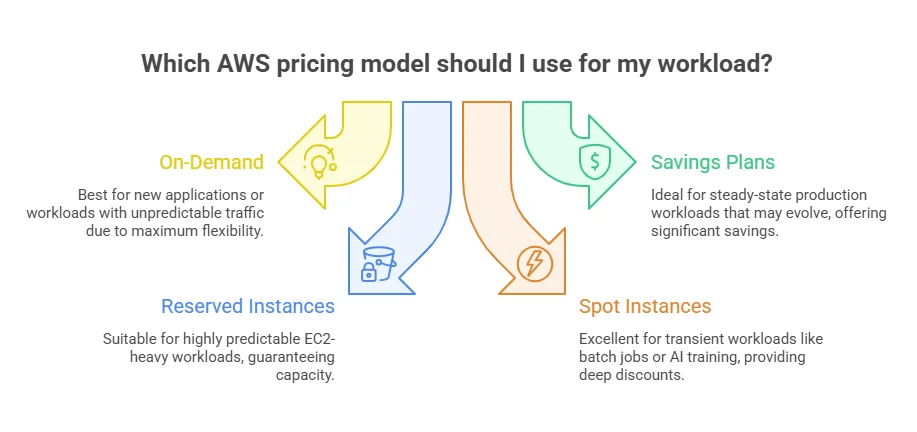
| On-Demand | Pay per second or hour with no long-term commitment | New applications, pilots, or workloads with unpredictable or spiky traffic | Maximum flexibility; no upfront commitment | Highest per-unit cost; convenience premium if used long-term |
| Savings Plans | Commit to a consistent hourly spend (1- or 3-year term) for discounted pricing | Steady-state production workloads that may evolve | Up to 72% savings; applies across regions, instance families, and OS; now includes Database Savings Plans for RDS/Aurora/DynamoDB | Requires commitment; tracking usage is critical |
| Reserved Instances | Commit to specific instance type and region for 1-3 years | Highly predictable EC2-heavy workloads | Up to 72% savings; capacity guaranteed | Less flexible than Savings Plans; harder to shift workloads |
| Spot Instances | Use spare EC2 capacity at deep discounts | Batch jobs, CI/CD, AI/ML training, fault-tolerant workloads | Up to 90% off On-Demand; excellent for transient workloads | Can be interrupted with ~2-minute notice; requires automation for resiliency |
Practical Limits:
When AWS Free Tier is Sufficient:
When AWS Free Tier Isn’t Enough:
AWS costs vary by workload size and usage. Small apps typically run $300-$500/month, mid‑market SaaS development workloads $10k-$50k/month, and enterprise deployments $100k+ monthly. Expenses come from compute, storage, data transfer, managed services, and idle resources.
Scenario Breakdown
| Scenario | Monthly Cost Estimate | Why Costs Fluctuate |
|---|---|---|
| Static site / brochure app | S3 storage: $2.30 (100 GB), Internet egress: ~$9 (100 GB) → Total ~$11-$20 | Traffic spikes, CDN choices, log retention |
| Serverless MVP | Lambda compute often negligible under Free Tier; storage and egress dominate | Sudden API usage increases, logging costs |
| Small production SaaS | ALB: $16.43, S3 1TB: $23.55, Internet egress 1TB: $83.16, RDS r5.large: $101.18 → Baseline ~$224+ | Compute scaling, managed DB, monitoring, backups |
| Growth-stage / enterprise app | Multiple environments, HA, cross-AZ traffic → $1,000s–$100,000+ | Architecture complexity, governance gaps, operational overhead |
Key Takeaways for Decision-Makers:
Identical AWS services can cost more depending on the region. US East (N. Virginia) is a common baseline, but Europe, Asia Pacific, or South America can be 10-55% higher for compute, managed databases, and data transfer.
| Service | Usage | US East (N. Virginia) | Europe (Frankfurt) | Asia Pacific (Sydney) | Notes |
|---|---|---|---|---|---|
| EC2 t3.medium | 24/7 | $59.90 | $69.12 | $75.36 | ~10-25% higher outside US |
| RDS db.t3.medium | 24/7 | $48.24 | $55.92 | $60.48 | Managed DB fees vary by region |
| S3 Storage | 1 TB | $23.55 | $25.60 | $26.00 | Tiered storage differs slightly |
| S3 Data Transfer Out | 1 TB | $92.16 | $101.38 | $108.00 | Egress-sensitive |
| CloudFront | 1 TB transfer | $87.04 | $87.04 | $87.04 | Mostly global pricing |
The real cost of AWS often exceeds $130K-$133K/year per engineer, because talent, developers, DevOps, and cloud architects, typically outweighs raw compute and storage expenses. Infrastructure costs are only part of the story.
Cost Comparison Table:
| Approach | Infrastructure Spend | Talent / Management Cost | Best Fit |
|---|---|---|---|
| Founder-led startup | Low | Hidden cost in rework, slow delivery | MVPs, experiments |
| In-house DevOps + engineering | Optimizable | High fixed payroll; strong long-term capability | Product companies scaling internally |
| Consulting / managed support | Variable | Lower waste if architecture optimized fast | Migrations, audits, short timelines, cost rescue |
| Hybrid model | Balanced | Smaller internal team plus targeted experts | Mid-market firms balancing flexibility and cost |
Executive Insight:
Early decisions around architecture and pricing models often define long-term spend efficiency.
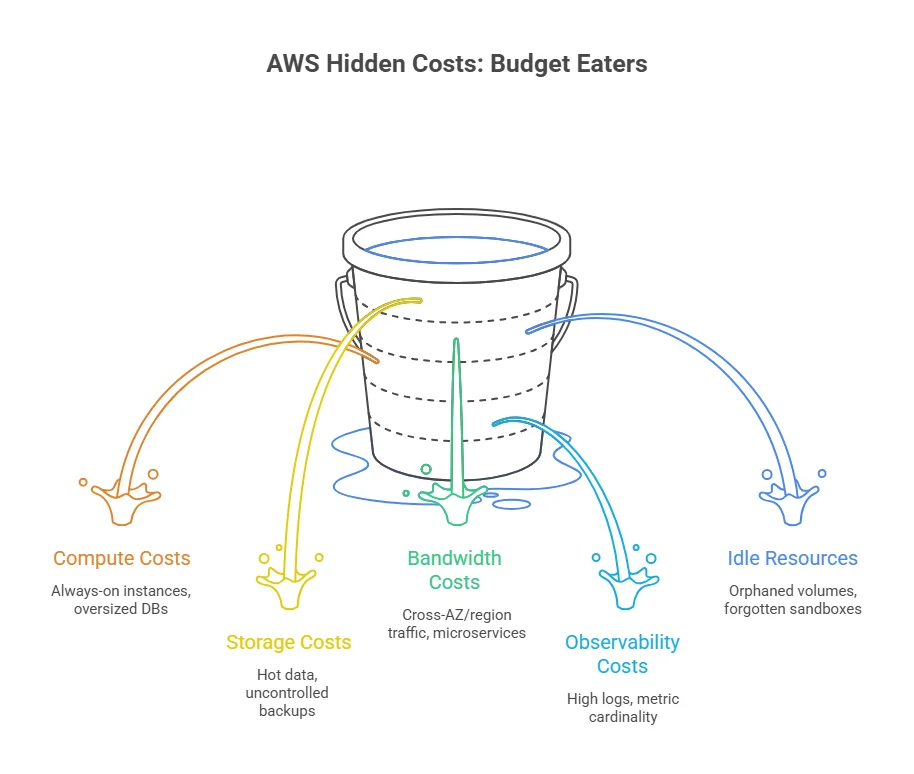
Plan My CostsAWS invoices rarely show the full picture. Beyond compute and storage, “invisible” costs can quietly eat 20-30% of your budget. Even a $1k bill can hide hundreds in unexpected costs if idle resources, logging, or cross-region traffic aren’t managed.
| Hidden Cost | Example / Impact | Mitigation |
|---|---|---|
| Compute | Always-on EC2 instances, oversized DBs, idle environments | Rightsize instances, terminate unused servers, schedule auto-scaling |
| Storage | Hot data in premium tiers, uncontrolled backups, RDS snapshots | Use S3 Intelligent-Tiering, lifecycle policies, move old snapshots to Glacier |
| Bandwidth | Cross-AZ or cross-region traffic, microservices across regions | Plan network topology, consolidate regions, optimize data transfer |
| Observability | CloudWatch logs, high metric cardinality, excessive tracing | Set retention, sampling, and filters; monitor usage growth |
| Idle Resources | Orphaned EBS volumes, stopped instances, forgotten sandboxes | Regular audits, automated cleanup scripts, enforce tagging policies |
Before launching a single instance or Lambda function, use the AWS Pricing Calculator to forecast costs transparently. Estimation prevents “bill shock” and allows leadership to plan staffing and architecture with precision.
Step-by-Step Cost Estimation Workflow:
The best AWS cost optimization strategies start with rightsizing compute, eliminating idle resources, and aligning workloads to Savings Plans, Reserved, or Spot instances, embedding cost control into architecture from day one.
Reactive fixes after high bills aren’t enough; multi-AZ setups, AI workloads, and growing data can drive 29% waste in IaaS/PaaS, quietly subsidizing competitors’ innovation.
Executive Checklist:
Developer discussions on Reddit, Stack Overflow, and internal forums consistently highlight three recurring themes:
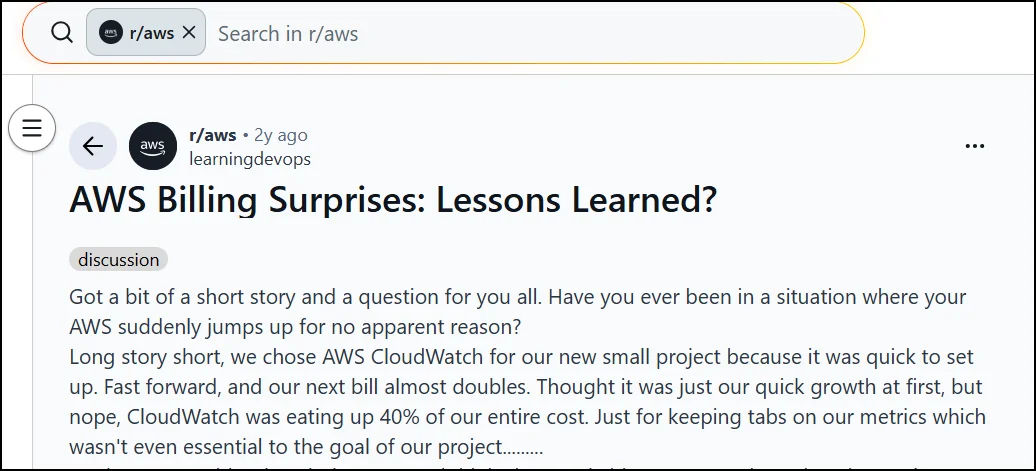
“CloudWatch was eating up 40% of our entire cost.”
This is a classic example of how monitoring and logging costs can spiral when debug-level logging or excessive custom metrics are left unchecked.
This highlights a frequent hidden cost in multi-AZ architectures, especially with load balancers or microservices that don’t optimize for same-AZ traffic.
Practitioner Insight:
Even technically skilled teams can see AWS bills grow unexpectedly without structured oversight. At AppVerticals, we:
Not every AWS deployment requires external help, but engaging consulting experts can accelerate efficiency, reduce risk, and optimize costs when workloads are critical, complex, or growing rapidly.
| Option | When It Works | Trade-Off |
|---|---|---|
| Build in-house | Small, controlled workloads; internal expertise available | Longer learning curve; slower optimization |
| Hire full-time | Steady-state production with ongoing cloud growth | High payroll cost; may underutilize expertise |
| Consult / MSP | Fast migrations, audits, cost optimization, or short-term expertise | Variable cost; requires external coordination |
AWS costs are flexible but can quickly grow without careful workload planning and optimization. Rightsizing, Savings Plans, tagging, and monitoring can cut spend by 30-50% while maintaining performance.
At AppVerticals, I’ve seen how early guidance and structured cost management help organizations save money, improve visibility, and scale confidently. Treating cost optimization as part of every cloud decision turns AWS from a variable expense into a predictable platform for growth.
From pricing models to architecture, small decisions can have long-term financial impact.
Review My Decisions
verified expert
Vareesha writes about platforms and SaaS with a clear, experience-led approach. With 3+ years in technical writing, she translates complex business and technical concepts into structured, actionable content for founders and product teams. Having worked closely on platform implementation and documentation, she brings real-world insight into how these systems function beyond the surface.
 We’re AppVerticals
AppVerticals is where innovative startups and Fortune 500s come for transformation.
View About Us AWS
AWS
AWS Cloud Migration Strategy is the structured approach organizations use to move workloads to AWS while balancing speed, cost, risk, and long-term va...

16 min read
Discover how our team can help you transform your ideas into powerful Tech experiences.
AppVerticals © 2026 | All Rights Reserved

Get In Touch.












 ChatGPT
 Perplexity
 Google AI