About Us

About Us
We’re a future-focused tech partner working with some of the world’s top enterprises. At AppVerticals, we design solutions that drive growth and reimagine digital experiences.

Services
Software Development
Mobile App Development
Web Design & Development
Tell us what you're looking for, and we'll tailor a solution based on your business needs.
Talk to Experts
Health Tech

EdTech

Logistics

Real Estate

Ecommerce

Sports

Fintech

Travel

Restaurant

Automotive
HIPAA-compliant digital solutions for hospitals, clinics, and healthtech startups driving better patient outcomes.
What we do:
Scalable learning platforms for schools, universities, and EdTech startups transforming education delivery.
What we do:
Real-time tracking and automation solutions for freight companies, warehouses, and delivery services.
What we do:
PropTech platforms for brokerages, property managers, and real estate marketplaces are streamlining operations.
What we do:
High-converting commerce platforms for D2C brands, retailers, and online marketplaces are driving revenue growth.
What we do:
Fan engagement platforms for sports teams, leagues, and betting operators are creating immersive experiences.
What we do:
PCI-DSS compliant solutions for digital banks, payment platforms, and InsurTech companies, ensuring security.
What we do:
Booking and hospitality solutions for OTAs, hotels, and tourism platforms, enhancing traveler experiences.
What we do:
Online ordering and operations software for restaurants, cloud kitchens, and food delivery platforms.
What we do:
Connected vehicle platforms for automotive OEMs, dealerships, and mobility providers are accelerating innovation.
What we do:
Portfolio

AppVerticals was featured in Inc. 5000 as
America’s Fastest Growing Tech Company
See what it might cost to bring your app idea to life. Our calculator gives you a quick, simple estimate based on what you need.



 verified expert
Senior Writer and Editor - App, AI, and Software
Muhammad Adnan is a Senior Writer and Editor at AppVerticals, specializing in apps, AI, software, and EdTech, with work featured on DZone, BuiltIn, CEO Magazine, HackerNoon, and other leading tech publications. Over the past 6...
See Full Bio19 minutes read
Angular vs React is a strategic decision that affects scalability, hiring, and long-term maintainability.
Whether you’re building in-house or working with a web development company, the framework you choose will influence architecture, governance, and long-term technical risk.
According to Stack Overflow, React remains the most widely used web framework among professional developers, reflecting its broad ecosystem and talent availability.
Angular, backed by Google, continues to be widely adopted in enterprise environments that prioritize structured architecture and TypeScript-first development.
Both can power large-scale applications, but their architectural philosophies differ. This guide compares React and Angular specifically through the lens of scalable web applications.
| Evaluation Area | React | Angular |
|---|---|---|
| Core Type | UI Library | Full Framework |
| Maintained By | Meta | |
| Architecture Style | Flexible, unopinionated | Opinionated, structured |
| Language | JavaScript / Optional TypeScript | TypeScript-first |
| Learning Curve | Moderate | Steeper |
| Built-in Tooling | Minimal (choose ecosystem tools) | Integrated routing, DI, forms |
| Startup Fit | Strong (fast iteration) | Moderate |
| Enterprise Fit | Strong with governance | Very Strong by default |
| Hiring Pool | Broader global adoption | More enterprise-aligned |
| Scalability Ceiling | High (architecture-driven) | High (architecture-driven) |
| Technical Debt Risk | Depends on internal discipline | Depends on structural complexity |
| Best For | Flexible SaaS, rapid MVPs | Large teams, structured environments |
Angular and React both power modern web applications, but they differ fundamentally in philosophy, structure, and ecosystem design. React is a UI-focused library that prioritizes flexibility and composability, while Angular is a full-featured framework that provides built-in architectural patterns and tooling.
Understanding this distinction is critical when evaluating scalability, team coordination, and long-term maintainability.
React is a JavaScript library focused specifically on building user interfaces through reusable, component-based architecture. It gives developers flexibility to choose routing, state management, and tooling based on project needs.
React is maintained by Meta and has one of the largest frontend ecosystems globally. React has over 220,000+ GitHub stars, reflecting strong community adoption and ecosystem maturity.
Because React is unopinionated about application structure, teams must define architectural conventions themselves. This flexibility accelerates development but requires disciplined engineering standards as projects scale.
Angular is a full-fledged frontend framework developed and maintained by Google. Unlike React, it provides built-in solutions for routing, dependency injection, form handling, HTTP services, and state management patterns.
Angular is written in and strongly integrated with TypeScript, which aligns with broader enterprise development trends.
According to the State of JavaScript, TypeScript usage continues to grow across professional teams, reinforcing Angular’s enterprise positioning.
Angular’s opinionated architecture enforces structure by default. This can reduce ambiguity in large development teams but may introduce additional complexity for smaller projects.
| Evaluation Factor | React | Angular |
|---|---|---|
| Type | UI Library | Full Framework |
| Maintained By | Meta | |
| GitHub Stars (2024) | 220K+ | 95K+ |
| Architecture Style | Flexible | Opinionated |
| Language | JavaScript / TypeScript | TypeScript-first |
| Built-in Tooling | Minimal | Extensive (routing, DI, forms) |
| Learning Curve | Moderate | Steeper |
| Ecosystem Size | Very Large | Large |
| Team Standardization | Requires internal conventions | Enforced by framework |
| Enterprise Alignment | High | Very High |
Both Angular and React scale effectively for large web applications when the underlying architecture is well designed.
I don’t consider one inherently more scalable than the other, performance at scale depends more on state management, code organization, and backend infrastructure than on the framework itself.
React gives teams architectural flexibility, which can scale extremely well with disciplined engineering practices. Angular enforces structure by default, which can make large team coordination more predictable.
If scalability is the only concern, either framework can support high-growth applications, the deciding factor is how your team manages complexity as the product evolves.
Scalability is driven more by architecture and performance discipline than by whether you pick React or Angular. On today’s web, the biggest scalability killers are usually payload size, rendering strategy, and backend/API efficiency, not the framework label.
The median desktop page ships ~708 KB of JavaScript, showing how quickly performance can degrade if you don’t control bundles, code splitting, and loading strategy.
Real-user performance improvements also show measurable business impact: Rakuten 24 reported that a “good” LCP was associated with a 61.13% conversion rate increase (measured using real-user Web Vitals).
So, treat React vs Angular as a team/process and architecture choice: state management, module boundaries, lazy loading, caching/CDN, and API performance determine whether your app scales cleanly.
Both React and Angular are capable of supporting high-traffic applications, including performance-sensitive use cases like ecommerce web development.
The real performance constraints at scale typically come from JavaScript execution cost, bundle size, rendering strategy, and backend infrastructure, not from the framework label itself.
The median JavaScript execution time on mobile is over 3.5 seconds for the 75th percentile of sites. This shows that client-side performance bottlenecks are often tied to script weight and optimization strategy rather than framework choice.
At this stage, framework differences are rarely the bottleneck.
According to Google’s Core Web Vitals documentation, user experience degradation is more strongly correlated with rendering delays and resource loading strategy than with specific frontend frameworks.
Verdict: Under 100K users, framework choice has minimal impact on scalability if basic performance practices are followed.
In growth-stage applications, architectural quality begins to matter more.
At this scale:
The Chrome team has consistently emphasized that excessive JavaScript execution blocks the main thread, impacting Time to Interactive.
This reinforces that architectural decisions, not React vs Angular, determine responsiveness at scale.
Insight: Between 100K and 500K users, performance depends more on disciplined state management and rendering optimization than on the framework itself.
At enterprise scale, governance and code discipline dominate performance outcomes.
Large-scale systems typically face:
According to the Web.dev, maintaining performance budgets and controlling bundle growth are essential as applications grow in complexity .
At this stage:
When applications grow, team complexity often becomes a bigger challenge than technical performance. At scale, the question shifts from “Can the framework handle traffic?” to “Can multiple teams maintain and evolve this codebase efficiently?”
According to the DORA, high-performing engineering organizations are 2.6× more likely to have well-defined architectural standards and clear ownership boundaries. Governance, not tooling alone, drives sustainable scaling.
React offers architectural flexibility. This allows teams to design systems tailored to product needs, but it also requires:
Without internal governance, React projects can diverge structurally across teams. With discipline, however, React scales effectively across distributed organizations.
Angular enforces structure through its module system, dependency injection, and opinionated patterns. This reduces decision fatigue and can standardize development practices across teams.
According to JetBrains, TypeScript is used by over 70% of frontend developers. Angular’s TypeScript-first design aligns closely with enterprise environments that prioritize static typing and consistency.
In practice: For large teams, Angular reduces structural ambiguity by default. React requires stronger internal standards, but scales equally well when those standards are enforced.
The Angular or React decision becomes much clearer when you stop thinking about features and start thinking about constraints. Startups optimize for speed and flexibility. Enterprises optimize for governance and predictability. Both frameworks scale, but they reduce friction in different environments.
According to CB Insights, 38% of startups fail because they run out of cash. That reality forces early-stage teams to prioritize speed, hiring flexibility, and reduced engineering overhead over architectural rigidity.
At the enterprise level, the constraint shifts. McKinsey’s research shows that organizations with standardized technology governance are more likely to succeed in digital transformation initiatives. Structure becomes an asset at scale.
The framework I choose depends on which constraint dominates.
When I evaluate frameworks for startups or MVP-stage products, I focus on three things: hiring speed, iteration velocity, and flexibility.
React’s ecosystem is significantly larger, which reduces hiring friction. React has broader professional adoption than Angular, making it easier to recruit from a wider talent pool.
More importantly, React does not enforce architectural decisions early. That flexibility allows startups to pivot, experiment with state management solutions, and adjust project structure as the product evolves. In early stages, that freedom often outweighs the benefits of strict structure.
That said, flexibility comes with responsibility. Without internal discipline, React codebases can become inconsistent as teams grow.
My verdict for startups:
If speed, experimentation, and hiring flexibility are critical, I lean toward React.
In enterprise environments, my evaluation criteria change. I care more about governance, cross-team alignment, and long-term maintainability than rapid experimentation.
Angular’s opinionated structure reduces architectural ambiguity. Built-in dependency injection, routing, and modular patterns create consistency across teams. That consistency becomes valuable when multiple squads contribute to the same product.
The State of Agile highlights that alignment and standardized practices significantly influence delivery performance in large organizations. Frameworks that enforce conventions can support that alignment.
Angular’s TypeScript-first design also supports stricter typing and clearer contracts between modules, which I’ve seen reduce onboarding friction in structured enterprise teams.
My verdict for enterprise:
If I’m managing multiple teams and need architectural consistency at scale, Angular reduces coordination risk.
Growth-stage SaaS products sit in the middle. They need startup-level velocity and enterprise-level discipline.
At this stage, I evaluate:
If the team is small but scaling quickly, React’s flexibility supports rapid UI evolution. If the organization already operates with defined architectural standards and expects multiple parallel teams, Angular’s structure can prevent long-term fragmentation.
Here’s how I typically frame it:
| If My SaaS Prioritizes… | I Lean Toward |
|---|---|
| Rapid feature iteration | React |
| Strict architectural standards | Angular |
| Broad hiring pool | React |
| Enterprise client compliance | Angular |
| Strong internal engineering governance | Either works |
My SaaS insight:
Beyond 100K users, the bigger risk is complexity. The framework should match the maturity of the team managing that complexity.
We help startups and enterprises choose the right frontend architecture based on scalability goals, team structure, and long-term maintenance strategy.
Get a Free ConsultationWhile evaluating React vs Angular from a cost perspective, look at total cost of ownership (TCO), which includes hiring, onboarding, architectural risk, maintenance overhead, and long-term refactoring cost.
This is why mature web app development services evaluate frontend framework decisions not just on build cost, but on long-term maintainability and governance impact.
Upfront development cost differences between React and Angular are usually marginal. The bigger financial impact comes from talent availability and productivity.
According to the U.S. Bureau of Labor Statistics, employment of software developers is projected to grow 25% from 2022 to 2032, significantly faster than average. In a growing talent market, access to a larger developer pool directly affects hiring speed and salary pressure.
From what I’ve observed:
However, this difference rarely determines the overall project budget. Architecture discipline matters more than framework selection.
Hiring is often the hidden cost driver.
React’s broader ecosystem and adoption typically provide a larger candidate pool globally. A wider hiring base can reduce recruitment timelines and mitigate salary inflation in competitive markets.
Angular talent often aligns with enterprise environments and TypeScript-heavy stacks. In structured organizations, that specialization can increase productivity consistency, even if the hiring pool is slightly narrower.
Hiring friction and onboarding time often influence cost more than framework complexity itself.
Long-term maintenance is where cost divergence can occur.
If React projects lack architectural standards, refactoring and inconsistency can increase future maintenance overhead. Conversely, Angular’s enforced structure can reduce ambiguity but may introduce upgrade and dependency management complexity over time.
The longer teams spend resolving architectural inconsistencies, the higher the indirect cost.
From a TCO perspective, I focus on:
In my experience, neither React nor Angular is inherently cheaper.
The framework that aligns better with your team structure and governance maturity will ultimately be the more cost-effective choice.
| Cost Factor | React | Angular | Long-Term Cost Impact |
|---|---|---|---|
| Initial Setup Time | Faster to start, flexible tooling | Structured setup, more configuration upfront | Minor impact overall |
| Hiring Availability | Broader global talent pool | Strong enterprise-focused pool | Hiring friction affects timeline |
| Onboarding Speed | Depends on internal standards | Faster in structured teams | Governance maturity critical |
| Architectural Risk | Higher if standards are weak | Lower ambiguity by default | Impacts refactoring cost |
| Refactor Frequency | Higher in loosely governed teams | Moderate if over-structured | Influences maintenance budget |
| Upgrade Complexity | Ecosystem-driven dependencies | Framework-driven version upgrades | Can affect long-term stability |
| Multi-Team Coordination Cost | Requires internal conventions | Built-in structural guidance | Impacts scaling efficiency |
Final cost principle:
The most expensive framework is the one that doesn’t match your organizational discipline.
When evaluating React vs Angular for long-term sustainability, focus less on features and more on technical debt risk. At scale, technical debt rarely comes from the framework itself, it comes from inconsistent patterns, rushed decisions, and weak architectural governance.
React’s flexibility is both its strength and its risk. Because React does not enforce architectural patterns by default, teams must define:
In disciplined teams, this flexibility enables clean, modular systems. In loosely governed teams, it can create fragmentation and refactoring cost as the codebase grows.
In my experience, React does not create technical debt, lack of architectural standards does.
Angular enforces structure through modules, dependency injection, and opinionated patterns. That structure can reduce architectural ambiguity early in the lifecycle.
However, enforced structure does not eliminate debt. It shifts the risk.
Angular applications can accumulate complexity through:
Structure helps, but governance still determines long-term maintainability.
From a risk perspective:
In both cases, technical debt compounds when teams move fast without clear architectural boundaries.
My conclusion:
Neither framework inherently reduces technical debt. The lower-risk option is the one that aligns with your team’s discipline, review processes, and long-term architectural strategy.
When evaluating React vs Angular from a hiring perspective, focus on three factors: talent availability, onboarding speed, and long-term recruitment sustainability.
Framework popularity alone doesn’t determine hiring ease, like supply, demand, and specialization patterns do.
According to GitHub, JavaScript remains the most widely used programming language on GitHub, with TypeScript ranking among the fastest-growing languages globally.
This matters because React primarily operates within the broader JavaScript ecosystem, while Angular is deeply integrated with TypeScript.
React’s ecosystem benefits from JavaScript’s dominant market position. Because JavaScript is the foundation of modern frontend development, the React talent pool is generally broader across regions.
The Indeed Hiring Lab has consistently reported high job posting volumes for React-related roles compared to Angular in major tech markets. Higher job demand typically correlates with larger available talent pools, but also increased competition.
In practice, I’ve found React roles attract more applicants, especially in startup and SaaS environments.
Angular tends to be more concentrated in enterprise and corporate environments. Because Angular is TypeScript-first and more opinionated, it often attracts developers comfortable with structured, framework-driven development.
The rise of TypeScript adoption strengthens Angular’s positioning. That aligns well with Angular’s enterprise use cases.
However, Angular’s talent pool may be more specialized compared to React’s broader JavaScript-driven ecosystem.
From a hiring perspective:
Note!
If hiring speed and candidate volume are critical, React often provides more flexibility. If you need developers aligned with structured, enterprise-grade patterns, Angular may offer stronger consistency.
Don’t start with popularity. Start with constraints. The right decision depends on team size, governance maturity, hiring reality, and product velocity.
Both React and Angular are mature, production-proven technologies. React ranks among the most desired web technologies, while Angular maintains strong usage in structured enterprise environments. Popularity alone, however, should not drive architecture decisions.
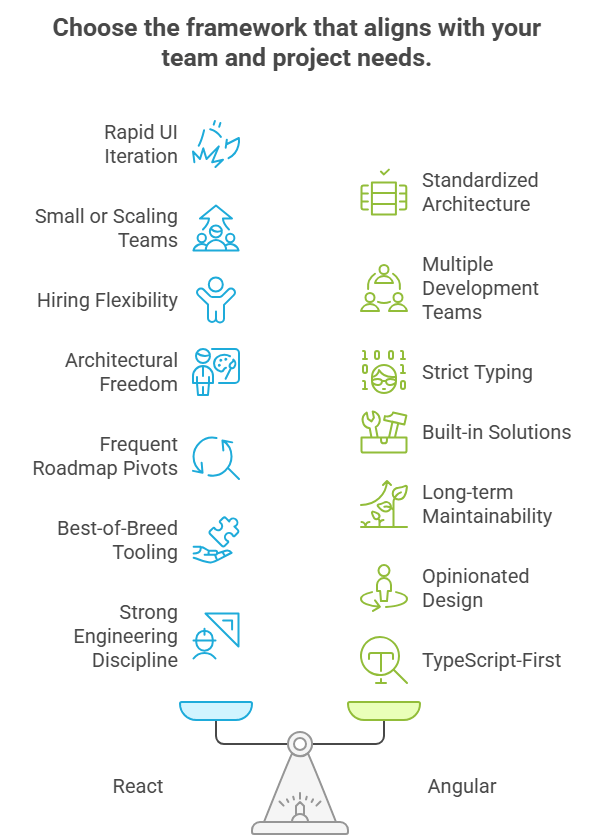
Here’s the checklist I use when making the call.
I lean toward React when:
React aligns well with startup velocity and SaaS environments that prioritize speed.
That ecosystem strength often translates into community support, tooling variety, and faster problem resolution.
My rule: If flexibility and hiring breadth matter more than enforced structure, React is usually the better fit.
I lean toward Angular when:
Angular’s opinionated design reduces ambiguity across large teams.
Angular’s TypeScript-first architecture aligns well with enterprise engineering practices focused on static typing and contract enforcement.
My rule: If structural consistency and cross-team coordination are your primary concerns, Angular often reduces long-term governance risk.
When I strip away brand preference and community hype, the conclusion is consistent:
The correct choice is the one that matches your organizational discipline and growth trajectory.
At AppVerticals, React and Angular decisions are evaluated through scalability modeling, governance maturity, and long-term maintainability risk.
They have implemented both frameworks in production environments serving high-growth SaaS platforms, performance-sensitive ecommerce systems, and enterprise-grade web applications.
Their approach begins with architectural boundaries: state management strategy, modular isolation, performance budgets, and infrastructure alignment. Framework selection is made only after analyzing projected user growth, team expansion plans, and compliance requirements.
React and Angular are both capable of powering scalable web applications, the difference lies in how they shape team coordination, architectural discipline, and long-term growth.
React offers flexibility and hiring breadth, while Angular provides built-in structure and governance clarity. The right choice aligns with your product stage, organizational maturity, and long-term engineering strategy.
Get a technical roadmap tailored to your growth stage, from MVP validation to enterprise-grade architecture.
Talk to a Frontend Architect
verified expert
Muhammad Adnan is a Senior Writer and Editor at AppVerticals, specializing in apps, AI, software, and EdTech, with work featured on DZone, BuiltIn, CEO Magazine, HackerNoon, and other leading tech publications. Over the past 6 years, he’s known for turning intricate ideas into practical guidance. He creates in-depth guides, tutorials, and analyses that support tech teams, business leaders, and decision-makers in tech-focused domains.
 We’re AppVerticals
AppVerticals is where innovative startups and Fortune 500s come for transformation.
View About Us Web Development
Web portal development means building a secure, login-based system where users can access data, complete tasks, and interact with your business in one...

19 min read
 Web Development
To outsource web development strategically, scale delivery, reduce fixed hiring risk, and accelerate product execution by partnering with an external...
15 min read
 Web App
Python is one of the most widely used languages for web app development, valued for its clean syntax, speed, and extensive library support. From build...

13 min read
Discover how our team can help you transform your ideas into powerful Tech experiences.
AppVerticals © 2026 | All Rights Reserved

Get In Touch.














 ChatGPT
 Perplexity
 Google AI