














 ChatGPT
 Perplexity
 Claude
 Google AI
App developers charge $20 to $200+ an hour in 2026. Seniority and region set most of that spread: a junior in South Asia bills around $15–$25, a senior in the US bills $130–$150+, and the global mid-level average sits near $60. Hiring full time in the US instead costs $110,000 to $200,000 a year fully loaded.
Having scoped multiple projects, built the estimate, and watched founders decide whether the number in front of them is fair, I have learned that rate is the least useful number in the whole discussion. Two developers at the same rate can differ by a factor of three in what they actually deliver, and the gap only shows up in month four.
So this guide covers what developers charge, why those rates differ, and how to work out which quote in front of you is real. Rate tables by region and seniority, salary benchmarks, engagement models, what AI has done to pricing this year, and the vetting that separates a good rate from a good hire.
What You Should Expect To Pay: A Quick Overview
- By seniority. Junior developers with null to two years bill $20–$50 an hour. Mid-level at two to five years bill $40–$100. Senior at five-plus bill $100–$200+.
- By engagement model. Freelancers run $30–$150 an hour depending on seniority and market. Agencies run $75–$250. Dedicated offshore teams run $30–$60 per developer. In-house costs $110,000–$200,000 a year fully loaded in the US.
- By region. North America $65–$150+. Western Europe $50–$100. Eastern Europe $25–$70. Latin America $20–$60. South Asia and Southeast Asia $10–$45.
- The average. If you want a single number, the global mid-level app developer rate lands close to $60 an hour in 2026. It is a nearly useless number on its own, and I include it only because it is the thing people search for.
How App Developers Calculate What They Charge
Before you can judge a quote you need to know how it was built. Three billing structures dominate, and the one your developer defaults to will shape your total more than their rate does.
Time and materials
The developer logs hours and you pay for what gets used. It suits work where the scope will move, which is most product development.
The risk is drift. Without milestones and someone enforcing scope, hours expand to fill the available budget. I would not take a time-and-materials engagement without a named person on your side who can say no to a feature.
Fixed price
You agree a scope and a number. It looks safer and it moves risk around rather than removing it.
Anyone quoting fixed price pads for the unknowns, usually by fifteen to twenty-five percent, and every change becomes a change order. Fixed price works when requirements are genuinely settled, which in practice means a defined discovery phase or a very small build.
Retainer or dedicated capacity
You buy a developer or a team at an agreed monthly rate with no hourly accounting. Expect $3,000–$8,000 per developer per month depending on seniority and market.
This is what most companies past their first release end up wanting. You are buying continuity as much as capacity, and continuity is the thing that gets expensive to replace.
One caution on retainers. Buying capacity you cannot fill is the most common way to waste money in this model, and it happens whenever the product side cannot keep a backlog ahead of the engineering side. Before signing a retainer, check that someone on your team can specify enough work to keep the team busy for the next two months.
| Billing Model | Best Fit | Budget Predictability | Scope Flexibility |
|---|---|---|---|
| Time and materials | Evolving scope, iterative builds | Medium | High |
| Fixed price | Settled, short, well-documented scope | High | Low |
| Retainer or dedicated | Ongoing product development | High | Medium |
App Developer Hourly Rates by Region And Seniority
This is where most budget conversations start. Rates reflect local cost of living, market competition and talent density, so the same skill prices very differently depending on where the person sits.
| Region | Junior (0–2 yrs) | Mid-level (2–5 yrs) | Senior (5+ yrs) |
|---|---|---|---|
| United States and Canada | $65–$90/hr | $100–$130/hr | $130–$150+/hr |
| United Kingdom | $60–$80/hr | $85–$110/hr | $100–$120/hr |
| Western Europe | $50–$70/hr | $70–$90/hr | $80–$100/hr |
| Eastern Europe | $25–$40/hr | $35–$55/hr | $45–$70/hr |
| Latin America | $20–$35/hr | $30–$50/hr | $40–$60/hr |
| South and Southeast Asia | $15–$25/hr | $20–$35/hr | $30–$45/hr |
| East Asia | $20–$35/hr | $35–$50/hr | $45–$60/hr |
The gap between a senior developer in the US and a senior developer in Eastern Europe is roughly two to three times on an hourly basis. Whether that gap is worth paying depends on your product and your own capacity to manage, not on a general preference for one region.
The cheapest region is rarely the cheapest decision
South and Southeast Asia carry the lowest absolute rates. Low rate and low cost are different things.
What matters is cost per unit of work you keep. Three rounds of rework at $20 an hour costs more than one round at $50, and it costs you six weeks as well. When you assess offshore talent, look at portfolio depth, written communication and time zone overlap before you look at the rate.
Eastern Europe tends to offer the strongest value-to-quality ratio for mid and senior work. Latin America is the pragmatic choice for US companies that need real-time overlap.
How to compare offshore developer quotes properly
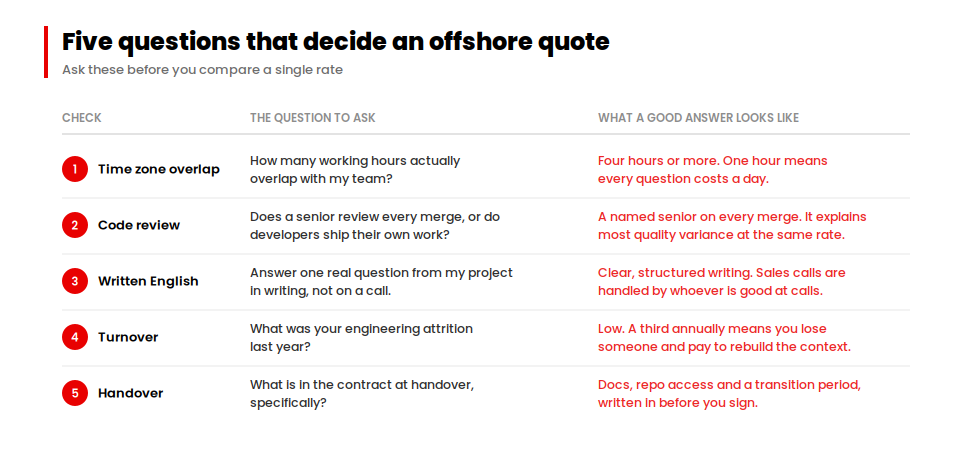
The rate is one line in a comparison that should have five. When I help a client evaluate offshore proposals, these are the columns that actually decide it.
Time zone overlap in working hours. Four hours of genuine overlap is workable. One hour means every question costs a day, and on a six-month build that is thirty lost days nobody budgeted.
Who reviews the code? Ask whether there is a senior reviewing every merge or whether developers ship their own work. This single answer explains most of the quality variance between vendors at the same rate.
English in writing, not on a call. Sales calls are handled by the people who are good at calls. Ask for a written technical response to a real question from your project and read what comes back.
Turnover. Ask what their engineering attrition was last year. A team losing a third of its people annually will lose someone on your project, and rebuilding that context is billed to you.
What happens at handover? Documentation, repository access and a transition period should be in the contract rather than negotiated at the end when your leverage is gone.
App Developer Salaries If You Hire In-House
Hourly rates only answer half the question. If you are considering a full-time hire, the number that matters is fully loaded annual cost, which is base salary plus benefits, equipment, tooling and the recruiting spend that got them through the door.
| Role | US Base Salary | Fully Loaded Annual Cost |
|---|---|---|
| Junior mobile developer | $75,000 – $95,000 | $95,000 – $120,000 |
| Mid-level mobile developer | $100,000 – $130,000 | $125,000 – $165,000 |
| Senior mobile developer | $130,000 – $170,000 | $165,000 – $215,000 |
| Mobile engineering lead | $160,000 – $200,000 | $200,000 – $260,000 |
Fully loaded runs roughly 1.25 to 1.3 time’s base once you count payroll taxes, benefits, hardware and software. Add recruiting, which is fifteen to twenty-five percent of first-year salary through an agency, and a hire takes three to five months to reach full productivity.
The honest framing for a first product is this. One senior in-house developer for a year costs about the same as a small agency team for six to eight months, and the agency team covers design, QA and project management inside that number. In-house wins on retention and context. It rarely wins on time to first release.
Factors Driving the Cost of Hiring an App Developer
Rate cards are an opening position. Five things move the number that lands in your inbox.
Seniority, honestly assessed
Years of experience and actual capability diverge more in this field than in most. A developer who has shipped and then maintained three products is worth more than one who has started twelve.
Specialism and scarcity
Generalist mobile developers are plentiful. Developers who have shipped a payment integration that passed audit, or built a media pipeline that holds up under load, are not, and they price accordingly.
Engagement length
Almost everyone discounts for duration. A three-month commitment typically prices ten to fifteen percent below a two-week one, because the vendor stops paying for the gap between contracts.
Who carries the risk?
A fixed price includes a risk premium. A time-and-materials rate does not, because you are carrying it. Comparing the two rates directly is the most common mistake I see in vendor evaluations.
What surrounds the developer?
An agency rate covers project management, QA, design and someone answering when a person leaves. A freelancer rate covers a person. Both can be correct. They are not the same purchase.
Notice that none of those are about what you are building. What you are building sets your project budget, and that is a separate question from what a developer costs per hour.
Building an app rather than hiring a person?
Project totals depend on the product, not the rate card. Start with what a mobile app costs to build, or go straight to the numbers for an MVP, an ecommerce app or a fintech app.
What AI Has Done To Developer Rates In 2026
This is the question I get most often now and the one with the least written about it, so here is what I actually observe.
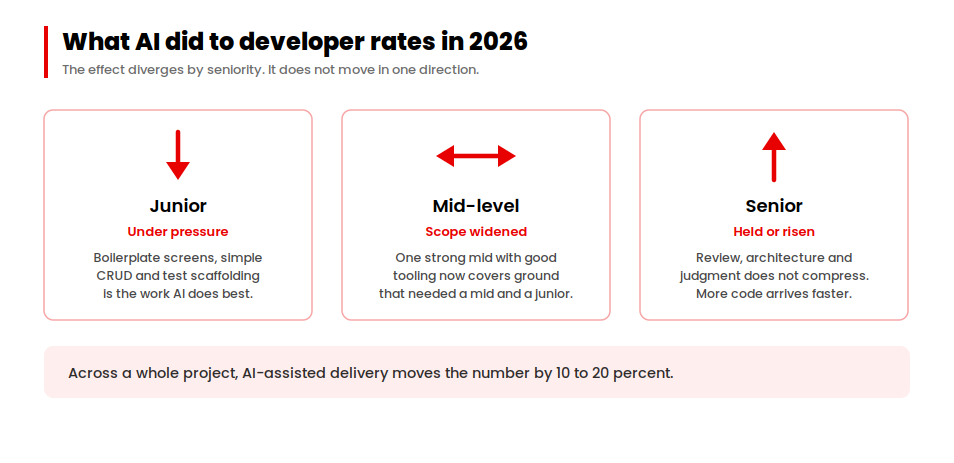
Junior rates are under pressure. The work that used to justify a junior hire, boilerplate screens, simple CRUD endpoints, test scaffolding, is the work AI does well. Junior rates have not collapsed, and the expectation attached to them has moved. A junior who cannot use these tools well is now competing against one who can.
Senior rates have held or risen. Reviewing generated code, deciding architecture and knowing which of four plausible answers is right for your system are not tasks that compress. If anything the review burden has grown, because there is more code arriving faster.
The middle is where it gets interesting. A strong mid-level developer with good tooling now covers ground that used to need a mid and a junior. Some teams are pricing that as a premium; others are passing the saving on. Ask directly how a vendor’s rate reflects their tooling, and treat a vague answer as information.
What it means for how you buy. If a vendor’s rate has not moved and their delivery speed has, you are getting the benefit as time rather than money, which on most products is the better trade. Shipping six weeks earlier is usually worth more than saving ten percent.
The question to ask is not whether they use AI. Everyone will say yes. Ask what they stopped doing manually in the last year and what their review process looks like now, and you will learn whether the tooling is real or on the website.
What has not changed is the shape of a project. AI-assisted delivery moves a build by roughly ten to twenty percent, concentrated in the parts where the correct answer was already known. Anyone quoting you a rate on the basis that AI has halved the work is describing a scope you have not agreed to.
Freelancer, Agency, Dedicated Team or In-House
| Model | Rate | Best For | Main Risk |
|---|---|---|---|
| Freelancer | $30 – $150/hr | Bounded work, a specific feature, a prototype | Single point of failure, no continuity, IP exposure |
| Development agency | $75 – $250/hr | Full-scope projects with a real deadline | Paying agency prices for junior execution |
| Dedicated offshore team | $30 – $60/hr per developer | Ongoing development, scaling capacity | Needs technical oversight on your side |
| In-house | $110,000 – $200,000/yr fully loaded | Core product roles after validation | Highest fixed cost, slowest to start |
When the scope also requires product planning, UI/UX design, backend engineering, QA, and store release, hiring a full-service mobile app development company can reduce handoffs and the risk of depending on a single freelancer.
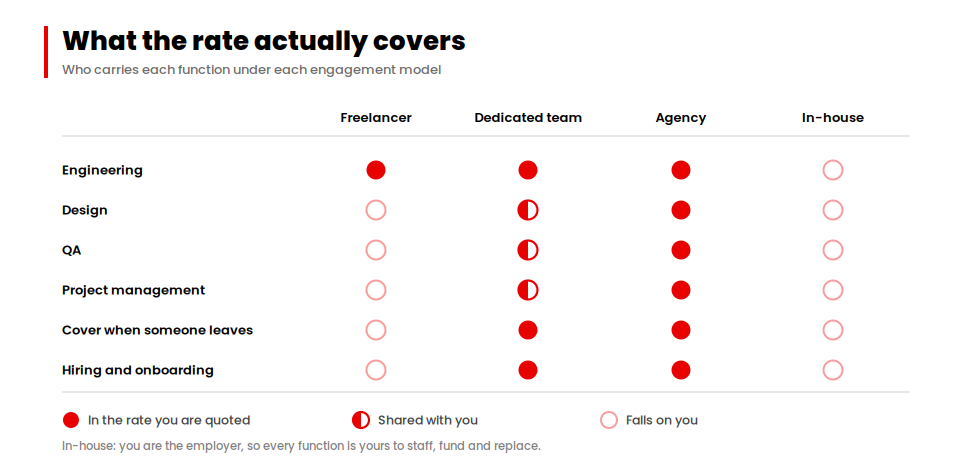
Freelancers are fast to engage and right for work with clear edges. The risk scales with your dependency on them. If they go quiet, get overcommitted or hand you code nobody else can maintain, your recourse is limited to what the contract says, which for most freelance engagements is not much.
Agencies sell you a structure rather than a person: project management, QA, design, and someone still there when an individual leaves. The trap is paying for that structure and getting a junior on the keyboard. Ask who is actually building it, ask what else they are staffed on, and ask what happens if they leave mid-project. If you are evaluating an agency instead of hiring a person directly, the vetting checklist changes shape entirely.
Dedicated offshore teams give the best cost per unit of output for sustained work, on one condition. You need someone technical on your side who can judge the output. A dedicated team without internal oversight is not a solution, it is a delegation of a problem you still own.
In-house makes sense for core roles once the product is validated. Hiring permanently to test a hypothesis is an expensive way to learn the hypothesis was wrong.
What does hiring a team of app developers actually costs, in headcount terms
The Coca-Cola Dubai platform we built ran on a ten-person design and engineering team over nine months and shipped 92 screens with zero critical bugs at launch. That ratio is a useful reference point when a quote arrives.
If someone proposes delivering a comparable scope with three people in four months, the arithmetic is telling you something the proposal is not.
What a Scoping Call Looks Like From Our Side
I have been on the vendor end of a multiple of these, and it is worth telling you what we are reading while you are asking about rates.
The first thing we listen for is whether you can describe what the product has to do before you describe what it should have. A founder who leads with a feature list is usually three conversations away from a scope we could price. One who leads with the problem is one conversation away.
The second is whether anyone on your side will own the decisions. Every project needs a person who can approve a design, kill a feature and answer a question inside a day. When that person does not exist, timelines slip for reasons no contract covers, and both sides end up frustrated about something neither of us priced.
The third is your reaction to the range. If the first number lands badly and the response is to ask what we would cut, that is a good sign and the project usually happens. If the response is to ask who else could do it cheaper, that is fine too, and it often comes back to us six months later at a higher total.
What I would tell you to do with this: come to a scoping call with the problem, the deadline that actually matters, and the name of the person who will make decisions. Those three things get you a more accurate number than any amount of feature detail, from us or from anyone else.
The Costs That Never Appear On the Invoice
The quote covers the developer’s time. These are the costs of hiring that land on you.
Your own time. Vetting, interviewing and reference checks for a serious hire take twenty to forty hours of someone senior. That is a real cost and it is the one nobody books.
Onboarding and ramp-up. Every new developer needs context, access and codebase orientation. Budget twenty to thirty percent of the first sprint as non-productive. It does not appear on any invoice and it happens every single time.
Recruiting. Agency placement runs fifteen to twenty-five percent of first-year salary. Job board spend and your team’s screening hours are on top.
Contract and legal. Getting IP assignment, scope-change protocol and confidentiality right costs a few hundred to a few thousand dollars once. Getting it wrong costs considerably more, and it costs it at the worst possible moment.
The bad hire. This is the expensive one. A developer who writes brittle code, misreads requirements or disappears mid-project costs you the fees paid, the time to re-hire, the re-scoping, and usually a rebuild of part of what was delivered. Conservative estimates put the true cost at one and a half to three times the original contract value.
Running costs for the product itself, hosting, app store fees, third-party services and ongoing maintenance, are a separate budget line. They are covered properly in the mobile app development cost guide.
How to Vet, Interview and Contract with an App Developer without Overpaying
The hiring process has a cost and a cost of failure. These are the checks worth the time.
Portfolio depth over portfolio volume. Three products that are live, scaled and still maintained beats fifteen that shipped once. Ask for links to production apps, not mockups.
A code sample. A repository or a small paid assessment. Clean, documented, maintainable code is the whole point. A developer who resists showing their work has told you something.
Stack alignment. Verify experience in the stack your product needs. A React Native specialist is not the right hire for a Swift-native build, whatever the portfolio suggests.
Written communication. Most of the relationship will run on writing. How someone structures a project update is a fair preview of the next six to twelve months.
Comparable project type. Three consumer apps does not qualify someone for a fintech backend. Ask about projects with similar compliance requirements, architecture or user scale.
Take the reference call seriously
Most people skip references or treat them as a formality. It is the cheapest signal available and the only one that comes from someone who has already paid for this developer’s work.
Ask for a client whose project ended badly or changed direction, not just the happy one. How a developer handled a project going sideways tells you far more than how they handled one going well.
Two questions worth asking every reference: what did they underestimate, and would you hire them again for something larger. The pause before the second answer is usually the answer.
Contract terms that protect your budget
- Milestone-based payments. Never pay in full upfront. Thirty percent at kickoff, forty at a defined mid-point, thirty on delivery and sign-off is a reasonable default.
- IP assignment. All code, designs and assets transfer to you on payment. This matters most with freelancers and offshore teams, and it is the clause most often missing.
- Scope change protocol. Define in writing how out-of-scope requests get priced, approved and recorded. Without it, every feature conversation becomes a negotiation.
- Delay and non-delivery. Specify what happens when a milestone slips. It does not need teeth so much as clarity.
- Confidentiality. Required for anything involving proprietary logic, user data or an unreleased product.
Red flags in a developer quote
I read a lot of competing proposals, usually because a client sends me theirs. These are the patterns worth pausing on.
- A number with no breakdown. A single figure at the bottom of a page tells you nothing about what happens when scope moves. Ask for it by module.
- A rate that undercuts the market by more than half. Somebody is absorbing the difference. It is usually a junior on the keyboard, no QA, or a plan to make it back on change orders.
- No discovery in the plan. A vendor quoting a fixed price on a two-page brief has not scoped it. They have guessed, and you will pay for the guess either as padding or as change orders.
- Nobody named. If the proposal describes a team but names no individuals, you cannot verify anything about who builds your product.
- No maintenance conversation. A vendor who never raises what happens after launch is quoting you a handover, not a product.
- Silence on compliance. If you are in a regulated space and it did not come up in the first scoping call, that is disqualifying on its own.
- Design treated as a line item at the end. A proposal where design is a small fixed number after engineering has usually not thought about the product, only about building whatever arrives in a ticket.
- A timeline with no dependencies in it. Real plans have things waiting on other things: your API credentials, a client sign-off, a store review. A plan that runs in a clean straight line has not met a real project.
The pattern across all of these is the same. A quote that has been thought about tells you where it might be wrong. A quote that has been produced tells you nothing at all, and you find out where it was wrong in month three.
Conclusion
Work out what you are buying before you compare rates. A person, a team, or a structure with a team inside it are three different purchases, and their hourly numbers are not comparable.
Then judge the rate against output rather than against other rates. The most useful question in any vendor conversation is who specifically will write this, and what else are they working on.
If the answer is vague, the rate does not matter.
Get a straight rate and a named team
We staff senior engineers, designers and QA as one team, and we tell you who is on it before you sign.
Explore our app development services.Comparing quotes right now?
Send us what you have. We will tell you what is missing from it, whether or not you work with us. Book a 30-minute review.